Perez Denise Alves, Vago Juliana Priscila, Athayde Rayssa Maciel, Reis Alesandra Corte, Teixeira Mauro Martins, Sousa Lirlândia Pires, Pinho Vanessa
Laboratório de Resolução da Resposta Inflamatória, Departamento de Morfologia, Instituto de Ciências Biológicas, Universidade Federal de Minas Gerais, Avenida Antônio Carlos 6627, Pampulha, 31270-901 Belo Horizonte, MG, Brazil ; Laboratório de Imunofarmacologia, Departamento de Bioquímica e Imunologia, Instituto de Ciências Biológicas, Universidade Federal de Minas Gerais, 31270-901 Belo Horizonte, MG, Brazil.
Laboratório de Imunofarmacologia, Departamento de Bioquímica e Imunologia, Instituto de Ciências Biológicas, Universidade Federal de Minas Gerais, 31270-901 Belo Horizonte, MG, Brazil ; Laboratório de Sinalização inflamação, Departamento de Análises Clínicas e Toxicológicas, Faculdade de Farmácia, Universidade Federal de Minas Gerais, 31270-901 Belo Horizonte, MG, Brazil.
Mediators Inflamm. 2014;2014:829851. doi: 10.1155/2014/829851. Epub 2014 Jul 17.
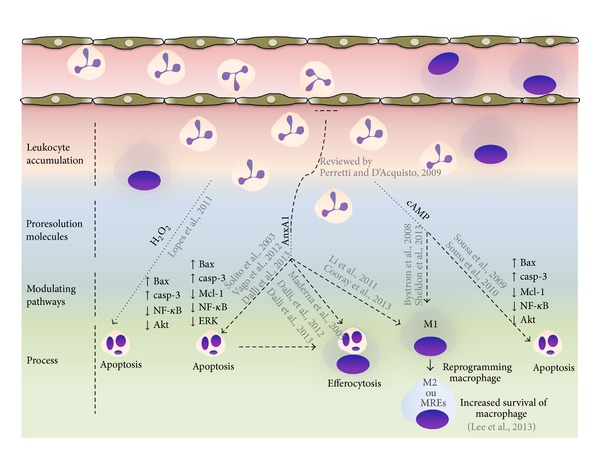
Inflammation is a physiological response of the immune system to injury or infection but may become chronic. In general, inflammation is self-limiting and resolves by activating a termination program named resolution of inflammation. It has been argued that unresolved inflammation may be the basis of a variety of chronic inflammatory diseases. Resolution of inflammation is an active process that is fine-tuned by the production of proresolving mediators and the shutdown of intracellular signaling molecules associated with cytokine production and leukocyte survival. Apoptosis of leukocytes (especially granulocytes) is a key element in the resolution of inflammation and several signaling molecules are thought to be involved in this process. Here, we explore key signaling molecules and some mediators that are crucial regulators of leukocyte survival in vivo and that may be targeted for therapeutic purposes in the context of chronic inflammatory diseases.
炎症是免疫系统对损伤或感染的生理反应,但可能会转为慢性。一般来说,炎症是自我限制的,并通过激活一个名为炎症消退的终止程序来解决。有人认为,未解决的炎症可能是多种慢性炎症性疾病的基础。炎症消退是一个活跃的过程,通过促消退介质的产生以及与细胞因子产生和白细胞存活相关的细胞内信号分子的关闭来进行微调。白细胞(尤其是粒细胞)的凋亡是炎症消退的关键因素,并且一些信号分子被认为参与了这一过程。在这里,我们探讨了关键信号分子和一些介质,它们是体内白细胞存活的关键调节因子,并且在慢性炎症性疾病的背景下可能成为治疗靶点。