Rheumatology Research Group, Center for Translational Inflammation Research, Queen Elizabeth Hospital, Birmingham B15 2WD, UK.
Centre for Clinical Pharmacology and Therapeutics, Division of Medicine, University College London, London WC1E 6JJ, UK.
Immunity. 2014 Mar 20;40(3):315-27. doi: 10.1016/j.immuni.2014.02.009.
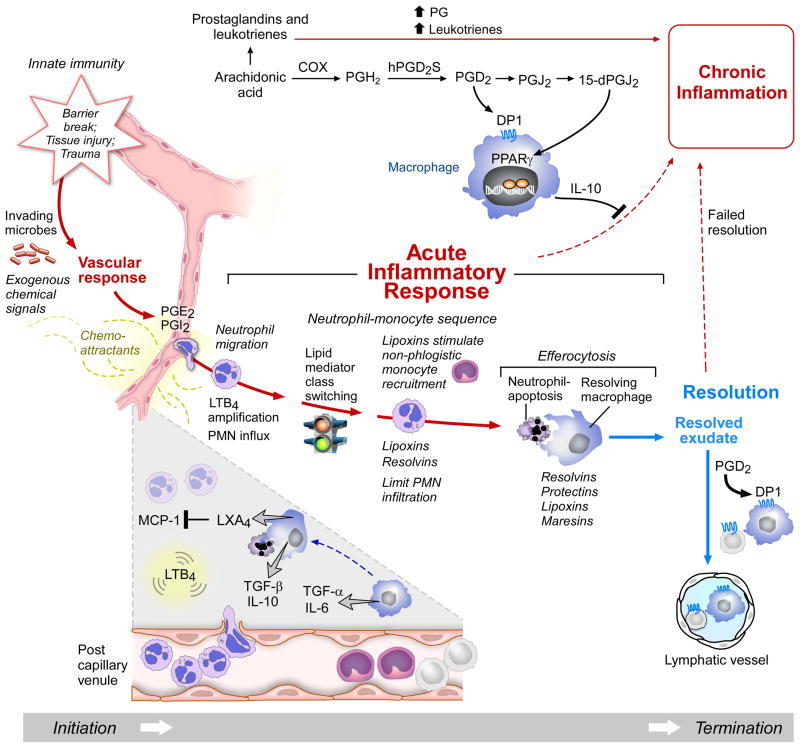
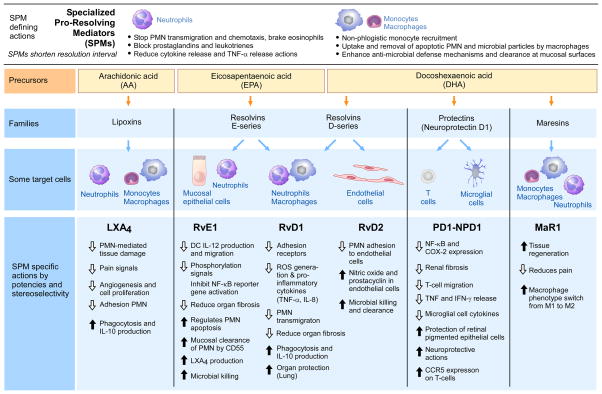
Inflammatory responses, like all biological cascades, are shaped by a delicate balance between positive and negative feedback loops. It is now clear that in addition to positive and negative checkpoints, the inflammatory cascade rather unexpectedly boasts an additional checkpoint, a family of chemicals that actively promote resolution and tissue repair without compromising host defense. Indeed, the resolution phase of inflammation is just as actively orchestrated and carefully choreographed as its induction and inhibition. In this review, we explore the immunological consequences of omega-3-derived specialized proresolving mediators (SPMs) and discuss their place within what is currently understood of the role of the arachidonic acid-derived prostaglandins, lipoxins, and their natural C15-epimers. We propose that treatment of inflammation should not be restricted to the use of inhibitors of the acute cascade (antagonism) but broadened to take account of the enormous therapeutic potential of inducers (agonists) of the resolution phase of inflammation.
炎症反应与所有生物级联反应一样,是由正反馈和负反馈环之间的微妙平衡所塑造的。现在很清楚,除了正反馈和负反馈的检查点外,炎症级联反应出人意料地拥有另一个检查点,即一组积极促进解决和组织修复的化学物质,而不会损害宿主防御。事实上,炎症的解决阶段与诱导和抑制阶段一样,是经过精心策划和精心编排的。在这篇综述中,我们探讨了ω-3 衍生的特异性促解决介质 (SPM) 的免疫学后果,并讨论了它们在当前对花生四烯酸衍生的前列腺素、脂氧素及其天然 C15-差向异构体的作用的理解中的地位。我们提出,炎症的治疗不应仅限于使用急性级联反应抑制剂(拮抗剂),而应扩大到考虑炎症解决阶段诱导剂(激动剂)的巨大治疗潜力。