Kinesiology Program, School of Nutrition and Health Promotion, Arizona State University Tempe, AZ, USA.
Faculty of Human Movement Sciences, Move Research Institute, VU University Amsterdam Amsterdam, Netherlands.
Front Hum Neurosci. 2014 Aug 4;8:564. doi: 10.3389/fnhum.2014.00564. eCollection 2014.
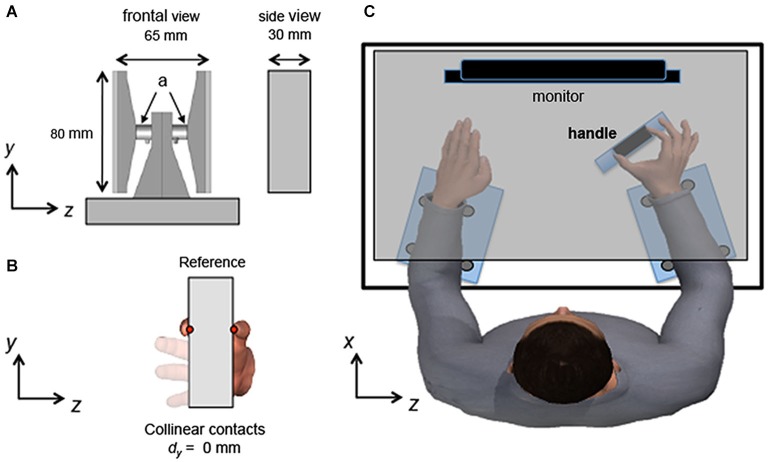
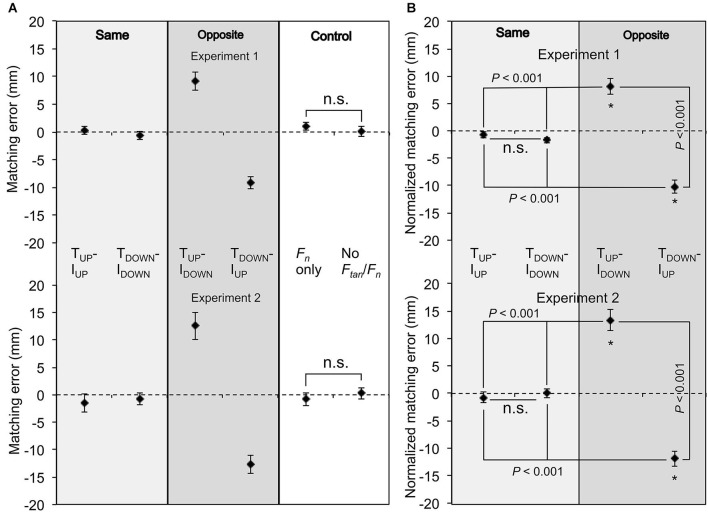
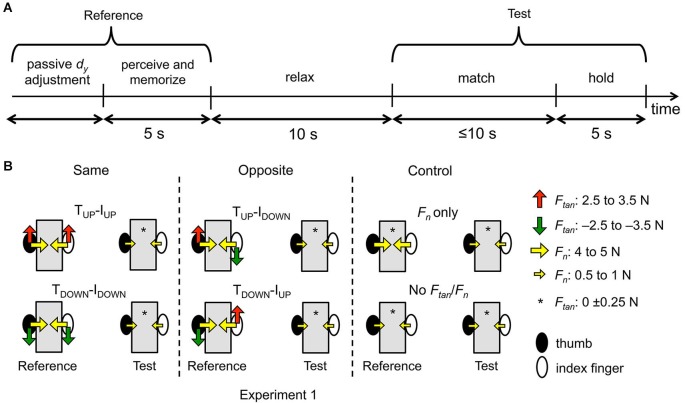
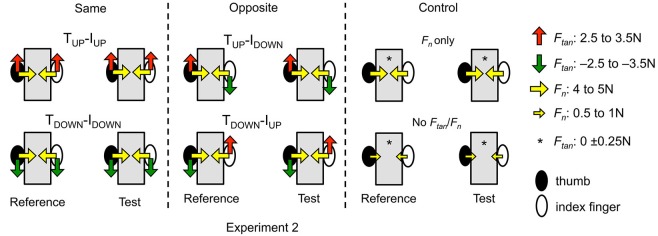
Humans are able to modulate digit forces as a function of position despite changes in digit placement that might occur from trial to trial or when changing grip type for object manipulation. Although this phenomenon is likely to rely on sensing the position of the digits relative to each other and the object, the underlying mechanisms remain unclear. To address this question, we asked subjects (n = 30) to match perceived vertical distance between the center of pressure (CoP) of the thumb and index finger pads (dy ) of the right hand ("reference" hand) using the same hand ("test" hand). The digits of reference hand were passively placed collinearly (dy = 0 mm). Subjects were then asked to exert different combinations of normal and tangential digit forces (Fn and Ftan , respectively) using the reference hand and then match the memorized dy using the test hand. The reference hand exerted Ftan of thumb and index finger in either same or opposite direction. We hypothesized that, when the tangential forces of the digits are produced in opposite directions, matching error (1) would be biased toward the directions of the tangential forces; and (2) would be greater when the remembered relative contact points are matched with negligible digit force production. For the test hand, digit forces were either negligible (0.5-1 N, 0 ± 0.25 N; Experiment 1) or the same as those exerted by the reference hand (Experiment 2).Matching error was biased towards the direction of digit tangential forces: thumb CoP was placed higher than the index finger CoP when thumb and index finger Ftan were directed upward and downward, respectively, and vice versa (p < 0.001). However, matching error was not dependent on whether the reference and test hand exerted similar or different forces. We propose that the expected sensory consequence of motor commands for tangential forces in opposite directions overrides estimation of fingertip position through haptic sensory feedback.
人类能够根据位置调节手指力,尽管手指位置可能会因试验或改变物体操作的握持类型而发生变化。尽管这种现象可能依赖于感知手指之间以及与物体之间的相对位置,但潜在机制尚不清楚。为了解决这个问题,我们要求受试者(n=30)使用右手(“参考”手)的同一手(“测试”手)来匹配右手拇指和食指垫的压力中心(CoP)之间的感知垂直距离(dy)。参考手的手指被动地放在同一直线上(dy=0mm)。然后,要求受试者使用参考手施加不同组合的正常和切向手指力(分别为 Fn 和 Ftan),然后使用测试手匹配记忆中的 dy。参考手的拇指和食指施加的 Ftan 方向相同或相反。我们假设,当手指的切向力方向相反时,匹配误差(1)将偏向切向力的方向;并且(2)当匹配记忆中的相对接触点时,匹配误差将更大,此时手指力的产生可以忽略不计。对于测试手,手指力要么可以忽略不计(0.5-1N,0±0.25N;实验 1),要么与参考手施加的力相同(实验 2)。匹配误差偏向于手指切向力的方向:当拇指和食指 Ftan 分别向上和向下指向时,拇指 CoP 高于食指 CoP,反之亦然(p<0.001)。然而,匹配误差并不取决于参考手和测试手是否施加相似或不同的力。我们提出,相反方向的切向力运动指令的预期感觉后果会覆盖通过触觉感觉反馈对手指尖位置的估计。