Sender Vicky, Stamme Cordula
Department of Microbiology, Tumor and Cell Biology; Karolinska Institutet; Stockholm, Sweden.
Division of Cellular Pneumology, Research Center Borstel, Leibniz-Center for Medicine and Biosciences; Borstel, Germany ; Department of Anesthesiology, University Hospital of Lübeck, Lübeck, Germany.
Commun Integr Biol. 2014 May 16;7:e29053. doi: 10.4161/cib.29053. eCollection 2014.
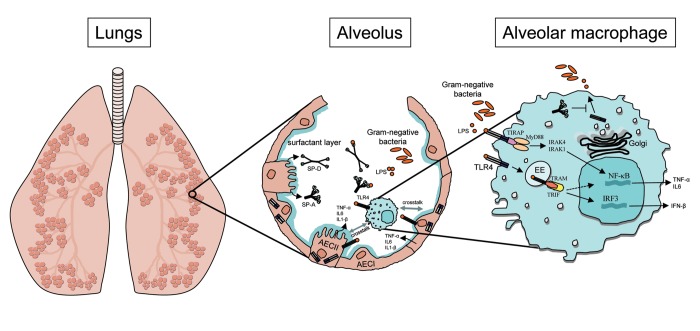
Lung infection by Gram-negative bacteria is a major cause of morbidity and mortality in humans. Lipopolysaccharide (LPS), located in the outer membrane of the Gram-negative bacterial cell wall, is a highly potent stimulus of immune and structural cells via the TLR4/MD2 complex whose function is sequentially regulated by defined subsets of adaptor proteins. Regulatory mechanisms of lung-specific defense pathways point at the crucial role of resident alveolar macrophages, alveolar epithelial cells, the TLR4 receptor pathway, and lung surfactant in shaping the innate immune response to Gram-negative bacteria and LPS. During the past decade intracellular spatiotemporal localization of TLR4 emerged as a key feature of TLR4 function. Here, we briefly review lung cell type- and compartment-specific mechanisms of LPS-induced TLR4 regulation with a focus on primary resident hematopoietic and structural cells as well as modifying microenvironmental factors involved.
革兰氏阴性菌引起的肺部感染是人类发病和死亡的主要原因。脂多糖(LPS)位于革兰氏阴性菌细胞壁的外膜中,是通过TLR4/MD2复合物对免疫细胞和结构细胞产生高度强效刺激的物质,其功能由特定的衔接蛋白亚群依次调节。肺部特异性防御途径的调节机制表明,驻留肺泡巨噬细胞、肺泡上皮细胞、TLR4受体途径和肺表面活性物质在塑造对革兰氏阴性菌和LPS的先天性免疫反应中起着关键作用。在过去十年中,TLR4的细胞内时空定位成为TLR4功能的一个关键特征。在这里,我们简要回顾LPS诱导的TLR4调节的肺细胞类型和区室特异性机制,重点关注原发性驻留造血细胞和结构细胞以及相关的微环境修饰因素。