Nakatani Keisuke, Ishikawa Haruto, Aono Shigetoshi, Mizutani Yasuhisa
Department of Chemistry, Graduate School of Science, Osaka University, 1-1 Machikaneyama, Toyonaka, Osaka 560-0043, Japan.
Okazaki Institute for Integrative Bioscience, National Institutes of Natural Sciences, 5-1 Higashiyama, Myodaiji, Okazaki 444-8786, Japan.
Sci Rep. 2014 Aug 20;4:6137. doi: 10.1038/srep06137.
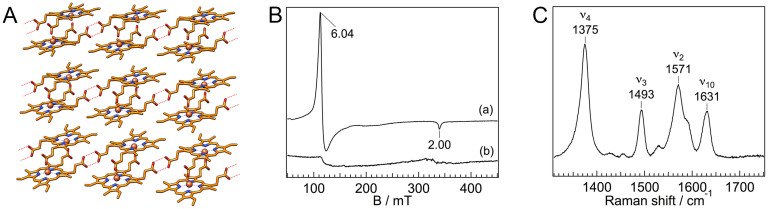
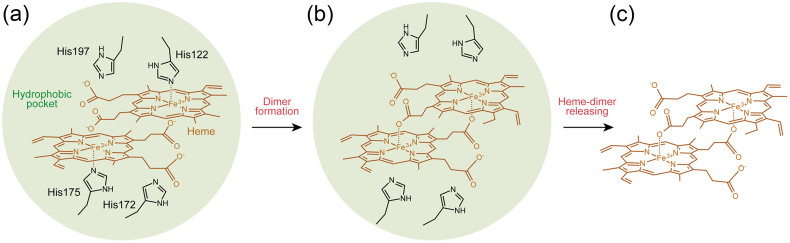
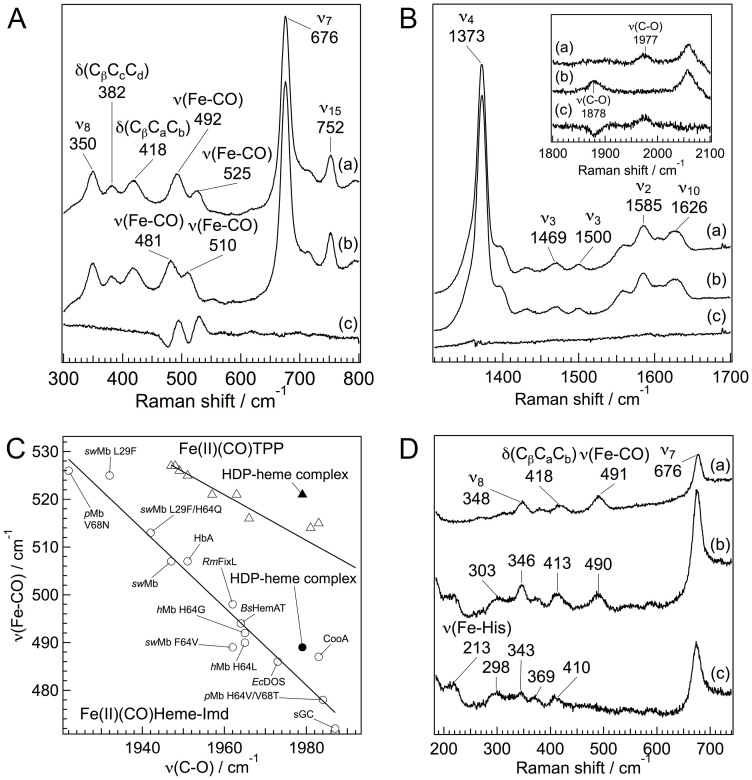
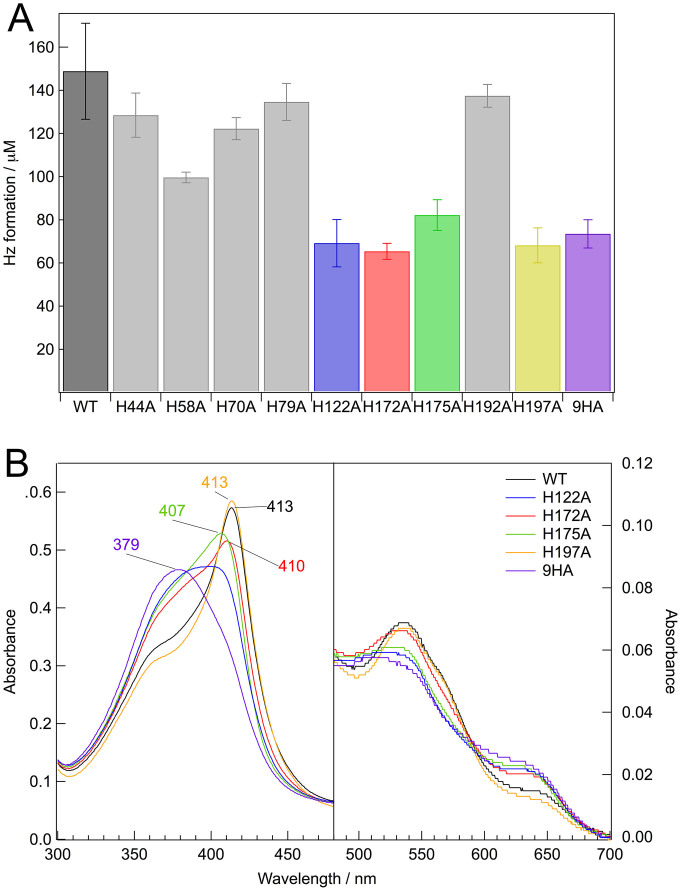
Malaria parasites digest hemoglobin within a food vacuole to supply amino acids, releasing the toxic product heme. During the detoxification, toxic free heme is converted into an insoluble crystalline form called hemozoin (Hz). Heme detoxification protein (HDP) in Plasmodium falciparum is one of the most potent of the hemozoin-producing enzymes. However, the reaction mechanisms of HDP are poorly understood. We identified the active site residues in HDP using a combination of Hz formation assay and spectroscopic characterization of mutant proteins. Replacement of the critical histidine residues His122, His172, His175, and His197 resulted in a reduction in the Hz formation activity to approximately 50% of the wild-type protein. Spectroscopic characterization of histidine-substituted mutants revealed that His122 binds heme and that His172 and His175 form a part of another heme-binding site. Our results show that the histidine residues could be present in the individual active sites and could be ligated to each heme. The interaction between heme and the histidine residues would serve as a molecular tether, allowing the proper positioning of two hemes to enable heme dimer formation. The heme dimer would act as a seed for the crystal growth of Hz in P. falciparum.
疟原虫在食物泡内消化血红蛋白以供应氨基酸,同时释放有毒产物血红素。在解毒过程中,有毒的游离血红素会转化为一种不溶性晶体形式,称为疟原虫色素(Hz)。恶性疟原虫中的血红素解毒蛋白(HDP)是产生疟原虫色素的最有效酶之一。然而,HDP的反应机制尚不清楚。我们结合Hz形成测定和突变蛋白的光谱表征,确定了HDP中的活性位点残基。关键组氨酸残基His122、His172、His175和His197的替换导致Hz形成活性降低至野生型蛋白的约50%。组氨酸取代突变体的光谱表征表明,His122结合血红素,His172和His175构成另一个血红素结合位点的一部分。我们的结果表明,组氨酸残基可能存在于各个活性位点,并可能与每个血红素连接。血红素与组氨酸残基之间的相互作用将作为分子系链,使两个血红素正确定位以形成血红素二聚体。血红素二聚体将作为恶性疟原虫中Hz晶体生长的种子。