Nguyen Vi, Nguyen-Viet Hung, Pham-Duc Phuc, Wiese Martin
Centre for Public Health and Ecosystem Research, Hanoi School of Public Health, Hanoi, Vietnam;
Centre for Public Health and Ecosystem Research, Hanoi School of Public Health, Hanoi, Vietnam; Department of Epidemiology and Public Health, Swiss Tropical and Public Health Institute, Socinstrasse, Basel, Switzerland, and Food Safety and Zoonoses Program, International Livestock Research Institute, Hanoi, Vietnam; Swiss Federal Institute of Aquatic Science and Technology, Sandec - Department of Water and Sanitation in Developing Countries, Dübendorf, Switzerland.
Glob Health Action. 2014 Aug 18;7:24482. doi: 10.3402/gha.v7.24482. eCollection 2014.
Like many countries in Southeast Asia, Vietnam's rapid population and economic growth has met challenges in infrastructure development, especially sanitation in rural areas.
As an entry point, we developed scenario planning as an action-research tool in a peri-urban community to identify first steps towards improving their complex sanitation problem and to, systemically, address emerging/re-emerging infectious diseases, as these are commonly linked to unsafe water and inadequate sanitation conditions. As an integrated approach, the process of constructing scenarios allowed us to work across sectors and stakeholders to incorporate this knowledge into a common vision.
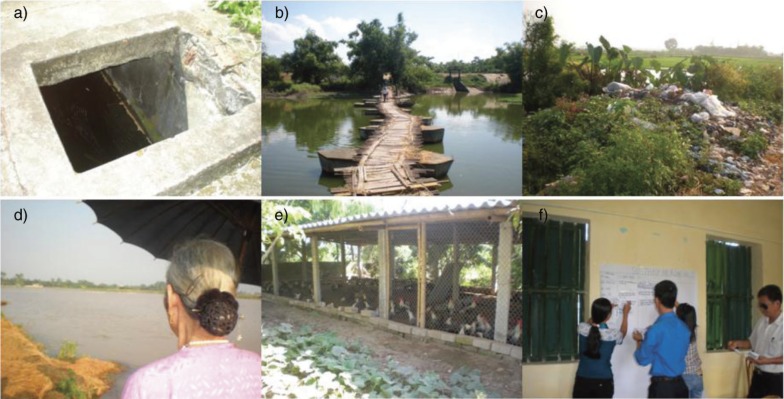
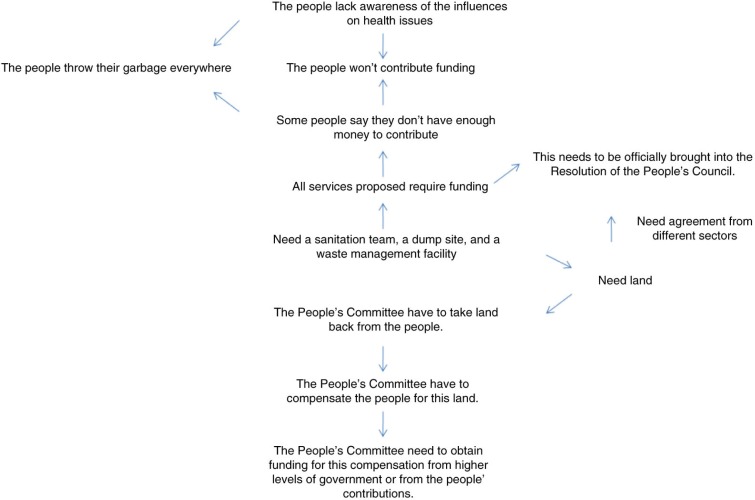
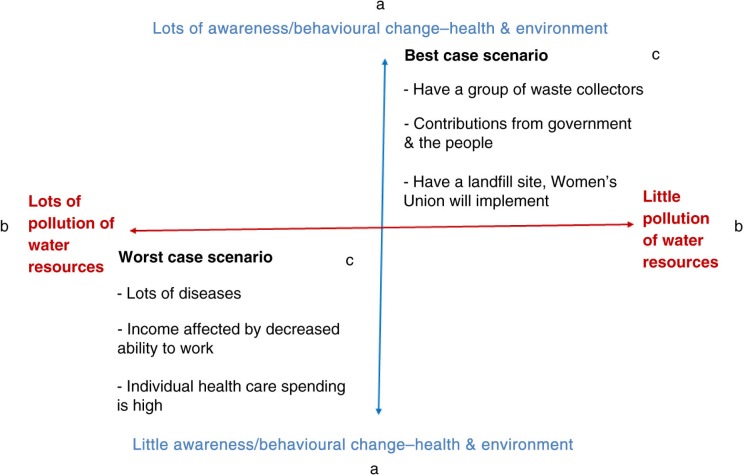
We conducted focus group discussions to identify and rank driving forces, orally constructed scenarios for the most uncertain drivers, discussed scenario implications and options, and examined the overall process for usefulness and sustainability. During a one-month scoping phase and in between focus group meetings, we carried out household visits which helped us understand the context of data and gather feedback from participants outside of the formal data collection process. Recorded results from these activities were used to develop subsequent tools.
The research process gave us insights into how to adapt the scenario planning tool to identify alternative options. This involved choosing boundary partners, negotiating priorities, drawing out participant learning through self-assessment of our process (a prerequisite for changing mental models and thus achieving outcomes), and understanding how conveyed messages may reinforce the status quo. These insights showed the importance of examining research results beyond outputs and outcomes, namely through process.
与许多东南亚国家一样,越南人口与经济的快速增长在基础设施建设方面面临挑战,尤其是农村地区的卫生设施。
作为切入点,我们在一个城郊社区将情景规划作为一种行动研究工具来开发,以确定改善其复杂卫生问题的初步措施,并系统地应对新出现/再次出现的传染病,因为这些疾病通常与不安全饮用水和卫生条件不足有关。作为一种综合方法,构建情景的过程使我们能够跨部门和利益相关者开展工作,将这些知识融入共同愿景。
我们进行了焦点小组讨论,以识别驱动力并进行排序,针对最不确定的驱动力口头构建情景,讨论情景的影响和选项,并审视整个过程的实用性和可持续性。在为期一个月的范围界定阶段以及焦点小组会议期间,我们进行了家庭访问,这有助于我们了解数据背景,并在正式数据收集过程之外收集参与者的反馈。这些活动的记录结果被用于开发后续工具。
研究过程让我们深入了解了如何调整情景规划工具以识别替代选项。这包括选择边界伙伴、协商优先事项、通过对我们的过程进行自我评估来引导参与者学习(这是改变思维模式从而实现成果的先决条件),以及理解所传达的信息如何可能强化现状。这些见解表明,除了产出和结果之外,通过过程审视研究结果非常重要。