Vollmar Horst Christian, Ostermann Thomas, Redaèlli Marcus
Institute of General Practice, Medical Faculty, Heinrich-Heine-University Düsseldorf, Moorenstr. 5, 40225, Düsseldorf, Germany.
Institute of General Practice and Family Medicine, Faculty of Health, Witten/Herdecke University, Witten, Germany.
BMC Med Res Methodol. 2015 Oct 16;15:89. doi: 10.1186/s12874-015-0083-1.
The scenario technique is a method for future research and for strategic planning. Today, it includes both qualitative and quantitative elements. The aims of this scoping review are to give an overview of the application of the scenario method in the fields of health care and to make suggestions for better reporting in future scenario projects.
Between January 2013 and October 2013 we conducted a systematic search in the databases Medline, Embase, PsycInfo, Eric, The Cochrane Library, Scopus, Web of Science, and Cinahl since inception for the term 'scenario(s)' in combination with other terms, e.g. method, model, and technique. Our search was not restricted by date or language. In addition, we screened the reference lists of the included articles.
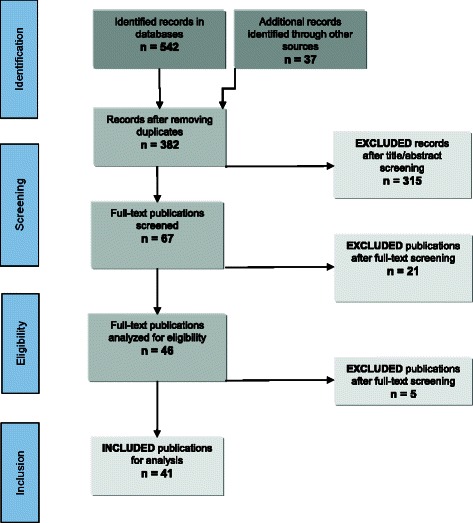
A total of 576 bibliographical records were screened. After removing duplicates and three rounds of screening, 41 articles covering 38 different scenario projects were included for the final analysis. Nine of the included articles addressed disease related issues, led by mental health and dementia (n = 4), and followed by cancer (n = 3). Five scenario projects focused on public health issues at an organizational level and five focused on the labor market for different health care professionals. In addition, four projects dealt with health care 'in general', four with the field of biotechnology and personalized medicine, and additional four with other technology developments. Some of the scenario projects suffered from poor reporting of methodological aspects.
Despite its potential, use of the scenario method seems to be published rarely in comparison to other methods such as the Delphi-technique, at least in the field of health care. This might be due to the complexity of the methodological approach. Individual project methods and activities vary widely and are poorly reported. Improved criteria are required for reporting of scenario project methods. With improved standards and greater transparency, the scenario method will be a good tool for scientific health care planning and strategic decision-making in public health.
情景分析法是一种用于未来研究和战略规划的方法。如今,它包含定性和定量要素。本综述的目的是概述情景分析法在医疗保健领域的应用情况,并为未来情景项目的更好报告提出建议。
2013年1月至10月期间,我们在Medline、Embase、PsycInfo、Eric、Cochrane图书馆、Scopus、科学引文索引和护理学与健康领域数据库自创建以来进行了系统检索,搜索“情景”一词与其他术语(如方法、模型和技术)的组合。我们的搜索不受日期或语言限制。此外,我们还筛选了纳入文章的参考文献列表。
共筛选了576条书目记录。在去除重复项并经过三轮筛选后,最终纳入了41篇文章,涵盖38个不同的情景项目进行分析。纳入的文章中有9篇涉及疾病相关问题,以心理健康和痴呆症为主导(n = 4),其次是癌症(n = 3)。五个情景项目关注组织层面的公共卫生问题,五个关注不同医疗保健专业人员的劳动力市场。此外,四个项目涉及“一般”医疗保健,四个涉及生物技术和个性化医疗领域,另外四个涉及其他技术发展。一些情景项目在方法学方面的报告较差。
尽管情景分析法具有潜力,但与德尔菲技术等其他方法相比,其应用在医疗保健领域的发表似乎很少。这可能是由于方法学方法的复杂性。各个项目的方法和活动差异很大且报告不佳。情景项目方法的报告需要改进标准。随着标准的提高和透明度的增加,情景分析法将成为公共卫生领域科学医疗保健规划和战略决策的良好工具。