Patil Shilpa A, Bshara Wiam, Morrison Carl, Chandrasekaran E V, Matta Khushi L, Neelamegham Sriram
Chemical and Biological Engineering, State University of New York, 906 Furnas Hall, Buffalo, NY, 14260, USA.
Glycoconj J. 2014 Oct;31(6-7):509-21. doi: 10.1007/s10719-014-9548-4.
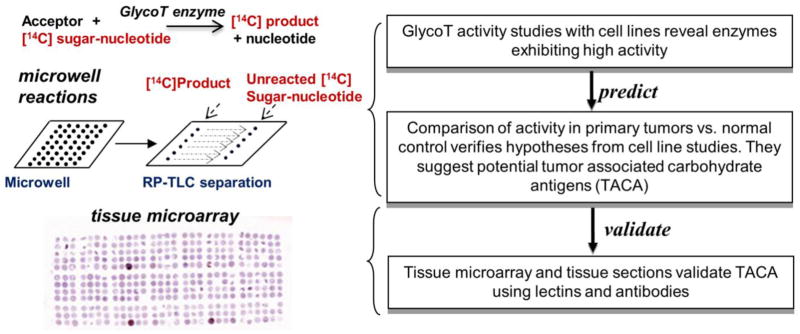
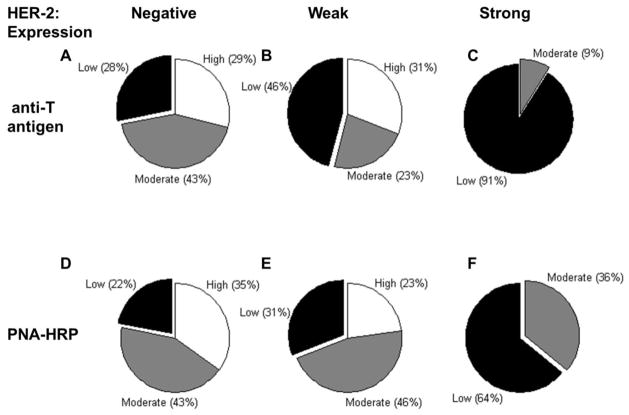
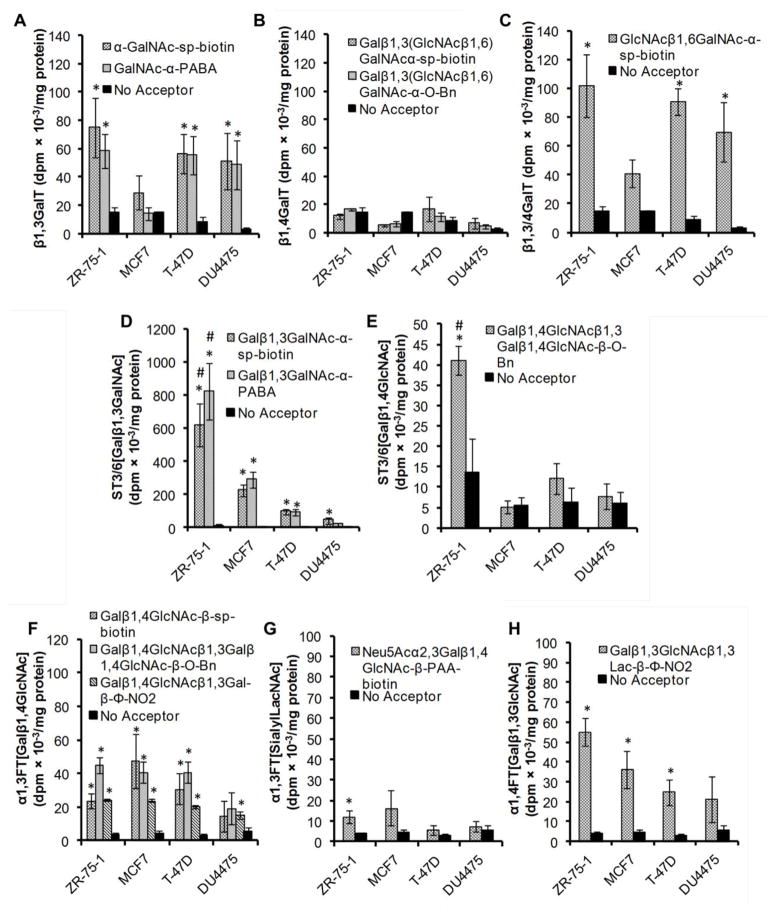
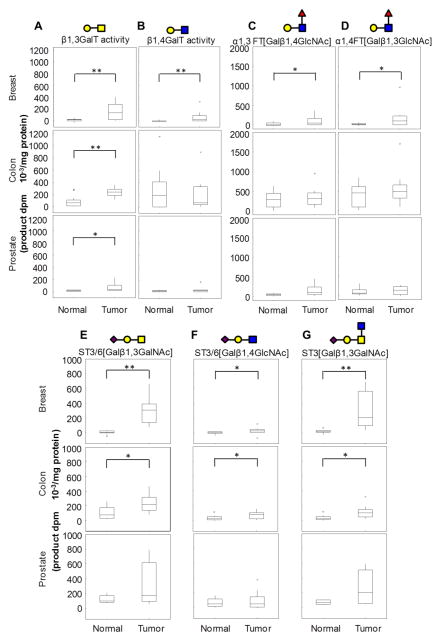
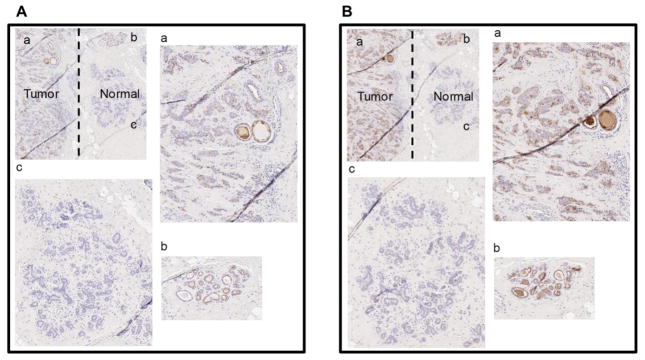
Glycan structure alterations during cancer regulate disease progression and represent clinical biomarkers. The study determined the degree to which changes in glycosyltransferase activities during cancer can be related to aberrant cell-surface tumor associated carbohydrate structures (TACA). To this end, changes in sialyltransferase (sialylT), fucosyltransferase (fucT) and galactosyltransferase (galT) activity were measured in normal and tumor tissue using a miniaturized enzyme activity assay and synthetic glycoconjugates bearing terminal LacNAc Type-I (Galβ1-3GlcNAc), LacNAc Type-II (Galβ1-4GlcNAc), and mucin core-1/Type-III (Galβ1-3GalNAc) structures. These data were related to TACA using tissue microarrays containing 115 breast and 26 colon cancer specimen. The results show that primary human breast and colon tumors, but not adjacent normal tissue, express elevated β1,3GalT and α2,3SialylT activity that can form α2,3SialylatedType-IIIglycans (Siaα2-3Galβ1-3GalNAc). Prostate tumors did not exhibit such elevated enzymatic activities. α1,3/4FucT activity was higher in breast, but not in colon tissue. The enzymology based prediction of enhanced α2,3sialylated Type-III structures in breast tumors was verified using histochemical analysis of tissue sections and tissue microarrays. Here, the binding of two markers that recognize Galβ1-3GalNAc (peanut lectin and mAb A78-G/A7) was elevated in breast tumor, but not in normal control, only upon sialidase treatment. These antigens were also upregulated in colon tumors though to a lesser extent. α2,3sialylatedType-III expression correlated inversely with patient HER2 expression and breast metastatic potential. Overall, enzymology measurements of glycoT activity predict truncated O-glycan structures in tumors. High expression of the α2,3sialylated T-antigen O-glycans occur in breast tumors. A transformation from linear core-1 glycan to other epitopes may accompany metastasis.
癌症期间聚糖结构的改变调控疾病进展并代表临床生物标志物。该研究确定了癌症期间糖基转移酶活性的变化与异常细胞表面肿瘤相关碳水化合物结构(TACA)相关的程度。为此,使用小型化酶活性测定法以及带有末端乳糖胺I型(Galβ1-3GlcNAc)、乳糖胺II型(Galβ1-4GlcNAc)和粘蛋白核心1/III型(Galβ1-3GalNAc)结构的合成糖缀合物,测量了正常组织和肿瘤组织中唾液酸转移酶(sialylT)、岩藻糖基转移酶(fucT)和半乳糖基转移酶(galT)的活性变化。使用包含115个乳腺癌和26个结肠癌标本的组织微阵列,将这些数据与TACA相关联。结果表明,原发性人乳腺癌和结肠癌组织,而非相邻的正常组织,表达升高的β1,3GalT和α2,3SialylT活性,其可形成α2,3唾液酸化III型聚糖(Siaα2-3Galβ1-3GalNAc)。前列腺肿瘤未表现出这种升高的酶活性。α1,3/4FucT活性在乳腺组织中较高,但在结肠组织中不高。通过对组织切片和组织微阵列的组织化学分析,验证了基于酶学对乳腺肿瘤中增强的α2,3唾液酸化III型结构的预测。在此,仅在唾液酸酶处理后,识别Galβ1-3GalNAc的两种标志物(花生凝集素和单克隆抗体A78-G/A7)在乳腺肿瘤中的结合升高,而在正常对照中未升高。这些抗原在结肠肿瘤中也上调,尽管程度较小。α2,3唾液酸化III型表达与患者HER2表达和乳腺转移潜能呈负相关。总体而言,糖基转移酶活性的酶学测量可预测肿瘤中截短的O-聚糖结构。α2,3唾液酸化T抗原O-聚糖在乳腺肿瘤中高表达。从线性核心1聚糖到其他表位的转变可能伴随转移发生。