Derikvand Peyman, Etemadifar Zahra
Department of Biology, Faculty of Sciences, University of Isfahan, Isfahan, IR Iran.
Jundishapur J Microbiol. 2014 Mar;7(3):e9123. doi: 10.5812/jjm.9123. Epub 2014 Mar 1.
Sulfur oxides released from the burning of oil causes severe environmental pollution. The sulfur can be removed via the 4S pathway in biodesulfurization (BDS). Immobilization approaches have been developed to prevent cell contamination of oil during the BDS process.
The encapsulation of Rhodococcus erythropolis R1 in calcium alginate beads was studied in order to enhance conversion of dibenzothiophene (DBT) to 2-hydroxy biphenyl (2-HBP) as the final product. Also the effect of different factors on the BDS process was investigated.
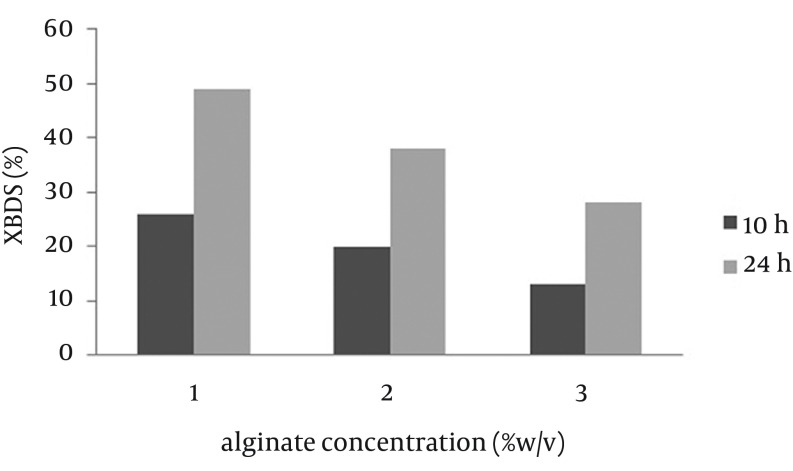
Calcium alginate capsules were prepared using peristaltic pumps with different needle sizes to control the beads sizes. Scanning electron microscopy and flow cytometry methods were used to study the distribution and viability of encapsulated cells, respectively. Two non-ionic surfactants and also nano Ƴ-Al2O3were used with the ratio of 0.5% (v/v) and 1:5 (v/v) respectively to investigate their BDS efficiency. In addition, the effect of different bead sizes and different concentrations of sodium alginate in BDS activity was studied.
The 2% (w/v) sodium alginate beads with 1.5mm size were found to be the optimum for beads stability and efficient 2-HBP production. The viability of encapsulated cells decreased by 12% after 20 h of desulfurization, compared to free cells. Adding the non-ionic surfactants markedly enhanced the rate of BDS, because of increasing mass transfer of DBT to the gel matrix. In addition, Span 80 was more effective than Tween 80. The nanoƳ-Al2O3 particles could increase BDS rate by up to two-folds greater than that of the control beads.
The nano Ƴ-Al2O3 can improve the immobilized biocatalyst for excellent efficiency of DBT desulfurization. Also the BDS activity can be enhanced by setting the other explained factors at optimum levels.
石油燃烧释放的硫氧化物会造成严重的环境污染。在生物脱硫(BDS)过程中,硫可通过4S途径去除。人们已开发出固定化方法来防止石油在BDS过程中被细胞污染。
研究将红平红球菌R1包封在海藻酸钙珠粒中,以提高二苯并噻吩(DBT)向最终产物2-羟基联苯(2-HBP)的转化。此外,还研究了不同因素对BDS过程的影响。
使用蠕动泵并采用不同尺寸的针头制备海藻酸钙胶囊,以控制珠粒大小。分别采用扫描电子显微镜和流式细胞术研究包封细胞的分布和活力。使用两种非离子表面活性剂以及纳米γ-Al2O3,其比例分别为0.5%(v/v)和1:5(v/v),以研究它们的BDS效率。此外,还研究了不同珠粒大小和不同浓度海藻酸钠对BDS活性的影响。
发现尺寸为1.5mm的2%(w/v)海藻酸钠珠粒对于珠粒稳定性和高效生产2-HBP最为适宜。与游离细胞相比,脱硫20小时后包封细胞的活力下降了12%。添加非离子表面活性剂显著提高了BDS速率,因为这增加了DBT向凝胶基质的传质。此外,Span 80比Tween 80更有效。纳米γ-Al2O3颗粒可使BDS速率比对照珠粒提高两倍以上。
纳米γ-Al2O3可改善固定化生物催化剂,实现DBT脱硫的优异效率。通过将其他解释的因素设定在最佳水平,也可提高BDS活性。