Varposhti Maryam, Abdi Ali Ahya, Mohammadi Parisa
Department of Biology, Faculty of Sciences, Alzahra University, Tehran, IR Iran.
Jundishapur J Microbiol. 2014 Mar;7(3):e9142. doi: 10.5812/jjm.9142. Epub 2014 Mar 1.
Pseudomonas aeruginosa is an opportunistic pathogen that takes advantages of some weaknesses in the immune system to initiate an infection. Biofilms of P. aeruginosa can cause chronic opportunistic infections in immunocompromised and elderly patients. This bacterium is considered as a model organism to study antibiotic resistance as well as biofilm formation. In the biofilm structures, bacteria are protected from many harmful environmental factors such as fluctuations in the level of oxygen and nutrients, and the alterations of pH as well as sensitivity to antibiotics. Decreased permeability of biofilms is one of the important reasons of antimicrobial resistance in bacteria.
In this study the anti-biofilm activity of bismuth thiols in combination with ciprofloxacin, imipenem and ceftazidime against the P. aeruginosa biofilm was investigated.
Checkerboard method was used to test the susceptibility of biofilms against various antimicrobial combinations. The biofilm formation was measured by 2,3-bis (2-methoxy-4-nitro-5-sulfo-phenyl)-2H-tetrazolium-5-carboxanilide (XTT) colorimetric assay. The fractional bio-film inhibitory concentration was reported for each agent.
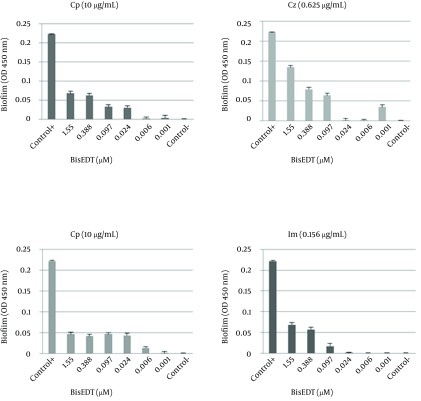
The combination of bismuth ethanedithiol with ciprofloxacin showed synergistic inhibitory effect on the P. aeruginosa biofilm formation. The combination of bismuth ethanedithiol ciprofloxacin, ceftazidime and imipenem showed synergistic inhibitory effects on the biofilm formation. Furthermore, the combination of bismuth ethanedithiol, imipenem and ceftazidime did not show any synergistic inhibitory effect on biofilm formation.
Our studies show that using appropriate concentrations of bismuth thiols in combination with various antibiotics can act synergistically against P. aeruginosa biofilm formation.
铜绿假单胞菌是一种机会致病菌,它利用免疫系统的某些弱点引发感染。铜绿假单胞菌生物膜可在免疫功能低下和老年患者中引起慢性机会性感染。这种细菌被视为研究抗生素耐药性以及生物膜形成的模式生物。在生物膜结构中,细菌受到许多有害环境因素的保护,如氧气和营养水平的波动、pH值的变化以及对抗生素的敏感性。生物膜通透性降低是细菌产生抗菌耐药性的重要原因之一。
本研究调查了铋硫醇与环丙沙星、亚胺培南和头孢他啶联合对铜绿假单胞菌生物膜的抗生物膜活性。
采用棋盘法测试生物膜对各种抗菌组合的敏感性。通过2,3-双(2-甲氧基-4-硝基-5-磺基苯基)-2H-四唑-5-羧基苯胺(XTT)比色法测定生物膜形成情况。报告每种药物的部分生物膜抑制浓度。
乙二硫醇铋与环丙沙星联合对铜绿假单胞菌生物膜形成具有协同抑制作用。乙二硫醇铋与环丙沙星、头孢他啶和亚胺培南联合对生物膜形成具有协同抑制作用。此外,乙二硫醇铋、亚胺培南和头孢他啶联合对生物膜形成未显示任何协同抑制作用。
我们的研究表明,使用适当浓度的铋硫醇与各种抗生素联合可协同对抗铜绿假单胞菌生物膜形成。