Martin Catherine A, Chapman Rose, Rahman Asheq, Graudins Andis
Monash Emergency, Dandenong Hospital, Monash Health, David Street, Dandenong, Victoria, Australia.
BMC Emerg Med. 2014 Aug 23;14:21. doi: 10.1186/1471-227X-14-21.
A proportion of deliberate self-poisoning (DSP) patients present repeatedly to the emergency department (ED). Understanding the characteristics of frequent DSP patients and their presentation is a first step to implementing interventions that are designed to prevent repeated self-poisoning.
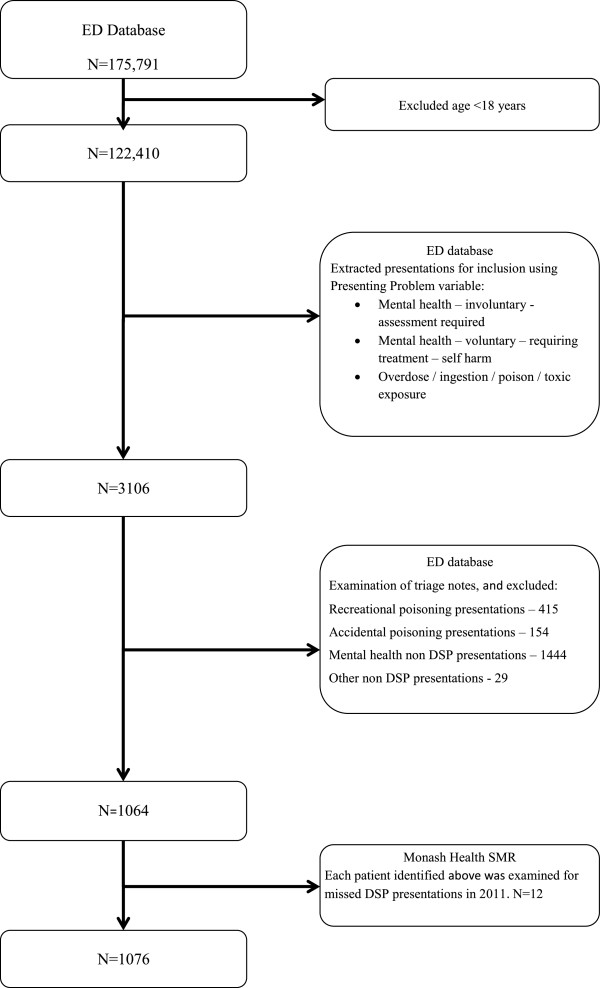
All DSP presentations to three networked Australian ED's were retrospectively identified from the ED electronic medical record and hospital scanned medical records for 2011. Demographics, types of drugs ingested, emergency department length of stay and disposition for the repeat DSP presenters were extracted and compared to those who presented once with DSP in a one year period. Logistic regression was used to analyse repeat versus single DSP data.
The study determined 755 single presenters and 93 repeat DSP presenters. The repeat presenters contributed to 321 DSP presentations. They were more likely to be unemployed (61.0% versus 39.9%, p = 0.008) and have a psychiatric illness compared to single presenters (36.6% versus 15.5%, p < 0.001). Repeat presenters were less likely to receive a toxicology consultation (11.5% versus 27.3%, p < 0.001) and were more likely to abscond from the ED (7.5% versus 3.4%, p = 0.004). Repeat presenters were more likely to ingest paracetamol and antipsychotics than single presenters. The defined daily dose for the most common antipsychotic ingested, quetiapine, was less in the repeat presenter group (median 1.9 [IQR: 1.3-3.5]) compared with the single presenter group (4 [1.4-9.5]), (OR 0.85, 95% CI 0.74-0.99).
Patients who present repeatedly to the ED with DSP have pre-existing disadvantages, with increased likelihood of being unemployed and having a mental illness. These patients are also more likely to have health service inequities given the greater likelihood to abscond from the ED and lower likelihood of receiving toxicology consultation for their DSP. Early recognition of repeat DSP patients in the ED may facilitate the development of individualised care plans with the aim to reduce repeat episodes of self-poisoning and subsequent risk of successful suicide.
一部分蓄意自我中毒(DSP)患者会反复前往急诊科(ED)就诊。了解频繁DSP患者的特征及其就诊情况是实施旨在预防反复自我中毒的干预措施的第一步。
从2011年的ED电子病历和医院扫描病历中回顾性识别出所有向三家联网的澳大利亚ED就诊的DSP病例。提取了复诊DSP患者的人口统计学信息、摄入药物类型、急诊科留观时间和处置情况,并与一年内仅一次因DSP就诊的患者进行比较。采用逻辑回归分析复诊与单次DSP数据。
该研究确定了755名单次就诊者和93名复诊DSP患者。复诊患者导致了321次DSP就诊。与单次就诊者相比,他们更可能失业(61.0%对39.9%,p = 0.008)且患有精神疾病(36.6%对15.5%,p < 0.001)。复诊患者接受毒理学咨询的可能性较小(11.5%对27.3%,p < 0.001),且更可能擅自离开ED(7.5%对3.4%,p = 0.004)。与单次就诊者相比,复诊患者更可能摄入对乙酰氨基酚和抗精神病药物。复诊患者组中摄入最常见抗精神病药物喹硫平的限定日剂量低于单次就诊者组(中位数1.9 [四分位间距:1.3 - 3.5])与单次就诊者组(4 [1.4 - 9.5]),(比值比0.85,95%置信区间0.74 - 0.99)。
反复因DSP前往ED就诊的患者存在既往不利因素,失业和患有精神疾病的可能性增加。鉴于这些患者更可能擅自离开ED且因DSP接受毒理学咨询的可能性较低,他们也更可能存在医疗服务不平等情况。在ED中早期识别复诊DSP患者可能有助于制定个性化护理计划,以减少自我中毒的反复发作及随后成功自杀的风险。