Rao Ashwini K, Marder Karen S, Uddin Jasim, Rakitin Brian C
Department of Rehabilitation & Regenerative Medicine (Program in Physical Therapy), and G.H. Sergievsky Center, College of Physicians & Surgeons, Columbia University, New York, New York, USA.
Mov Disord. 2014 Oct;29(12):1516-22. doi: 10.1002/mds.25998. Epub 2014 Aug 22.
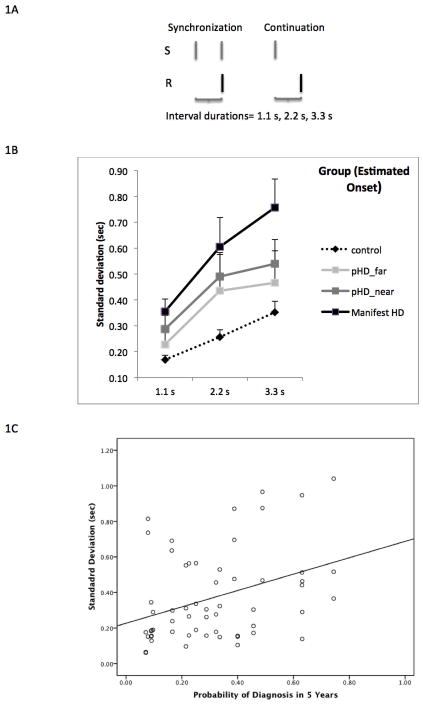
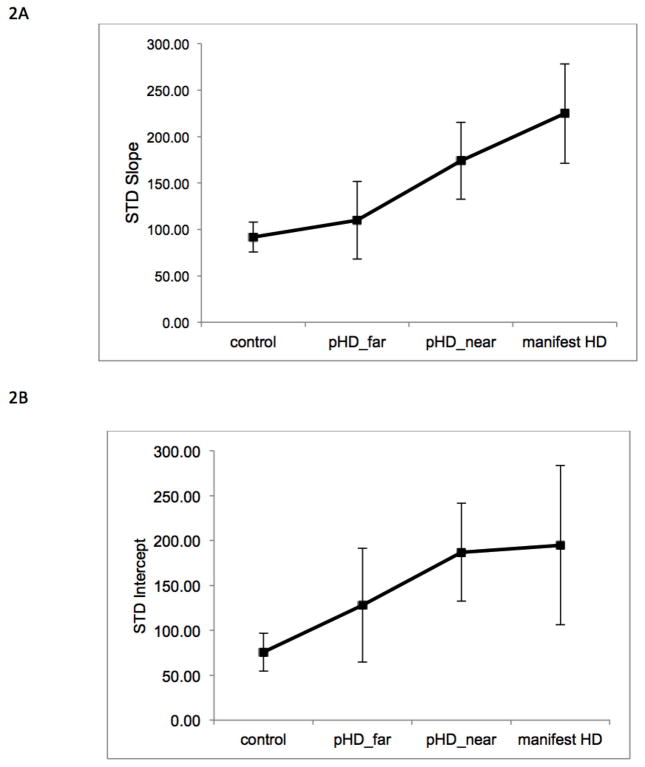
In Huntington's disease (HD), increased variability is seen in performance of motor tasks that require implicit control of timing. We examined whether timing variability was also evident in an explicit interval-timing task. Sixty subjects (21 controls, 19 manifest HD, and 20 pre-manifest HD) performed a single-interval production task with three target intervals (1.1 s, 2.2 s, 3.3 s). We analyzed accuracy (proportional error) and precision (standard deviation) across groups and intervals. No differences were seen in accuracy across groups or intervals. Precision was significantly lower in manifest (P = 0.0001) and pre-manifest HD (P = 0.04) compared with controls. This was particularly true for pre-manifest subjects close to diagnosis (based on probability of diagnosis in 5 years). Precision was correlated with proximity to diagnosis (r2 = 0.3, P < 0.01). To examine the source of reduced precision, we conducted linear regression of standard deviation with interval duration. Slope of the regression was significantly higher in manifest HD (P = 0.02) and in pre-manifest HD close to diagnosis (P = 0.04) compared with controls and pre-manifest participants far from diagnosis. Timing precision is impaired before clinical diagnosis in Huntington's disease. Slope analysis suggests that timing variability (decreased precision) was attributable to deficits in timing-dependent processes. Our results provide additional support for the proposal that the basal ganglia are implicated in central timekeeping functions. Because the single interval production task was sensitive to deficits in pre-manifest HD, temporal precision may be a useful outcome measure in future clinical trials.
在亨廷顿舞蹈症(HD)中,在需要对时间进行内隐控制的运动任务表现中可观察到变异性增加。我们研究了在明确的间隔计时任务中计时变异性是否也很明显。60名受试者(21名对照者、19名显性HD患者和20名症状前HD患者)进行了一个单间隔生成任务,有三个目标间隔(1.1秒、2.2秒、3.3秒)。我们分析了各组和各间隔的准确性(比例误差)和精确性(标准差)。在各组或各间隔之间,准确性没有差异。与对照者相比,显性HD患者(P = 0.0001)和症状前HD患者(P = 0.04)的精确性显著更低。对于接近诊断的症状前受试者(基于5年内的诊断概率)尤其如此。精确性与接近诊断的程度相关(r2 = 0.3,P < 0.01)。为了研究精确性降低的来源,我们对标准差与间隔持续时间进行了线性回归分析。与对照者以及远离诊断的症状前参与者相比,显性HD患者(P = 0.02)和接近诊断的症状前HD患者(P = 0.04)的回归斜率显著更高。在亨廷顿舞蹈症临床诊断之前,计时精确性就已受损。斜率分析表明,计时变异性(精确性降低)归因于与计时相关过程的缺陷。我们的结果为基底神经节参与中央计时功能这一观点提供了更多支持。由于单间隔生成任务对症状前HD患者的缺陷敏感,时间精确性可能是未来临床试验中一个有用的结果指标。