Lewis Christina M, Suzuki Masatoshi
Stem Cell Res Ther. 2014;5(2):32. doi: 10.1186/scrt421.
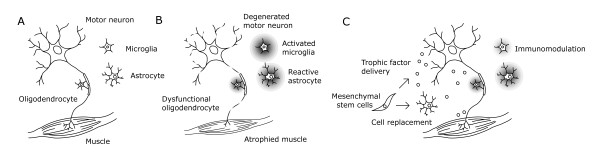
Amyotrophic lateral sclerosis (ALS) is a neurodegenerative disease affecting the neuromuscular system and does not have a known singular cause. Genetic mutations, extracellular factors, non-neuronal support cells, and the immune system have all been shown to play varied roles in clinical and pathological disease progression. The therapeutic plasticity of mesenchymal stem cells (MSCs) may be well matched to this complex disease pathology, making MSCs strong candidates for cellular therapy in ALS. In this review, we summarize a variety of explored mechanisms by which MSCs play a role in ALS progression, including neuronal and non-neuronal cell replacement, trophic factor delivery, and modulation of the immune system. Currently relevant techniques for applying MSC therapy in ALS are discussed, focusing in particular on delivery route and cell source. We include examples from in vitro, preclinical, and clinical investigations to elucidate the remaining progress that must be made to understand and apply MSCs as a treatment for ALS.
肌萎缩侧索硬化症(ALS)是一种影响神经肌肉系统的神经退行性疾病,其病因尚不明确。基因突变、细胞外因子、非神经元支持细胞和免疫系统在临床和病理疾病进展中均发挥了不同作用。间充质干细胞(MSCs)的治疗可塑性可能与这种复杂的疾病病理状况高度匹配,这使得MSCs成为ALS细胞治疗的有力候选者。在本综述中,我们总结了多种已探索的机制,通过这些机制MSCs在ALS进展中发挥作用,包括神经元和非神经元细胞替代、营养因子递送以及免疫系统调节。本文讨论了目前在ALS中应用MSC治疗的相关技术,特别关注递送途径和细胞来源。我们列举了体外、临床前和临床研究的实例,以阐明在理解和应用MSCs治疗ALS方面仍需取得的进展。