Lin Ting-Jung, Cheng Guang-Chao, Wu Luo-Yun, Lai Wei-Yu, Ling Thai-Yen, Kuo Yung-Che, Huang Yen-Hua
School of Medicine, College of Medicine, Taipei Medical University, Taipei, Taiwan.
Department of Biochemistry and Molecular Cell Biology, School of Medicine, College of Medicine, Taipei Medical University, Taipei, Taiwan.
Front Cell Dev Biol. 2022 Mar 16;10:851613. doi: 10.3389/fcell.2022.851613. eCollection 2022.
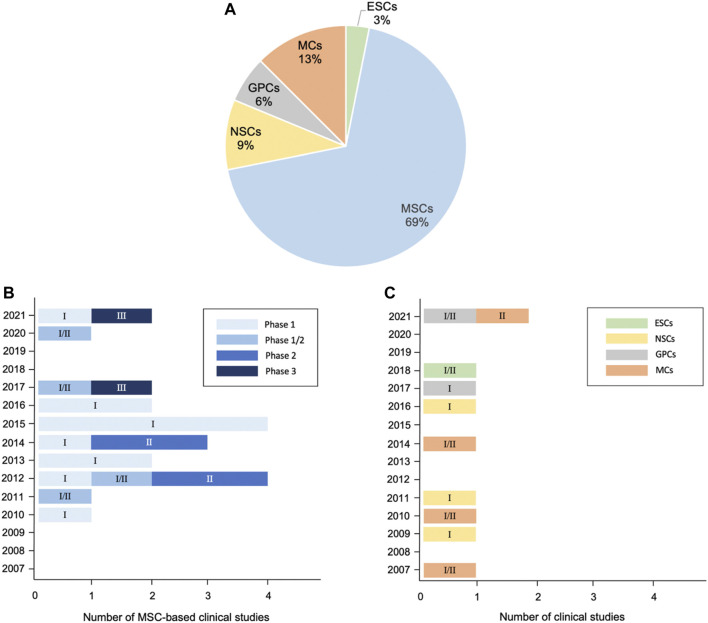
Amyotrophic lateral sclerosis (ALS) is a fatal neurodegenerative disease characterized by progressive upper and lower motor neuron (MN) degeneration with unclear pathology. The worldwide prevalence of ALS is approximately 4.42 per 100,000 populations, and death occurs within 3-5 years after diagnosis. However, no effective therapeutic modality for ALS is currently available. In recent years, cellular therapy has shown considerable therapeutic potential because it exerts immunomodulatory effects and protects the MN circuit. However, the safety and efficacy of cellular therapy in ALS are still under debate. In this review, we summarize the current progress in cellular therapy for ALS. The underlying mechanism, current clinical trials, and the pros and cons of cellular therapy using different types of cell are discussed. In addition, clinical studies of mesenchymal stem cells (MSCs) in ALS are highlighted. The summarized findings of this review can facilitate the future clinical application of precision medicine using cellular therapy in ALS.
肌萎缩侧索硬化症(ALS)是一种致命的神经退行性疾病,其特征是上、下运动神经元(MN)进行性退化,病理机制不明。全球范围内,ALS的患病率约为每10万人中有4.42例,患者在确诊后3至5年内死亡。然而,目前尚无针对ALS的有效治疗方法。近年来,细胞疗法因其具有免疫调节作用并能保护MN回路而显示出巨大的治疗潜力。然而,细胞疗法在ALS中的安全性和有效性仍存在争议。在本综述中,我们总结了ALS细胞疗法的当前进展。讨论了其潜在机制、当前的临床试验以及使用不同类型细胞进行细胞疗法的优缺点。此外,还重点介绍了间充质干细胞(MSC)在ALS中的临床研究。本综述的总结结果有助于未来细胞疗法在ALS精准医学中的临床应用。