González-Candelas L, Aristoy M C, Polaina J, Flors A
Instituto de Agroquímica y Tecnología de Alimentos, Consejo Superior de Investigaciones Científicas, Valencia, Spain.
Appl Environ Microbiol. 1989 Dec;55(12):3173-7. doi: 10.1128/aem.55.12.3173-3177.1989.
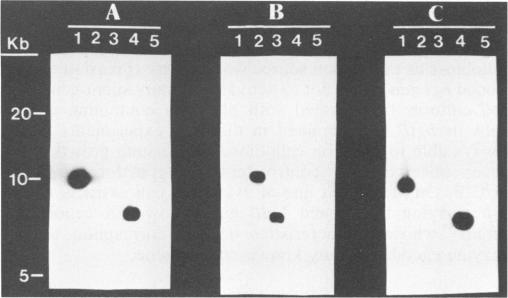
DNA fragments from Bacillus polymyxa which encode beta-glucosidase activity were cloned in Escherichia coli by selection of yellow transformants able to hydrolyze the artificial chromogenic substrate p-nitrophenyl-beta-D-glucopyranoside. Restriction endonuclease maps and Southern analysis of the cloned fragments showed the existence of two different genes. Expression of either one of these genes allowed growth of E. coli in minimal medium with cellobiose as the only carbon source. One of the two enzymes was found in the periplasm of E. coli, hydrolyzed arylglucosides more actively than cellobiose, and rendered glucose as the only product upon cellobiose hydrolysis. The other enzyme was located in the cytoplasm, was more active toward cellobiose, and hydrolyzed this disaccharide, yielding glucose and another, unidentified compound, probably a phosphorylated sugar.
通过筛选能够水解人工生色底物对硝基苯基-β-D-吡喃葡萄糖苷的黄色转化子,将来自多粘芽孢杆菌的编码β-葡萄糖苷酶活性的DNA片段克隆到大肠杆菌中。对克隆片段的限制性内切酶图谱分析和Southern分析表明存在两个不同的基因。这些基因中的任何一个的表达都使大肠杆菌能够在以纤维二糖作为唯一碳源的基本培养基中生长。发现这两种酶中的一种存在于大肠杆菌的周质中,它水解芳基葡萄糖苷比水解纤维二糖更活跃,并且在纤维二糖水解时产生葡萄糖作为唯一产物。另一种酶位于细胞质中,对纤维二糖更具活性,并且水解这种二糖,产生葡萄糖和另一种未鉴定的化合物,可能是一种磷酸化糖。