
心肌T2和T1与铁浓度的校准。
Calibration of myocardial T2 and T1 against iron concentration.
作者信息
Carpenter John-Paul, He Taigang, Kirk Paul, Roughton Michael, Anderson Lisa J, de Noronha Sofia V, Baksi A John, Sheppard Mary N, Porter John B, Walker J Malcolm, Wood John C, Forni Gianluca, Catani Gualtiero, Matta Gildo, Fucharoen Suthat, Fleming Adam, House Mike, Black Greg, Firmin David N, St Pierre Timothy G, Pennell Dudley J
出版信息
J Cardiovasc Magn Reson. 2014 Aug 12;16(1):62. doi: 10.1186/s12968-014-0062-4.
BACKGROUND
The assessment of myocardial iron using T2* cardiovascular magnetic resonance (CMR) has been validated and calibrated, and is in clinical use. However, there is very limited data assessing the relaxation parameters T1 and T2 for measurement of human myocardial iron.
METHODS
Twelve hearts were examined from transfusion-dependent patients: 11 with end-stage heart failure, either following death (n=7) or cardiac transplantation (n=4), and 1 heart from a patient who died from a stroke with no cardiac iron loading. Ex-vivo R1 and R2 measurements (R1=1/T1 and R2=1/T2) at 1.5 Tesla were compared with myocardial iron concentration measured using inductively coupled plasma atomic emission spectroscopy.
RESULTS
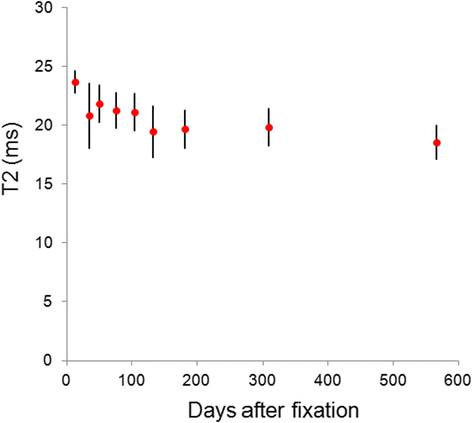
From a single myocardial slice in formalin which was repeatedly examined, a modest decrease in T2 was observed with time, from mean (± SD) 23.7 ± 0.93 ms at baseline (13 days after death and formalin fixation) to 18.5 ± 1.41 ms at day 566 (p<0.001). Raw T2 values were therefore adjusted to correct for this fall over time. Myocardial R2 was correlated with iron concentration [Fe] (R2 0.566, p<0.001), but the correlation was stronger between LnR2 and Ln[Fe] (R2 0.790, p<0.001). The relation was [Fe] = 5081•(T2)-2.22 between T2 (ms) and myocardial iron (mg/g dry weight). Analysis of T1 proved challenging with a dichotomous distribution of T1, with very short T1 (mean 72.3 ± 25.8 ms) that was independent of iron concentration in all hearts stored in formalin for greater than 12 months. In the remaining hearts stored for <10 weeks prior to scanning, LnR1 and iron concentration were correlated but with marked scatter (R2 0.517, p<0.001). A linear relationship was present between T1 and T2 in the hearts stored for a short period (R2 0.657, p<0.001).
CONCLUSION
Myocardial T2 correlates well with myocardial iron concentration, which raises the possibility that T2 may provide additive information to T2* for patients with myocardial siderosis. However, ex-vivo T1 measurements are less reliable due to the severe chemical effects of formalin on T1 shortening, and therefore T1 calibration may only be practical from in-vivo human studies.
背景
使用T2*心血管磁共振(CMR)评估心肌铁含量已得到验证和校准,并已应用于临床。然而,评估人类心肌铁含量的弛豫参数T1和T2的数据非常有限。
方法
对12例依赖输血患者的心脏进行了检查:11例为终末期心力衰竭患者,其中7例为死亡后(n = 7)或心脏移植后(n = 4),1例为死于中风且无心脏铁负荷的患者。将在1.5特斯拉下进行的离体R1和R2测量(R1 = 1/T1,R2 = 1/T2)与使用电感耦合等离子体原子发射光谱法测量的心肌铁浓度进行比较。
结果
从福尔马林中反复检查的单个心肌切片中观察到,T2随时间有适度下降,从基线时(死亡和福尔马林固定后13天)的平均值(±标准差)23.7±0.93毫秒降至第566天时的18.5±1.41毫秒(p<0.001)。因此,对原始T2值进行了调整,以校正这种随时间的下降。心肌R2与铁浓度[Fe]相关(R2 0.566,p<0.001),但LnR2与Ln[Fe]之间的相关性更强(R2 0.790,p<0.001)。T2(毫秒)与心肌铁(毫克/克干重)之间的关系为[Fe] = 5081•(T2)-2.22。对T1的分析具有挑战性,因为T1呈二分分布,在福尔马林中保存超过12个月的所有心脏中,T1非常短(平均值72.3±25.8毫秒),且与铁浓度无关。在扫描前保存<10周的其余心脏中,LnR1与铁浓度相关,但有明显的离散(R2 0.517,p<0.001)。在短期保存的心脏中,T1与T2之间存在线性关系(R2 0.657,p<0.001)。
结论
心肌T2与心肌铁浓度密切相关,这增加了T2可能为心肌铁沉着症患者提供比T2*更多信息的可能性。然而,由于福尔马林对T1缩短有严重的化学作用,离体T1测量不太可靠,因此T1校准可能仅在人体活体研究中可行。



 Zotero 插件