Preciado López Magdalena, Huber Florian, Grigoriev Ilya, Steinmetz Michel O, Akhmanova Anna, Koenderink Gijsje H, Dogterom Marileen
FOM Institute AMOLF, Science Park 104, 1098 XG Amsterdam, The Netherlands.
Division of Cell Biology, Faculty of Science, Utrecht University, Padualaan 8, 3584 CH Utrecht, The Netherlands.
Nat Commun. 2014 Aug 27;5:4778. doi: 10.1038/ncomms5778.
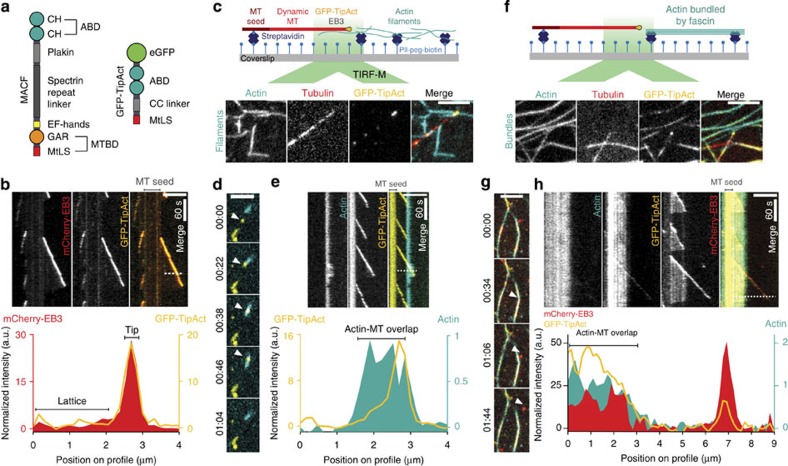
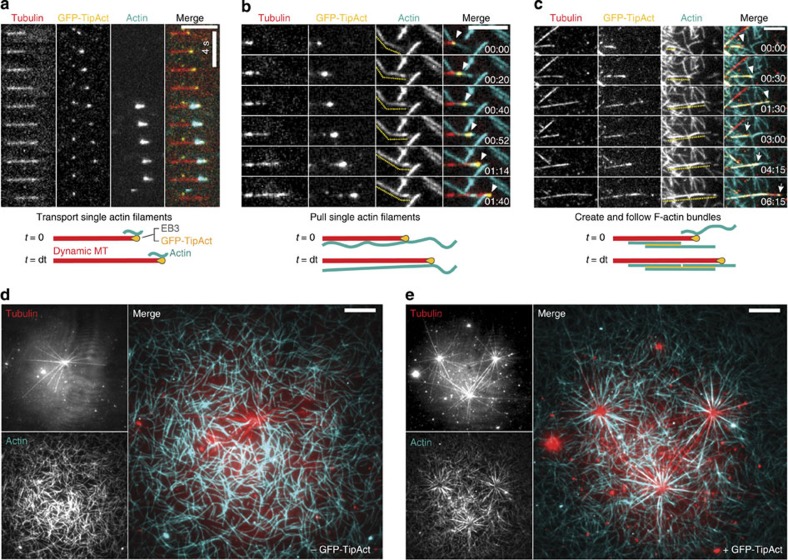
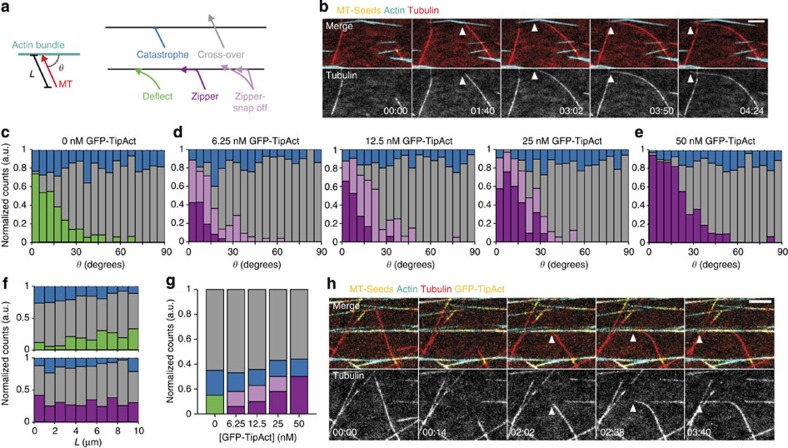
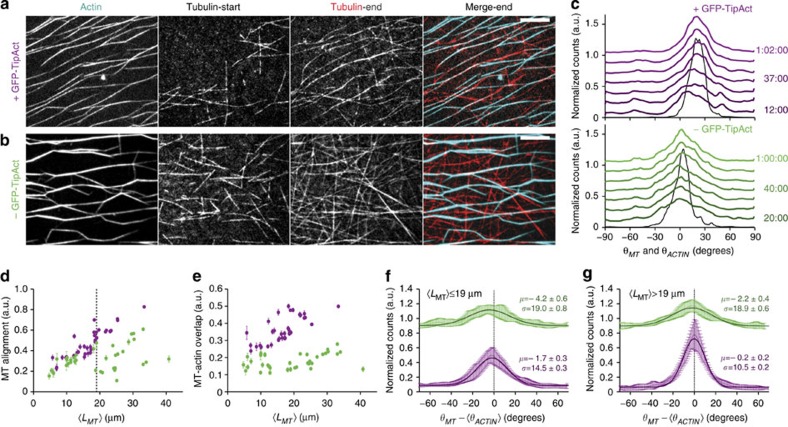
To power dynamic processes in cells, the actin and microtubule cytoskeletons organize into complex structures. Although it is known that cytoskeletal coordination is vital for cell function, the mechanisms by which cross-linking proteins coordinate actin and microtubule activities remain poorly understood. In particular, it is unknown how the distinct mechanical properties of different actin architectures modulate the outcome of actin-microtubule interactions. To address this question, we engineered the protein TipAct, which links growing microtubule ends via end-binding proteins to actin filaments. We show that growing microtubules can be captured and guided by stiff actin bundles, leading to global actin-microtubule alignment. Conversely, growing microtubule ends can transport, stretch and bundle individual actin filaments, thereby globally defining actin filament organization. Our results provide a physical basis to understand actin-microtubule cross-talk, and reveal that a simple cross-linker can enable a mechanical feedback between actin and microtubule organization that is relevant to diverse biological contexts.
为驱动细胞内的动态过程,肌动蛋白和微管细胞骨架会组织形成复杂的结构。尽管已知细胞骨架协调对于细胞功能至关重要,但交联蛋白协调肌动蛋白和微管活动的机制仍知之甚少。特别地,不同肌动蛋白结构的独特力学特性如何调节肌动蛋白 - 微管相互作用的结果尚不清楚。为解决这个问题,我们设计了蛋白质TipAct,它通过末端结合蛋白将生长中的微管末端与肌动蛋白丝连接起来。我们表明,生长中的微管可以被刚性肌动蛋白束捕获并引导,从而导致整体肌动蛋白 - 微管排列。相反,生长中的微管末端可以运输、拉伸并捆绑单个肌动蛋白丝,从而全局定义肌动蛋白丝的组织。我们的结果为理解肌动蛋白 - 微管相互作用提供了物理基础,并揭示了一个简单的交联剂可以在肌动蛋白和微管组织之间实现与多种生物学背景相关的机械反馈。