Department of Neuroinformatics, Institute of Cognitive Sciences, University of Osnabrück Osnabrück, Germany.
Faculty of Mathematics and Computer Science, Institute of Computer Science, University of Tartu Tartu, Estonia.
Front Integr Neurosci. 2014 Aug 13;8:64. doi: 10.3389/fnint.2014.00064. eCollection 2014.
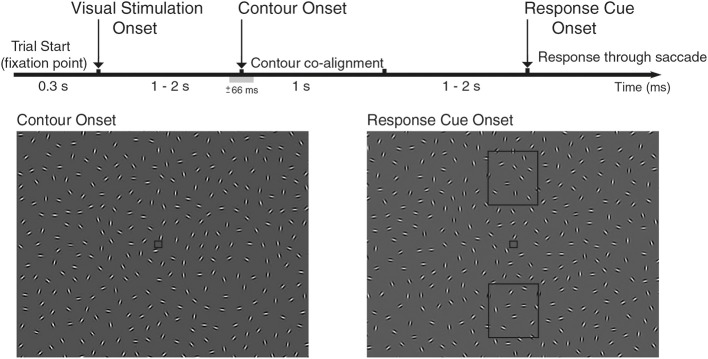
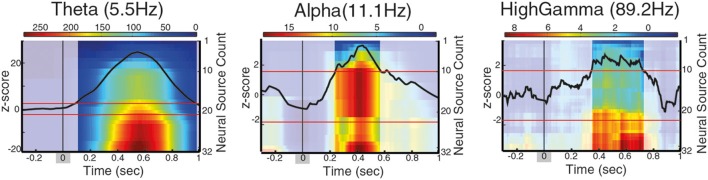
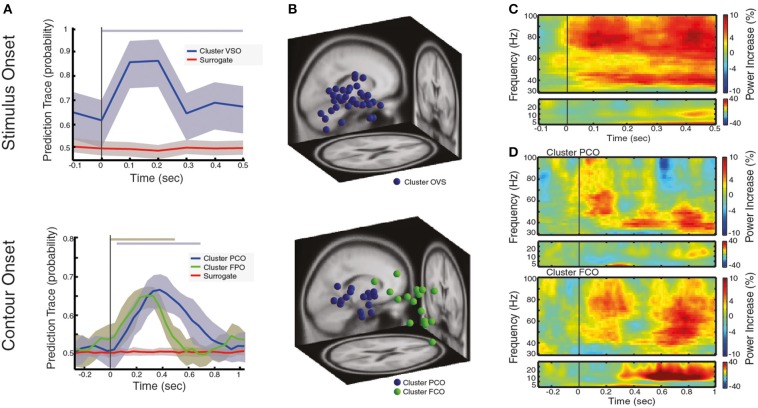
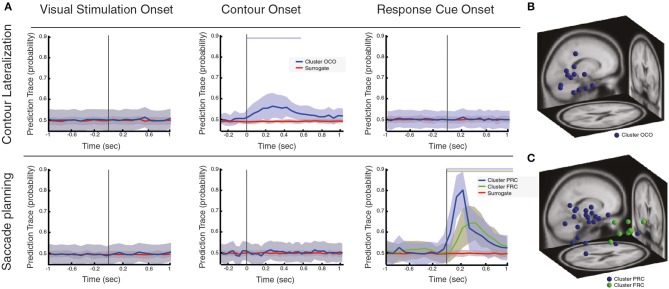
The ability to integrate visual features into a global coherent percept that can be further categorized and manipulated are fundamental abilities of the neural system. While the processing of visual information involves activation of early visual cortices, the recruitment of parietal and frontal cortices has been shown to be crucial for perceptual processes. Yet is it not clear how both cortical and long-range oscillatory activity leads to the integration of visual features into a coherent percept. Here, we will investigate perceptual grouping through the analysis of a contour categorization task, where the local elements that form contour must be linked into a coherent structure, which is then further processed and manipulated to perform the categorization task. The contour formation in our visual stimulus is a dynamic process where, for the first time, visual perception of contours is disentangled from the onset of visual stimulation or from motor preparation, cognitive processes that until now have been behaviorally attached to perceptual processes. Our main finding is that, while local and long-range synchronization at several frequencies seem to be an ongoing phenomena, categorization of a contour could only be predicted through local oscillatory activity within parietal/frontal sources, which in turn, would synchronize at gamma (>30 Hz) frequency. Simultaneously, fronto-parietal beta (13-30 Hz) phase locking forms a network spanning across neural sources that are not category specific. Both long range networks, i.e., the gamma network that is category specific, and the beta network that is not category specific, are functionally distinct but spatially overlapping. Altogether, we show that a critical mechanism underlying contour categorization involves oscillatory activity within parietal/frontal cortices, as well as its synchronization across distal cortical sites.
将视觉特征整合到一个可以进一步分类和操作的全局连贯感知中的能力是神经系统的基本能力。虽然视觉信息的处理涉及到早期视觉皮层的激活,但顶叶和额叶皮层的募集对于感知过程至关重要。然而,目前还不清楚皮质和长程振荡活动如何将视觉特征整合到一个连贯的感知中。在这里,我们将通过分析轮廓分类任务来研究感知分组,在该任务中,形成轮廓的局部元素必须链接成一个连贯的结构,然后进一步处理和操作以执行分类任务。我们的视觉刺激中的轮廓形成是一个动态过程,在这个过程中,轮廓的视觉感知第一次与视觉刺激的开始或运动准备分开,而这些认知过程直到现在才与感知过程在行为上联系在一起。我们的主要发现是,虽然局部和长程同步在几个频率似乎是一个持续的现象,但轮廓的分类只能通过顶叶/额叶源内的局部振荡活动来预测,而这反过来又会在伽马(>30 Hz)频率下同步。同时,额顶叶β(13-30 Hz)相位锁定形成一个跨越不具有类别特异性的神经源的网络。长程网络,即具有类别特异性的伽马网络和不具有类别特异性的β网络,在功能上是不同的,但在空间上是重叠的。总之,我们表明,轮廓分类的一个关键机制涉及顶叶/额叶皮层内的振荡活动,以及跨远距离皮层位点的同步。