Navis Marjon, Tran Karen, Bale Shridhar, Phad Ganesh E, Guenaga Javier, Wilson Richard, Soldemo Martina, McKee Krisha, Sundling Christopher, Mascola John, Li Yuxing, Wyatt Richard T, Karlsson Hedestam Gunilla B
Department of Microbiology, Tumor and Cell Biology, Karolinska Institutet, Stockholm, Sweden.
IAVI Neutralizing Antibody Center at The Scripps Research Institute, La Jolla, California, United States of America.
PLoS Pathog. 2014 Aug 28;10(8):e1004337. doi: 10.1371/journal.ppat.1004337. eCollection 2014 Aug.
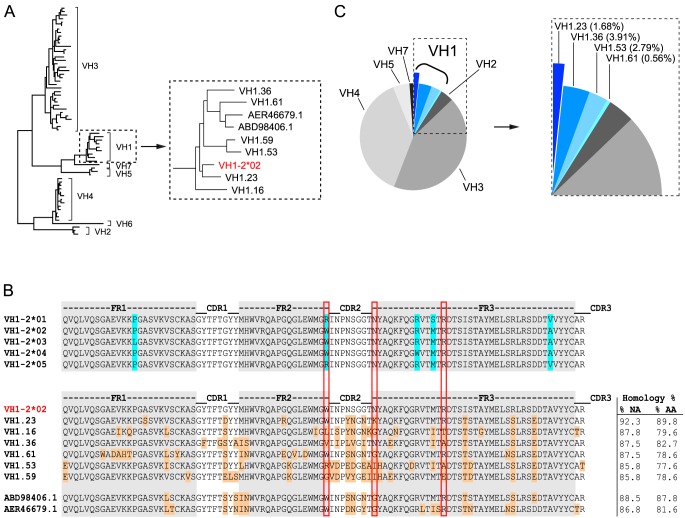
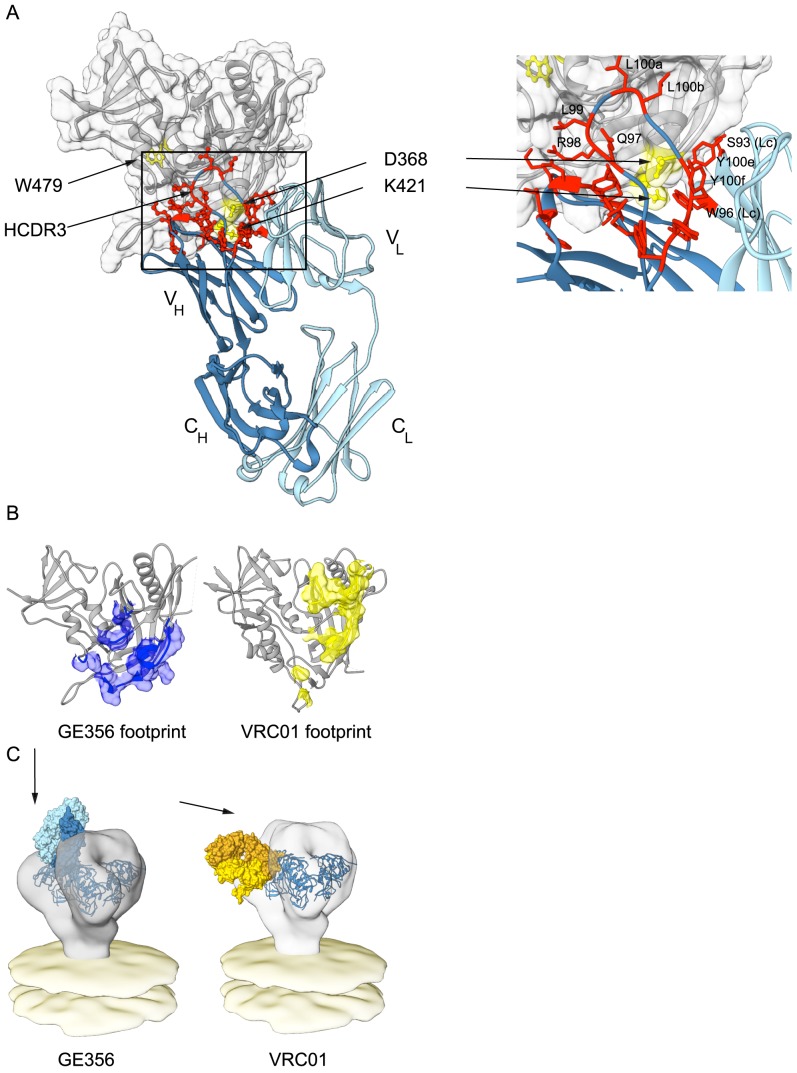
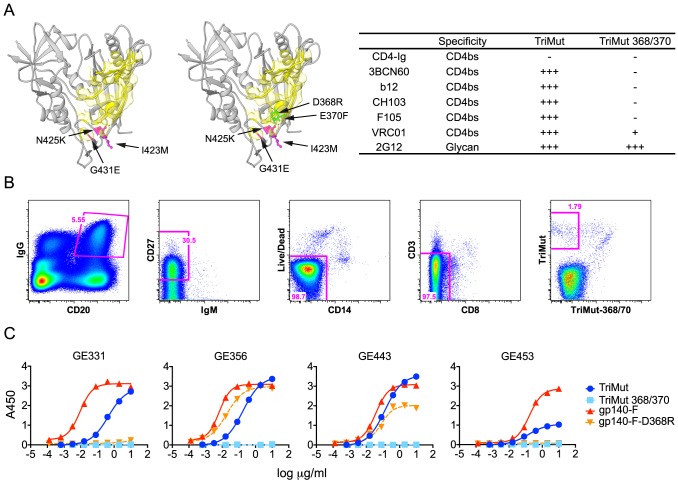
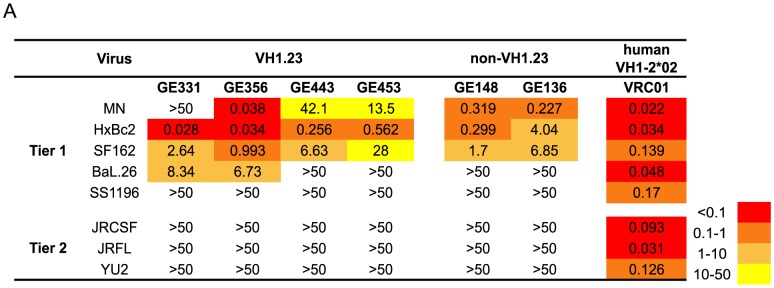
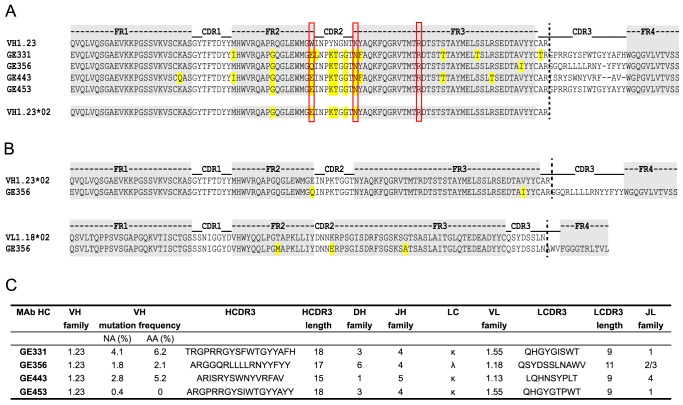
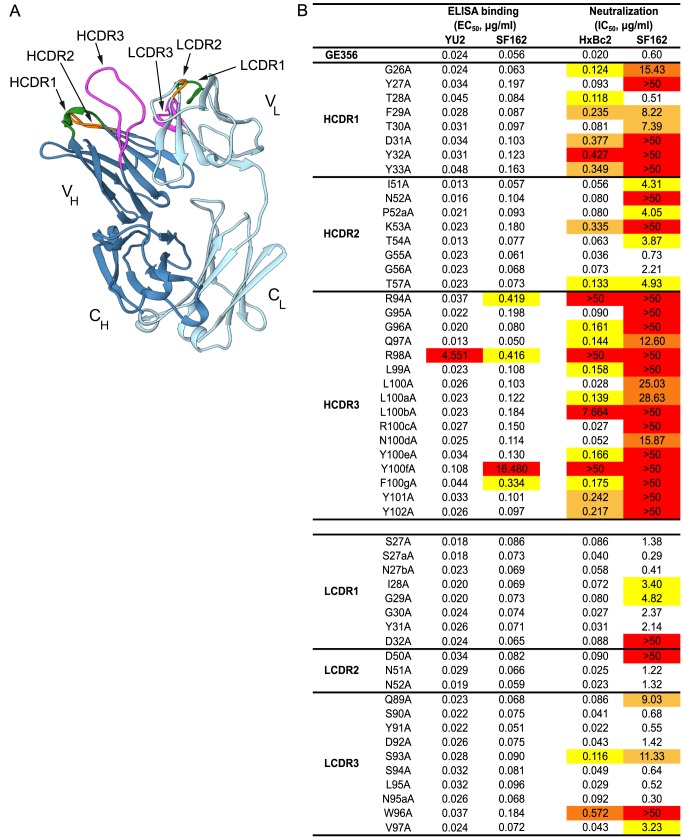
Broadly neutralizing antibodies (bNAbs) isolated from chronically HIV-1 infected individuals reveal important information regarding how antibodies target conserved determinants of the envelope glycoprotein (Env) spike such as the primary receptor CD4 binding site (CD4bs). Many CD4bs-directed bNAbs use the same heavy (H) chain variable (V) gene segment, VH1-202, suggesting that activation of B cells expressing this allele is linked to the generation of this type of Ab. Here, we identify the rhesus macaque VH1.23 gene segment to be the closest macaque orthologue to the human VH1-2 gene segment, with 92% homology to VH1-202. Of the three amino acids in the VH1-2*02 gene segment that define a motif for VRC01-like antibodies (W50, N58, flanking the HCDR2 region, and R71), the two identified macaque VH1.23 alleles described here encode two. We demonstrate that immunization with soluble Env trimers induced CD4bs-specific VH1.23-using Abs with restricted neutralization breadth. Through alanine scanning and structural studies of one such monoclonal Ab (MAb), GE356, we demonstrate that all three HCDRs are involved in neutralization. This contrasts to the highly potent CD4bs-directed VRC01 class of bNAb, which bind Env predominantly through the HCDR2. Also unlike VRC01, GE356 was minimally modified by somatic hypermutation, its light (L) chain CDRs were of average lengths and it displayed a binding footprint proximal to the trimer axis. These results illustrate that the Env trimer immunogen used here activates B cells encoding a VH1-2 gene segment orthologue, but that the resulting Abs interact distinctly differently with the HIV-1 Env spike compared to VRC01.
从慢性HIV-1感染个体中分离出的广泛中和抗体(bNAbs)揭示了有关抗体如何靶向包膜糖蛋白(Env)刺突保守决定簇(如主要受体CD4结合位点(CD4bs))的重要信息。许多针对CD4bs的bNAbs使用相同的重链(H)可变(V)基因片段VH1-202,这表明表达该等位基因的B细胞的激活与这类抗体的产生有关。在此,我们确定恒河猴VH1.23基因片段是与人类VH1-2基因片段最接近的猕猴直系同源物,与VH1-202具有92%的同源性。在VH1-2*02基因片段中定义VRC01样抗体基序的三个氨基酸(W50、N58,位于重链互补决定区2(HCDR2)区域两侧,以及R71)中,此处描述的两个已鉴定的猕猴VH1.23等位基因编码其中两个。我们证明,用可溶性Env三聚体免疫可诱导产生使用VH1.23的CD4bs特异性抗体,其中和广度有限。通过对一种这样的单克隆抗体(MAb)GE356进行丙氨酸扫描和结构研究,我们证明所有三个重链互补决定区(HCDR)都参与中和作用。这与高效的针对CD4bs的VRC01类bNAb形成对比,后者主要通过HCDR2结合Env。同样与VRC01不同的是,GE356经体细胞超突变修饰的程度最小,其轻链互补决定区(L)长度平均,并且其结合足迹靠近三聚体轴。这些结果表明,此处使用的Env三聚体免疫原激活了编码VH1-2基因片段直系同源物的B细胞,但与VRC01相比,所产生的抗体与HIV-1 Env刺突的相互作用明显不同。