Ye X-F, Wang J, Shi W-T, He J
Department of Health Statistics, Second Military Medical University, Shanghai 200433, China.
Br J Cancer. 2014 Nov 25;111(11):2172-9. doi: 10.1038/bjc.2014.481. Epub 2014 Sep 2.
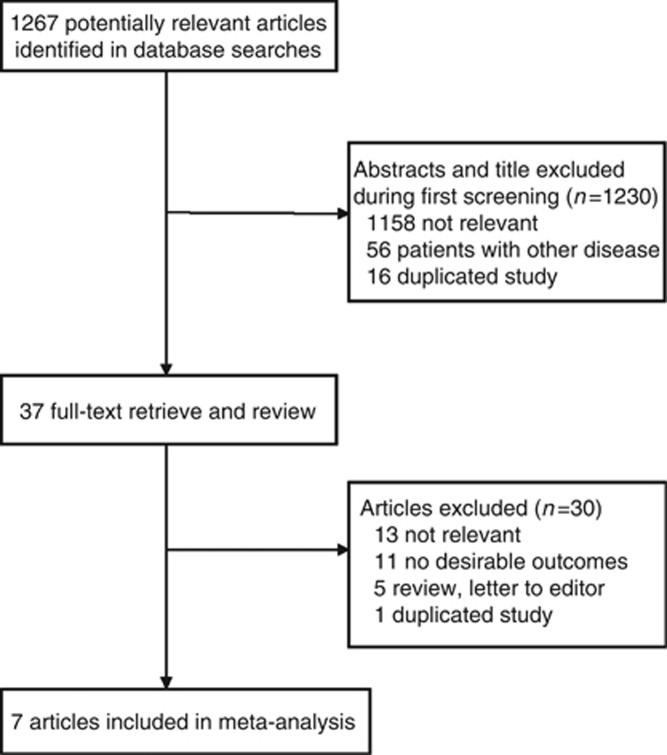
Epidemiological evidence suggests that use of aspirin after the diagnosis of colorectal cancer can lengthen survival. However, the supporting data vary between studies, and this hypothesis remains controversial. We conducted a meta-analysis to provide a quantitative assessment of the association between use of aspirin after diagnosis of colorectal cancer and patient survival.
We searched the Medline and Embase databases up to April 2014 to identify studies related to aspirin use after diagnosis and all-cause mortality or colorectal cancer-specific mortality. Summary effect estimates with 95% confidence intervals (CIs) were derived using a fixed or random effects model, depending on the heterogeneity between the included studies.
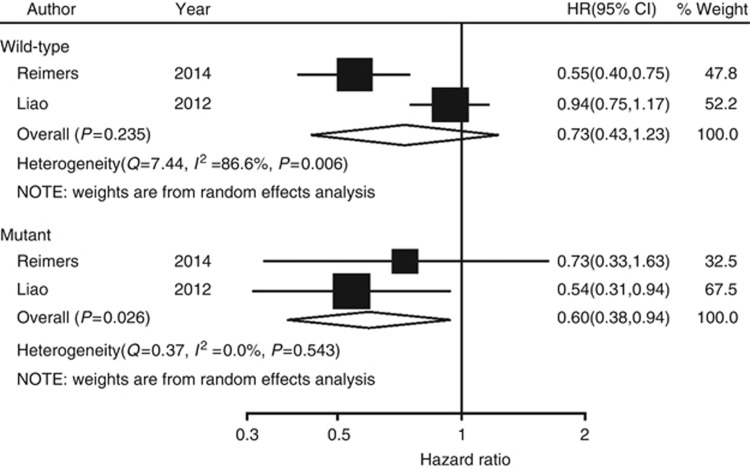
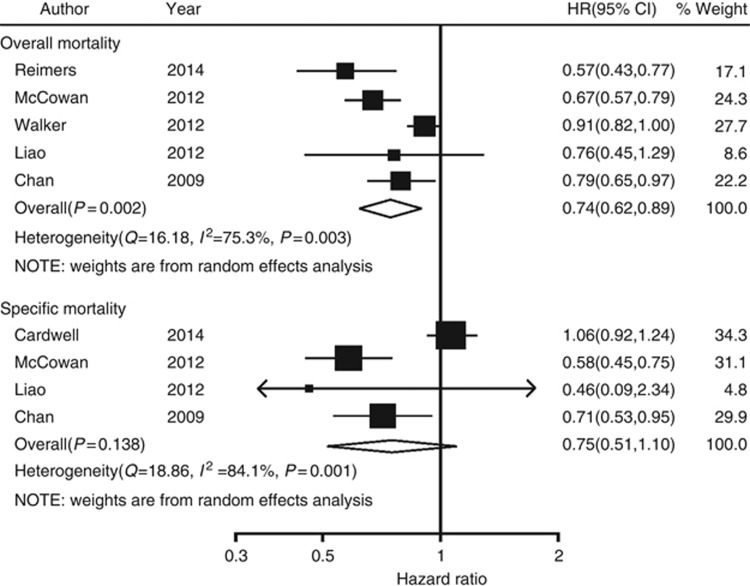
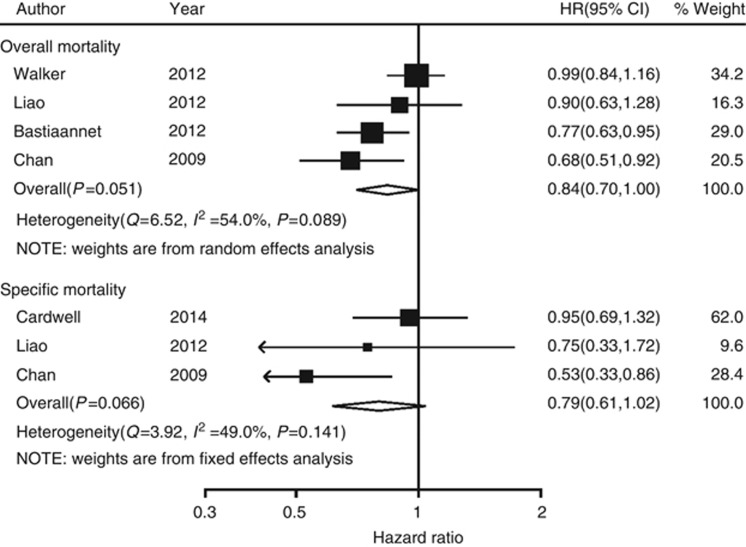
Seven epidemiologic studies that consisted of six cohort studies and one nested case-control study were included in this meta-analysis. The hazard ratio (HR) of the association between aspirin use after colorectal cancer diagnosis and overall mortality, which was reported in five studies, was 0.74 (95% CI, 0.62-0.89) using a random model (heterogeneity test P=0.003, I(2)=75.3%), and for colorectal cancer-specific mortality (four studies), it was 0.75 (95% CI, 0.51-1.10) using a random model (heterogeneity test P=0.001, I(2)=84.1%). In addition, we analysed postdiagnosis aspirin use according to whether aspirin was also used before diagnosis. The HR for the overall mortality of patients who did not use aspirin before diagnosis, which was reported in four studies, was 0.84 (95% CI, 0.70-1.00), and for colorectal cancer-specific mortality (three studies), it was 0.79 (95% CI, 0.61-1.02). For those who did use aspirin before diagnosis, the HR for overall mortality (four studies) was 0.88 (95% CI, 0.83-0.93), and for colorectal cancer-specific mortality (three studies), it was 0.80 (95% CI, 0.59-1.09). Subgroup analysis showed that use of aspirin after diagnosis was associated with longer overall survival among patients with the variant PIK3CA gene but not for those with wild-type PIK3CA.
Based on current evidence, the use of aspirin after diagnosis does not reduce colorectal cancer-specific mortality, but it does reduce all-cause mortality for colorectal cancer patients.
流行病学证据表明,结直肠癌诊断后使用阿司匹林可延长生存期。然而,各研究的支持数据存在差异,这一假说仍存在争议。我们进行了一项荟萃分析,以定量评估结直肠癌诊断后使用阿司匹林与患者生存期之间的关联。
我们检索了截至2014年4月的Medline和Embase数据库,以确定与诊断后使用阿司匹林及全因死亡率或结直肠癌特异性死亡率相关的研究。根据纳入研究之间的异质性,使用固定效应模型或随机效应模型得出95%置信区间(CI)的汇总效应估计值。
本荟萃分析纳入了七项流行病学研究,其中包括六项队列研究和一项巢式病例对照研究。五项研究报告了结直肠癌诊断后使用阿司匹林与总体死亡率之间的关联,采用随机模型得出的风险比(HR)为0.74(95%CI,0.62 - 0.89)(异质性检验P = 0.003,I² = 75.3%);对于结直肠癌特异性死亡率(四项研究),采用随机模型得出的HR为0.75(95%CI,0.51 - 1.10)(异质性检验P = 0.001,I² = 84.1%)。此外,我们根据诊断前是否也使用阿司匹林对诊断后使用阿司匹林的情况进行了分析。四项研究报告了诊断前未使用阿司匹林患者的总体死亡率HR为0.84(95%CI,0.70 - 1.00),结直肠癌特异性死亡率(三项研究)的HR为0.79(95%CI,0.61 - 1.02)。对于诊断前使用过阿司匹林的患者,总体死亡率HR(四项研究)为0.88(95%CI,0.83 - 0.93),结直肠癌特异性死亡率(三项研究)的HR为0.80(95%CI,0.59 - 1.09)。亚组分析显示,诊断后使用阿司匹林与PIK3CA基因变异型患者的总生存期延长有关,但与PIK3CA野生型患者无关。
基于现有证据,诊断后使用阿司匹林并不能降低结直肠癌特异性死亡率,但可降低结直肠癌患者的全因死亡率。