Department of Surgery, Leiden University Medical Centre, The Netherlands.
Br J Cancer. 2012 Apr 24;106(9):1564-70. doi: 10.1038/bjc.2012.101. Epub 2012 Mar 27.
The preventive role of non-steroid anti-inflammatory drugs (NSAIDs) and aspirin, in particular, on colorectal cancer is well established. More recently, it has been suggested that aspirin may also have a therapeutic role. Aim of the present observational population-based study was to assess the therapeutic effect on overall survival of aspirin/NSAIDs as adjuvant treatment used after the diagnosis of colorectal cancer patients.
Data concerning prescriptions were obtained from PHARMO record linkage systems and all patients diagnosed with colorectal cancer (1998-2007) were selected from the Eindhoven Cancer Registry (population-based cancer registry). Aspirin/NSAID use was classified as none, prediagnosis and postdiagnosis and only postdiagnosis. Patients were defined as non-user of aspirin/NSAIDs from the date of diagnosis of the colorectal cancer to the date of first use of aspirin or NSAIDs and user from first use to the end of follow-up. Poisson regression was performed with user status as time-varying exposure.
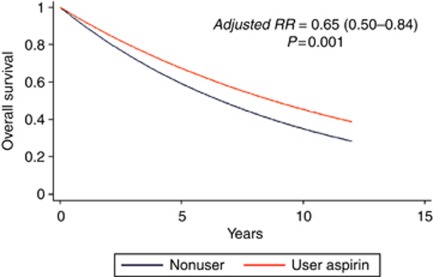
In total, 1176 (26%) patients were non-users, 2086 (47%) were prediagnosis and postdiagnosis users and 1219 (27%) were only postdiagnosis users (total n=4481). Compared with non-users, a survival gain was observed for aspirin users; the adjusted rate ratio (RR) was 0.77 (95% confidence interval (CI) 0.63-0.95; P=0.015). Stratified for colon and rectal, the survival gain was only present in colon cancer (adjusted RR 0.65 (95%CI 0.50-0.84; P=0.001)). For frequent users survival gain was larger (adjusted RR 0.61 (95%CI 0.46-0.81; P=0.001). In rectal cancer, aspirin use was not associated with survival (adjusted RR 1.10 (95%CI 0.79-1.54; P=0.6). The NSAIDs use was associated with decreased survival (adjusted RR 1.93 (95%CI 1.70-2.20; P<0.001).
Aspirin use initiated or continued after diagnosis of colon cancer is associated with a lower risk of overall mortality. These findings strongly support initiation of a placebo-controlled trial that investigates the role of aspirin as adjuvant treatment in colon cancer patients.
非甾体抗炎药(NSAIDs)和阿司匹林,尤其是预防结直肠癌的作用已得到充分证实。最近,有研究表明阿司匹林可能具有治疗作用。本观察性基于人群的研究旨在评估结直肠癌患者诊断后使用阿司匹林/NSAIDs 作为辅助治疗对总生存的治疗效果。
从 PHARMO 记录链接系统获得处方数据,并从埃因霍温癌症登记处(基于人群的癌症登记处)中选择所有诊断为结直肠癌的患者(1998-2007 年)。将阿司匹林/NSAID 的使用情况分为无、诊断前和诊断后,仅诊断后。从结直肠癌诊断之日到首次使用阿司匹林或 NSAIDs 之日,将患者定义为非阿司匹林/NSAIDs 使用者,从首次使用之日到随访结束之日定义为使用者。使用用户状态作为随时间变化的暴露进行泊松回归。
共有 1176 名(26%)患者为非使用者,2086 名(47%)为诊断前和诊断后使用者,1219 名(27%)仅为诊断后使用者(总计 4481 名)。与非使用者相比,阿司匹林使用者的生存获益明显,调整后的比率比(RR)为 0.77(95%置信区间(CI)0.63-0.95;P=0.015)。按结肠癌和直肠癌分层,仅在结肠癌中观察到生存获益(调整 RR 0.65(95%CI 0.50-0.84;P=0.001))。对于频繁使用者,生存获益更大(调整 RR 0.61(95%CI 0.46-0.81;P=0.001))。在直肠癌中,阿司匹林的使用与生存无关(调整 RR 1.10(95%CI 0.79-1.54;P=0.6))。NSAIDs 的使用与生存率降低相关(调整 RR 1.93(95%CI 1.70-2.20;P<0.001))。
结直肠癌诊断后开始或继续使用阿司匹林与总体死亡率降低相关。这些发现强烈支持开展一项安慰剂对照试验,以研究阿司匹林作为结肠癌患者辅助治疗的作用。