Celic T, Španjol J, Bobinac M, Tovmasyan A, Vukelic I, Reboucas J S, Batinic-Haberle I, Bobinac D
Department of Anatomy, Faculty of Medicine, University of Rijeka , Rijeka , Croatia.
Free Radic Res. 2014 Dec;48(12):1426-42. doi: 10.3109/10715762.2014.960865. Epub 2014 Oct 10.
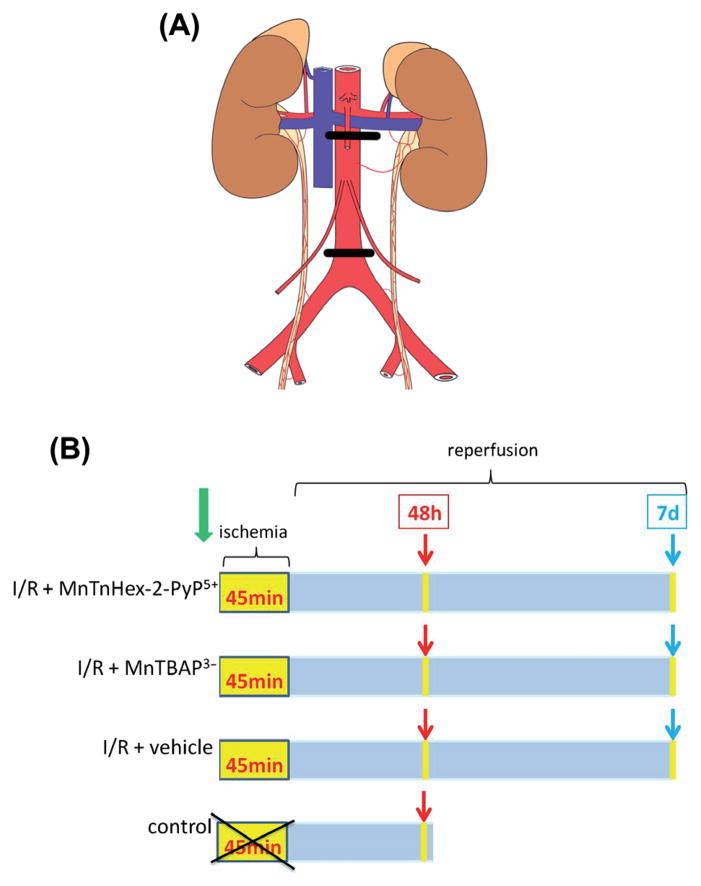
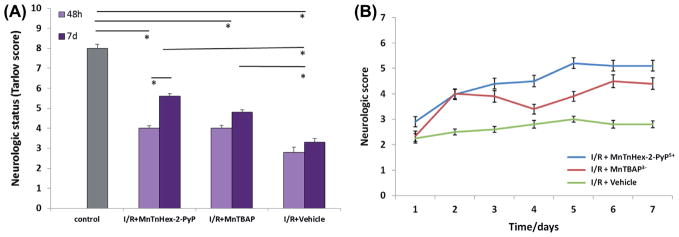
Herein we have demonstrated that both superoxide dismutase (SOD) mimic, cationic Mn(III) meso-tetrakis(N-n-hexylpyridinium-2-yl)porphyrin (MnTnHex-2-PyP(5+)), and non-SOD mimic, anionic Mn(III) meso-tetrakis(4-carboxylatophenyl)porphyrin (MnTBAP(3-)), protect against oxidative stress caused by spinal cord ischemia/reperfusion via suppression of nuclear factor kappa B (NF-κB) pro-inflammatory pathways. Earlier reports showed that Mn(III) N-alkylpyridylporphyrins were able to prevent the DNA binding of NF-κB in an aqueous system, whereas MnTBAP(3-) was not. Here, for the first time, in a complex in vivo system-animal model of spinal cord injury-a similar impact of MnTBAP(3-), at a dose identical to that of MnTnHex-2-PyP(5+), was demonstrated in NF-κB downregulation. Rats were treated subcutaneously at 1.5 mg/kg starting at 30 min before ischemia/reperfusion, and then every 12 h afterward for either 48 h or 7 days. The anti-inflammatory effects of both Mn porphyrins (MnPs) were demonstrated in the spinal cord tissue at both 48 h and 7 days. The downregulation of NF-κB, a major pro-inflammatory signaling protein regulating astrocyte activation, was detected and found to correlate well with the suppression of astrogliosis (as glial fibrillary acidic protein) by both MnPs. The markers of oxidative stress, lipid peroxidation and protein carbonyl formation, were significantly reduced by MnPs. The favorable impact of both MnPs on motor neurons (Tarlov score and inclined plane test) was assessed. No major changes in glutathione peroxidase- and SOD-like activities were demonstrated, which implies that none of the MnPs acted as SOD mimic. Increasing amount of data on the reactivity of MnTBAP(3-) with reactive nitrogen species (RNS) (.NO/HNO/ONOO(-)) suggests that RNS/MnTBAP(3-)-driven modification of NF-κB protein cysteines may be involved in its therapeutic effects. This differs from the therapeutic efficacy of MnTnHex-2-PyP(5+) which presumably occurs via reactive oxygen species and relates to NF-κB thiol oxidation; the role of RNS cannot be excluded.
在此,我们已经证明,超氧化物歧化酶(SOD)模拟物阳离子型中-四(N-正己基吡啶-2-基)锰卟啉(MnTnHex-2-PyP(5+))和非SOD模拟物阴离子型中-四(4-羧基苯基)锰卟啉(MnTBAP(3-)),均可通过抑制核因子κB(NF-κB)促炎途径,来抵御脊髓缺血/再灌注引起的氧化应激。早期报告显示,锰(III)N-烷基吡啶基卟啉能够在水体系中阻止NF-κB与DNA结合,而MnTBAP(3-)则不能。在此,首次在一个复杂的体内系统——脊髓损伤动物模型中,证明了与MnTnHex-2-PyP(5+)剂量相同的MnTBAP(3-)在下调NF-κB方面具有类似作用。大鼠在缺血/再灌注前30分钟开始,以1.5mg/kg的剂量皮下给药,之后每12小时给药一次,持续48小时或7天。两种锰卟啉(MnPs)的抗炎作用在48小时和7天时均在脊髓组织中得到证实。检测到NF-κB(一种调节星形胶质细胞活化的主要促炎信号蛋白)的下调,并且发现其与两种MnPs对星形胶质细胞增生(以胶质纤维酸性蛋白为指标)的抑制密切相关。氧化应激标志物脂质过氧化和蛋白质羰基形成均被MnPs显著降低。评估了两种MnPs对运动神经元的有利影响(塔尔洛夫评分和倾斜平面试验)。未发现谷胱甘肽过氧化物酶和类SOD活性有重大变化,这意味着两种MnPs均未起到SOD模拟物的作用。关于MnTBAP(3-)与活性氮物质(RNS)(·NO/HNO/ONOO(-))反应性的越来越多的数据表明,RNS/MnTBAP(3-)驱动的NF-κB蛋白半胱氨酸修饰可能与其治疗作用有关。这与MnTnHex-2-PyP(5+)的治疗效果不同,后者可能通过活性氧发生作用,并且与NF-κB硫醇氧化有关;不能排除RNS的作用。