Department of Psychiatry, Inha University Hospital, Incheon, Korea.
Clin Psychopharmacol Neurosci. 2014 Aug;12(2):128-36. doi: 10.9758/cpn.2014.12.2.128. Epub 2014 Aug 12.
This study investigated the prescription patterns for Korean patients with schizophrenia with a particular focus on antipsychotic polypharmacy. All data were gathered from patients presenting at 41 tertiary university hospitals and 8 secondary hospitals.
Data from three multicenter studies conducted in Korea were retrospectively reviewed and integrated to identify patients with schizophrenia who had their antipsychotic medication switched to paliperidone extended-release between 2008 and 2009. The rates for antipsychotic polypharmacy, combined use of different antipsychotic classes with a special focus on atypical antipsychotics, and psychotropic polypharmacy using benzodiazepines, mood stabilizers, and other relevant drugs were identified.
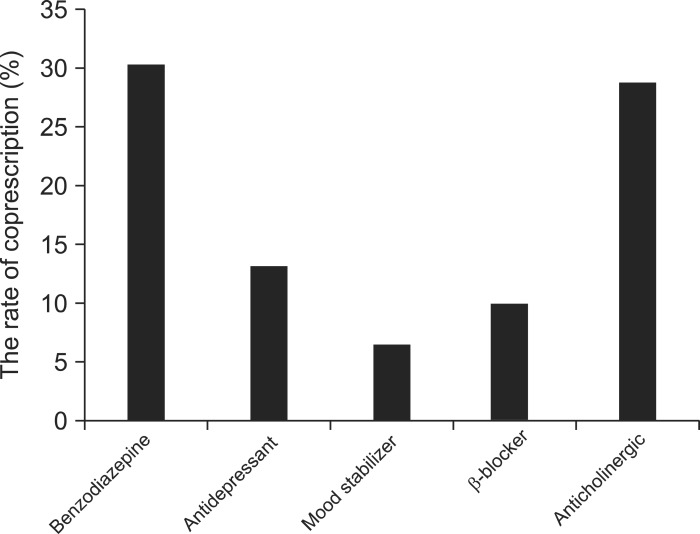
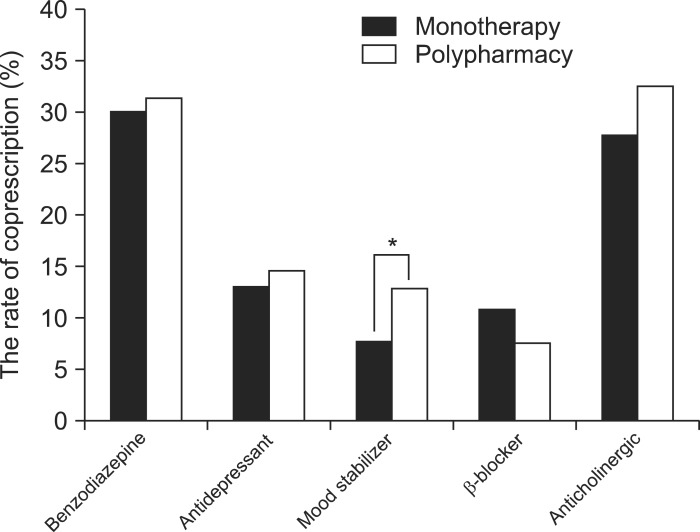
Of the 851 Korean patients analyzed in this study, 20.4% (n=173) had been prescribed antipsychotic polypharmacy. Of the 678 patients receiving antipsychotic monotherapy, 6.9% (n=47) were prescribed a typical antipsychotic and 93.1% (n=631) were prescribed an atypical antipsychotic. Of the 173 patients receiving a combination of antipsychotic drugs, only 6.4% (n=11) had been prescribed polypharmacy with typical antipsychotics, while 46.82% (n=81) were prescribed atypical+atypical antipsychotics or typical+atypical antipsychotics. The highest co-prescription rates for other psychotropic drugs in conjunction with antipsychotics included benzodiazepines (30.3%), anticholinergic drugs (28.8%), antidepressants (13.3%), β-blockers (10.1%), and mood stabilizers (8.7%).
The present findings demonstrate that the rate of antipsychotic polypharmacy is relatively low in Korea and that Korean clinicians prefer to prescribe atypical, rather than typical, antipsychotic drugs. This suggests that there is a distinct prescription pattern in Korea that is focused on antipsychotic polypharmacy.
本研究调查了韩国精神分裂症患者的处方模式,特别关注抗精神病药的联合用药。所有数据均来自于 2008 年至 2009 年在 41 家三级大学医院和 8 家二级医院就诊的患者。
回顾性分析了韩国三项多中心研究的数据,以确定在 2008 年至 2009 年期间将抗精神病药物转换为帕利哌酮缓释剂的精神分裂症患者。确定了抗精神病药联合用药的比率、不同抗精神病药类别的联合使用(特别关注非典型抗精神病药)以及使用苯二氮䓬类、心境稳定剂和其他相关药物的精神药物联合用药的比率。
在本研究分析的 851 名韩国患者中,20.4%(n=173)接受了抗精神病药联合用药。在接受抗精神病药单药治疗的 678 名患者中,6.9%(n=47)接受了典型抗精神病药治疗,93.1%(n=631)接受了非典型抗精神病药治疗。在接受联合抗精神病药治疗的 173 名患者中,只有 6.4%(n=11)接受了典型抗精神病药联合用药,而 46.82%(n=81)接受了非典型+非典型抗精神病药或典型+非典型抗精神病药治疗。与抗精神病药联合使用的其他精神药物的最高联合处方率包括苯二氮䓬类(30.3%)、抗胆碱能药物(28.8%)、抗抑郁药(13.3%)、β 受体阻滞剂(10.1%)和心境稳定剂(8.7%)。
本研究结果表明,韩国的抗精神病药联合用药率相对较低,韩国临床医生更倾向于开非典型而非典型抗精神病药。这表明韩国存在一种独特的以抗精神病药联合用药为重点的处方模式。