Dumas Fabrice, Preira Pascal, Salomé Laurence
CNRS, IPBS (Institut de Pharmacologie et de Biologie Structurale), 205 route de Narbonne, F-31077 Toulouse, France; Université de Toulouse, UPS, IPBS, F-31077 Toulouse, France.
CNRS, IPBS (Institut de Pharmacologie et de Biologie Structurale), 205 route de Narbonne, F-31077 Toulouse, France.
Biochimie. 2014 Dec;107 Pt A:22-7. doi: 10.1016/j.biochi.2014.08.015. Epub 2014 Sep 1.
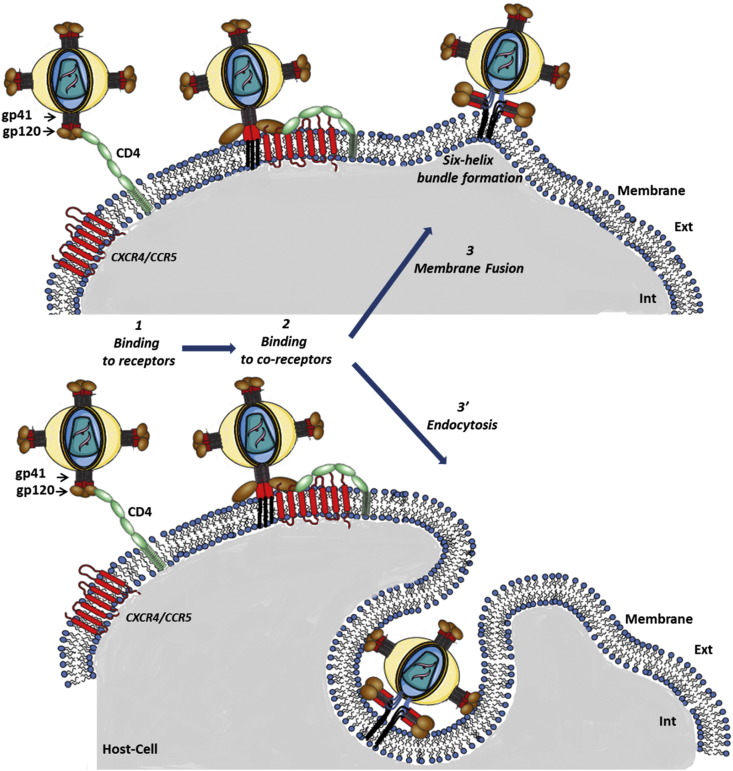
The initial steps of the Human Immunodeficiency Virus (HIV) replication cycle play a crucial role that arbitrates viral tropism and infection efficiency. Before the release of its genome into the host cell cytoplasm, viruses operate a complex sequence of events that take place at the plasma membrane of the target cell. The first step is the binding of the HIV protein envelope (Env) to the cellular receptor CD4. This triggers conformational changes of the gp120 viral protein that allow its interaction with a co-receptor that can be either CCR5 or CXCR4, defining the tropism of the virus entering the cell. This sequential interaction finally drives the fusion of the viral and host cell membrane or to the endocytosis of the viruses. Here, we discuss how the membrane composition and organization of both the virus and the target cell can affect these steps and thus influence the capability of the viruses to infect cells.
人类免疫缺陷病毒(HIV)复制周期的初始步骤起着关键作用,它决定了病毒嗜性和感染效率。在其基因组释放到宿主细胞质之前,病毒在靶细胞的质膜上会经历一系列复杂的事件。第一步是HIV包膜蛋白(Env)与细胞受体CD4结合。这会引发gp120病毒蛋白的构象变化,使其能够与共受体相互作用,该共受体可以是CCR5或CXCR4,从而确定进入细胞的病毒嗜性。这种顺序性相互作用最终驱动病毒膜与宿主细胞膜融合或病毒的内吞作用。在此,我们讨论病毒和靶细胞的膜组成及组织如何影响这些步骤,进而影响病毒感染细胞的能力。