Ghosh Subhanita, Kakumani Pavan Kumar, Kumar Ajit, Malhotra Pawan, Mukherjee Sunil K, Bhatnagar Raj K
Insect Resistance Group, International Centre for Genetic Engineering and Biotechnology, Aruna Asaf Ali Marg, New Delhi 110067, India.
BMC Genomics. 2014 Sep 9;15:775. doi: 10.1186/1471-2164-15-775.
RNA interference (RNAi) leads to sequence specific knock-down of gene expression and has emerged as an important tool to analyse gene functions, pathway analysis and gene therapy. Although RNAi is a conserved cellular process involving common elements and factors, species-specific differences have been observed among different eukaryotes. Identification of components for RNAi pathway is pursued intensively and successful genome-wide screens have been performed for components of RNAi pathways in various organisms. Functional comparative genomics analysis offers evolutionary insight that forms basis of discoveries of novel RNAi-factors within related organisms. Keeping in view the academic and commercial utility of insect derived cell-line from Spodoptera frugiperda, we pursued the identification and functional analysis of components of RNAi-machinery of Sf21 cell-line using genome-wide application.
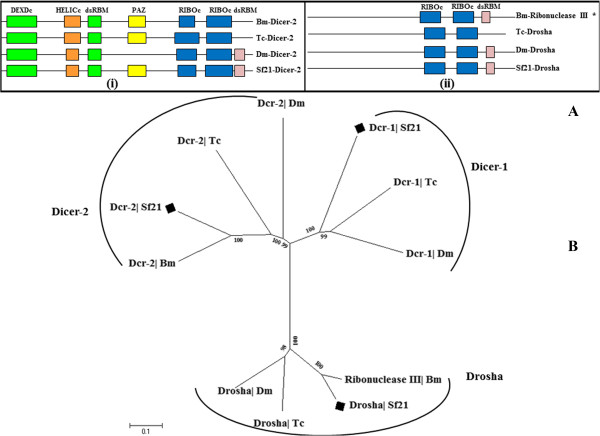
The genome and transcriptome of Sf21 was assembled and annotated. In silico application of comparative genome analysis among insects allowed us to identify several RNAi factors in Sf21 line. The candidate RNAi factors from assembled genome were validated by knockdown analysis of candidate factors using the siRNA screens on the Sf21-gfp reporter cell-line. Forty two (42) potential factors were identified using the cell based assay. These include core RNAi elements including Dicer-2, Argonaute-1, Drosha, Aubergine and auxiliary modules like chromatin factors, RNA helicases, RNA processing module, signalling allied proteins and others. Phylogenetic analyses and domain architecture revealed that Spodoptera frugiperda homologs retained identity with Lepidoptera (Bombyx mori) or Coleoptera (Tribolium castaneum) sustaining an evolutionary conserved scaffold in post-transcriptional gene silencing paradigm within insects.
The database of RNAi-factors generated by whole genome association survey offers comprehensive outlook about conservation as well as specific differences of the proteins of RNAi machinery. Understanding the interior involved in different phases of gene silencing also offers impending tool for RNAi-based applications.
RNA干扰(RNAi)导致基因表达的序列特异性敲低,并已成为分析基因功能、通路分析和基因治疗的重要工具。尽管RNAi是一个涉及共同元件和因子的保守细胞过程,但在不同真核生物中已观察到物种特异性差异。人们正在深入研究RNAi通路的组成成分,并且已经在各种生物体中成功进行了全基因组筛选以寻找RNAi通路的成分。功能比较基因组学分析提供了进化见解,这构成了在相关生物体中发现新型RNAi因子的基础。鉴于来自草地贪夜蛾的昆虫衍生细胞系在学术和商业上的实用性,我们通过全基因组应用对Sf21细胞系RNAi机制的成分进行了鉴定和功能分析。
对Sf21的基因组和转录组进行了组装和注释。通过昆虫间的比较基因组分析的计算机应用,我们在Sf21细胞系中鉴定了几个RNAi因子。使用针对Sf21 - gfp报告细胞系的siRNA筛选对候选因子进行敲低分析,验证了来自组装基因组的候选RNAi因子。通过基于细胞的分析鉴定了42个潜在因子。这些包括核心RNAi元件,如Dicer - 2、Argonaute - 1、Drosha、Aubergine,以及辅助模块,如染色质因子、RNA解旋酶、RNA加工模块、信号相关蛋白等。系统发育分析和结构域架构显示,草地贪夜蛾的同源物与鳞翅目(家蚕)或鞘翅目(赤拟谷盗)保持一致,在昆虫转录后基因沉默范式中维持进化保守的支架。
通过全基因组关联调查生成的RNAi因子数据库提供了关于RNAi机制蛋白质的保守性以及特异性差异的全面观点。了解基因沉默不同阶段所涉及的内部机制也为基于RNAi的应用提供了急需的工具。