Ghirlanda Stefano, Acerbi Alberto, Herzog Harold
Department of Psychology, Brooklyn College, Brooklyn, New York, United States of America; Centre for the Study of Cultural Evolution, Stockholm University, Stockholm, Sweden.
Centre for the Study of Cultural Evolution, Stockholm University, Stockholm, Sweden; Department of Archaeology and Anthropology, University of Bristol, Bristol, United Kingdom.
PLoS One. 2014 Sep 10;9(9):e106565. doi: 10.1371/journal.pone.0106565. eCollection 2014.
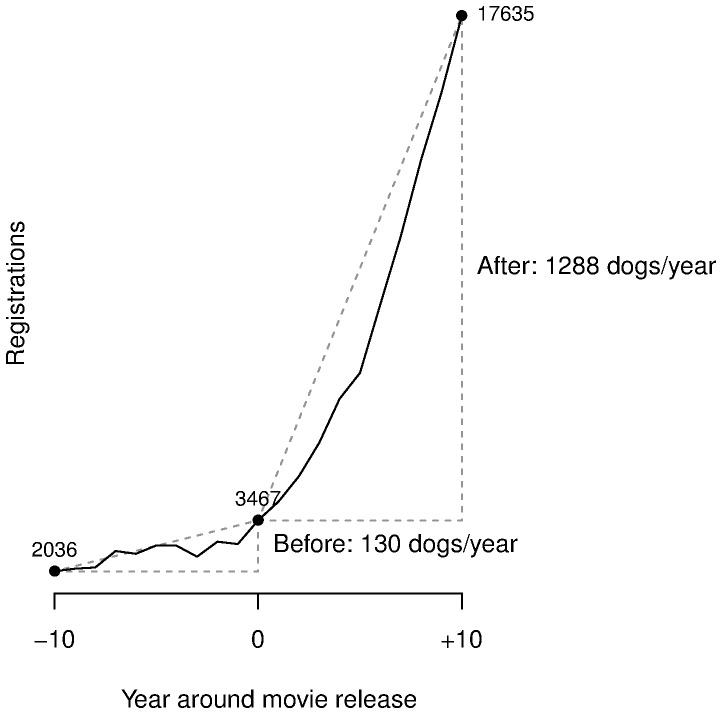
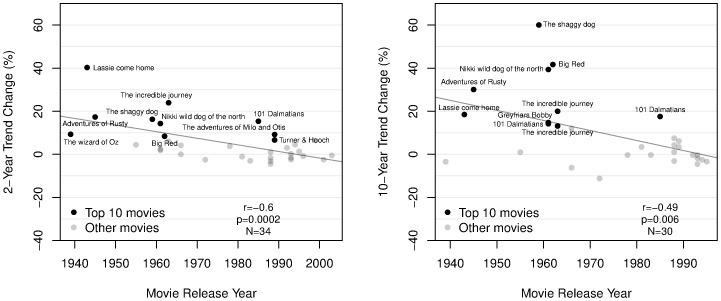
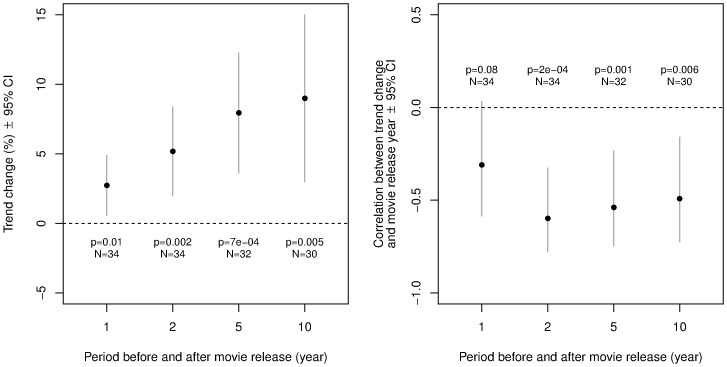
Fashions and fads are important phenomena that influence many individual choices. They are ubiquitous in human societies, and have recently been used as a source of data to test models of cultural dynamics. Although a few statistical regularities have been observed in fashion cycles, their empirical characterization is still incomplete. Here we consider the impact of mass media on popular culture, showing that the release of movies featuring dogs is often associated with an increase in the popularity of featured breeds, for up to 10 years after movie release. We also find that a movie's impact on breed popularity correlates with the estimated number of viewers during the movie's opening weekend--a proxy of the movie's reach among the general public. Movies' influence on breed popularity was strongest in the early 20th century, and has declined since. We reach these conclusions through a new, widely applicable method to measure the cultural impact of events, capable of disentangling the event's effect from ongoing cultural trends.
时尚潮流是影响许多个人选择的重要现象。它们在人类社会中无处不在,最近还被用作测试文化动态模型的数据来源。尽管在时尚周期中观察到了一些统计规律,但其实证特征仍不完整。在这里,我们考虑大众媒体对流行文化的影响,表明以狗为特色的电影上映后,其特色犬种的受欢迎程度通常会上升,这种影响在电影上映后的长达10年时间里都存在。我们还发现,一部电影对犬种受欢迎程度的影响与该电影首映周末的估计观众数量相关——这是电影在普通大众中的影响力的一个指标。电影对犬种受欢迎程度的影响在20世纪初最为强烈,此后有所下降。我们通过一种新的、广泛适用的方法来衡量事件的文化影响,从而得出这些结论,这种方法能够将事件的影响与持续的文化趋势区分开来。