Sagayama Hiroyuki, Jikumaru Yu, Hirata Akiko, Yamada Yosuke, Yoshimura Eiichi, Ichikawa Mamiko, Hatamoto Yoichi, Ebine Naoyuki, Kiyonaga Akira, Tanaka Hiroaki, Higaki Yasuki
Fukuoka University Institute for Physical Activity, 8-19-1 Nanakuma, Jounan-ku, Fukuoka 814-0180, Japan.
J Physiol Anthropol. 2014 Sep 10;33(1):29. doi: 10.1186/1880-6805-33-29.
Obesity and overweight are increasing in prevalence in developed countries as a result of changing dietary habits and a lack of physical activity. The purpose of the present study was to evaluate the changes in body composition during short-term overfeeding using the three-component model, which is composed of fat mass (FM), total body water (TBW), and fat-free dry solids (FFDS).
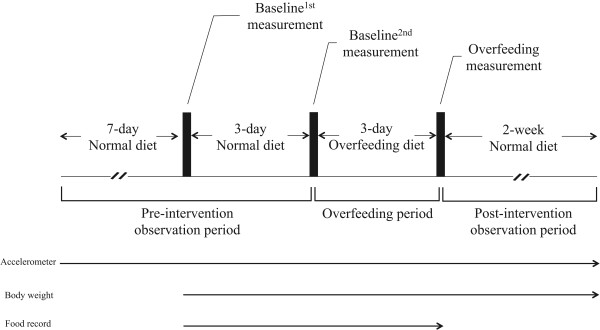
Ten healthy men completed 3 days of overfeeding during which they consumed 1,500 kcal/day more energy than consumed in their normal diets. Body composition was evaluated at three time points: the day before and after their normal diets and the day after the 3-day overfeeding diet.
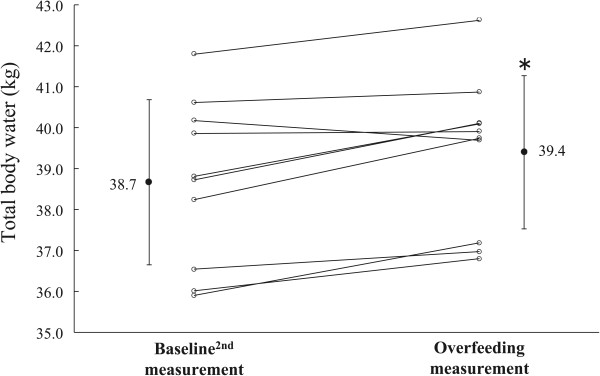
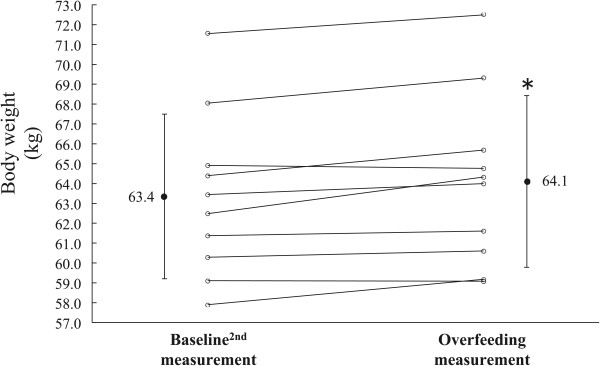
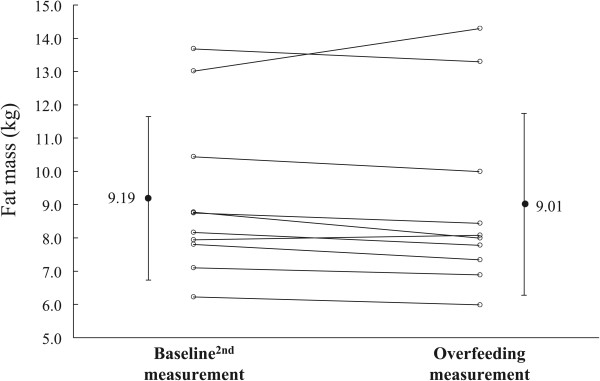
Before and after their normal diets, there were no significant differences in body weight and composition, but after 3 days of overfeeding, body weight, TBW, and FFDS increased 0.7, 0.7, and 0.2 kg, respectively (P <0.0001). There was no significant difference in FM between the normal and overfeeding diets.
This study suggests that TBW gain contributes to weight gain following a short-term overfeeding.
由于饮食习惯的改变和缺乏体育活动,肥胖和超重在发达国家的患病率正在上升。本研究的目的是使用由脂肪量(FM)、总体水(TBW)和无脂干固体(FFDS)组成的三成分模型,评估短期过度喂养期间身体成分的变化。
10名健康男性完成了3天的过度喂养,在此期间,他们每天摄入的能量比正常饮食多1500千卡。在三个时间点评估身体成分:正常饮食前后以及3天过度喂养饮食后的一天。
正常饮食前后,体重和身体成分无显著差异,但在3天过度喂养后,体重、TBW和FFDS分别增加了0.7、0.7和0.2千克(P<0.0001)。正常饮食和过度喂养饮食之间的FM无显著差异。
本研究表明,短期过度喂养后,TBW增加导致体重增加。