Louis Caroline, Tinant Gilles, Mignolet Eric, Thomé Jean-Pierre, Debier Cathy
Institut des Sciences de la Vie, Université catholique de Louvain, Louvain-la-Neuve, Belgium.
Laboratoire d'Ecologie animale et d'Ecotoxicologie, Université de Liège, Liège, Belgium.
PLoS One. 2014 Sep 11;9(9):e106495. doi: 10.1371/journal.pone.0106495. eCollection 2014.
Polychlorinated biphenyls (PCBs) are persistent organic pollutants. Due to their lipophilic character, they are preferentially stored within the adipose tissue. During the mobilisation of lipids, PCBs might be released from adipocytes into the bloodstream. However, the mechanisms associated with the release of PCBs have been poorly studied. Several in vivo studies followed their dynamics of release but the complexity of the in vivo situation, which is characterised by a large range of pollutants, does not allow understanding precisely the behaviour of individual congeners. The present in vitro experiment studied the impact of (i) the number and position of chlorine atoms of PCBs on their release from adipocytes and (ii) the presence of other PCB congeners on the mobilisation rate of such molecules.
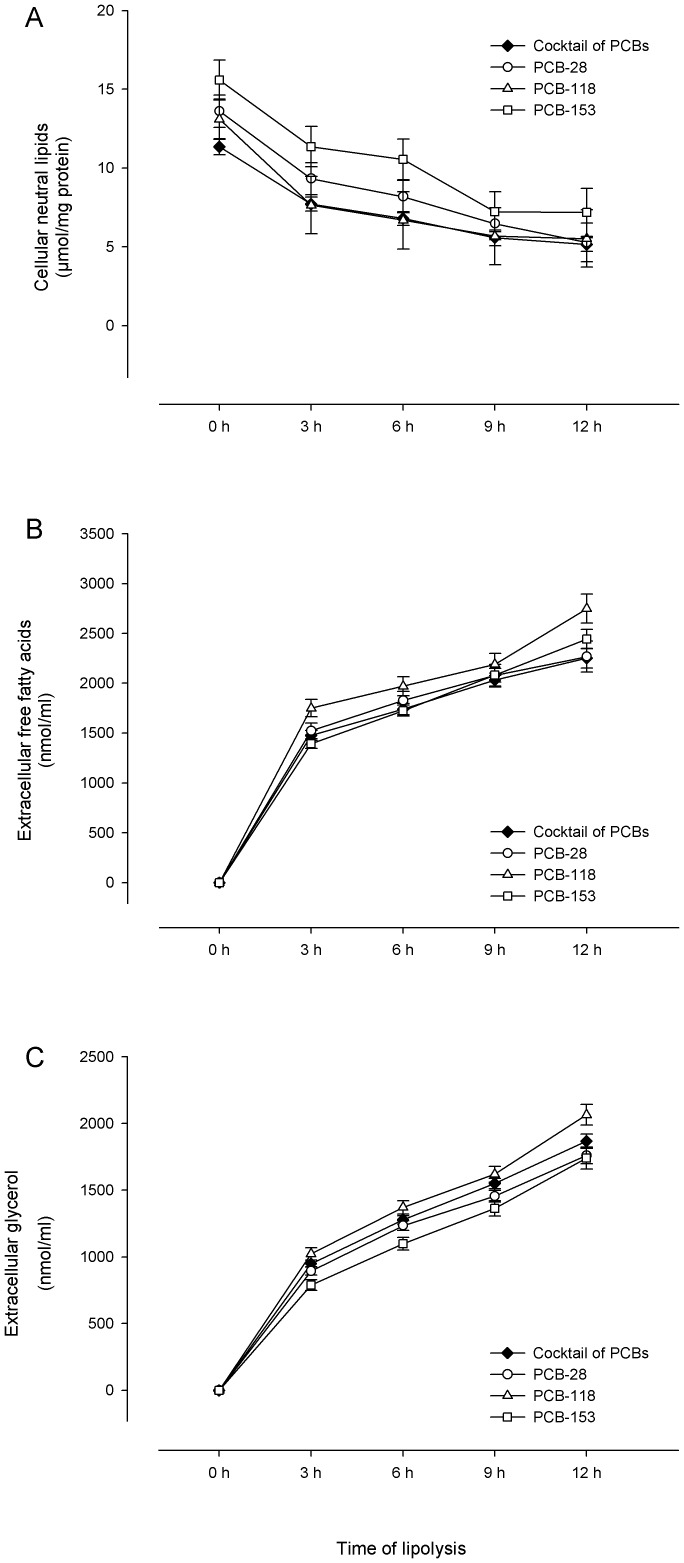
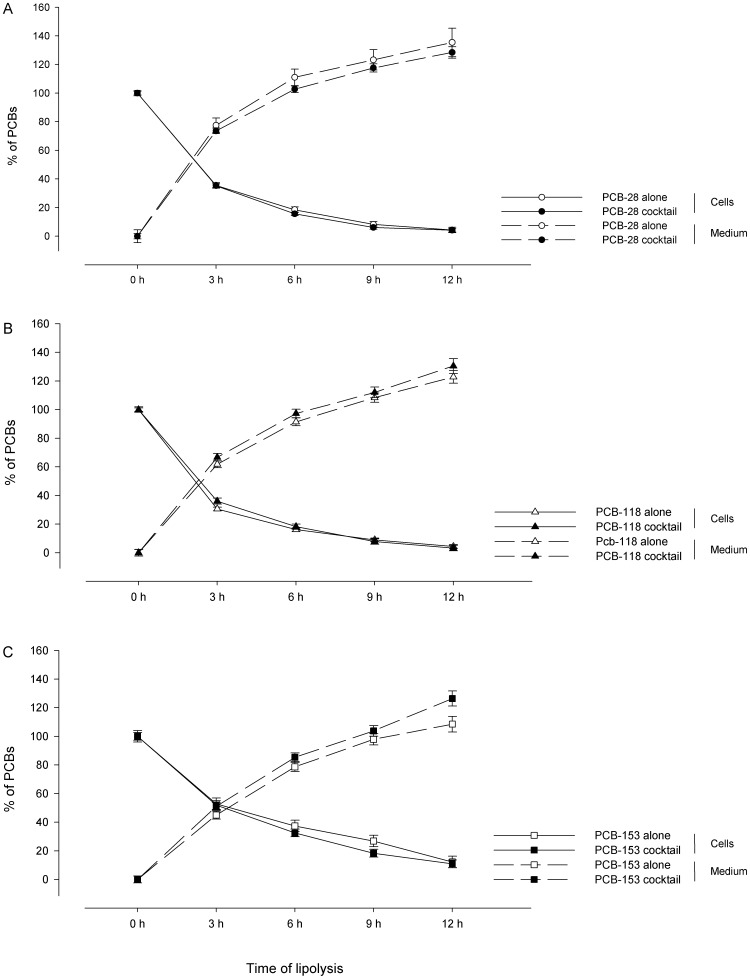
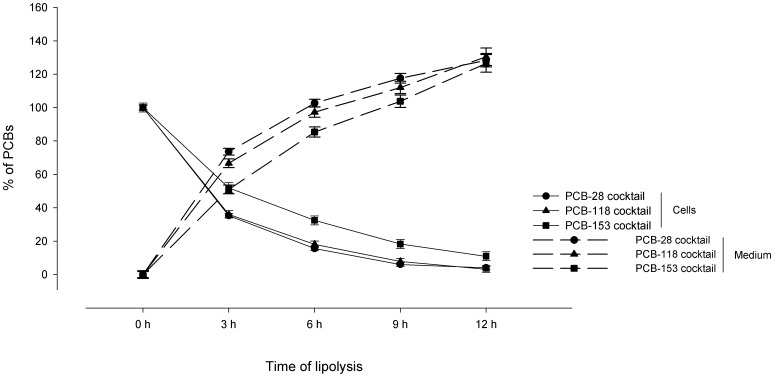
METHODOLOGY/PRINCIPAL FINDINGS: Differentiated rat adipocytes were used to compare the behaviour of PCB-28, -118 and -153. Cells were contaminated with the three congeners, alone or in cocktail, and a lipolysis was then induced with isoproterenol during 12 hours. Our data indicate that the three congeners were efficiently released from adipocytes and accumulated in the medium during the lipolysis. Interestingly, for a same level of cell lipids, PCB-153, a hexa-CB with two chlorine atoms in ortho-position, was mobilised slower than PCB-28, a tri-CB, and PCB-118, a penta-CB, which are both characterised by one chlorine atom in ortho-position. It suggests an impact of the chemical properties of pollutants on their mobilisation during periods of negative energy balance. Moreover, the mobilisation of PCB congeners, taken individually, did not seem to be influenced by the presence of other congeners within adipocytes.
CONCLUSION/SIGNIFICANCE: These results not only highlight the obvious mobilisation of PCBs from adipocytes during lipolysis, in parallel to lipids, but also demonstrate that the structure of congeners defines their rate of release from adipocytes.
多氯联苯(PCBs)是持久性有机污染物。由于其亲脂性,它们优先储存在脂肪组织中。在脂质动员过程中,多氯联苯可能从脂肪细胞释放到血液中。然而,与多氯联苯释放相关的机制研究较少。一些体内研究追踪了它们的释放动态,但体内情况复杂,存在多种污染物,这使得难以精确了解单个同系物的行为。本体外实验研究了(i)多氯联苯氯原子的数量和位置对其从脂肪细胞释放的影响,以及(ii)其他多氯联苯同系物的存在对这些分子动员速率的影响。
方法/主要发现:使用分化的大鼠脂肪细胞来比较多氯联苯-28、-118和-153的行为。细胞单独或混合用这三种同系物污染,然后用异丙肾上腺素诱导脂解12小时。我们的数据表明,在脂解过程中,这三种同系物有效地从脂肪细胞释放并积累在培养基中。有趣的是,对于相同水平的细胞脂质,具有两个邻位氯原子的六氯联苯多氯联苯-153的动员速度比具有一个邻位氯原子的三氯联苯多氯联苯-28和五氯联苯多氯联苯-118慢。这表明污染物的化学性质对负能量平衡期间它们的动员有影响。此外,单独考虑多氯联苯同系物的动员似乎不受脂肪细胞内其他同系物存在的影响。
结论/意义:这些结果不仅突出了脂解过程中多氯联苯与脂质平行地从脂肪细胞中明显动员出来,而且还表明同系物的结构决定了它们从脂肪细胞的释放速率。