
制定单位人员配置客观指标(DOMUS)研究
Developing Objective Metrics for Unit Staffing (DOMUS) study.
作者信息
Siddiqui I, Whittingham B, Meadowcroft K, Richardson M, Cooper J C, Belcher J, Morris E, Ismail K M K
机构信息
University Hospital of North Staffordshire NHS Trust, Stoke, UK.
Department of Primary Care Sciences, Arthritis Research UK Primary Care Centre, Keele University, Staffordshire, Keele, UK.
出版信息
BMJ Open. 2014 Sep 12;4(9):e005398. doi: 10.1136/bmjopen-2014-005398.
OBJECTIVE
Safe midwifery staffing levels on delivery suites is a priority area for any maternity service. Escalation policies are tools that provide an operational response to emergency pressures. The aim of this study was to assess the feasibility of using a scoring system to contemporaneously assess the required staffing level based on demand and use this to determine delivery suite escalation level and utilise the information generated regarding clinical activity (Demand) and staffing levels (Capacity) to generate unit-specific calculation for the actual number of midwifery staff required.
SETTING
A maternity unit of a university-affiliated tertiary referral hospital.
DESIGN
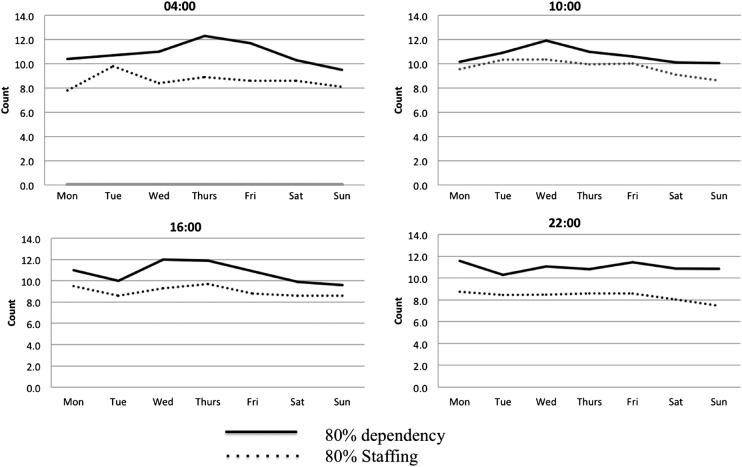
Over a 12-month period, specifically designed scoring sheets were completed by delivery suite shift co-ordinators four times a day (04:00, 10:00, 16:00 and 22:00). Based on the dependency score (Demand) and the number of midwifery staff available (Capacity), an escalation level was determined for each shift. The 80th centile of the demand was used to determine optimal capacity.
RESULTS
A total of 1160 scoring sheets were completed. Average staff number throughout the year on any shift was 7 (range 3-11). Average dependency score was 7 (range 1-14). The 80th centile for demand was calculated to be 11.
CONCLUSIONS
This study stresses the importance and usefulness of a simple tool that can be used to determine the level of escalation on delivery suite based on an objective scoring system and can also be used to determine the appropriate staffing on delivery suite.
目的
产房安全助产人员配置水平是任何产科服务的优先领域。升级政策是应对紧急压力的操作工具。本研究的目的是评估使用评分系统根据需求同步评估所需人员配置水平的可行性,并以此确定产房升级级别,利用所生成的有关临床活动(需求)和人员配置水平(能力)的信息,生成特定科室所需助产士实际人数的计算方法。
设置
一所大学附属医院的产科病房。
设计
在12个月期间,产房轮班协调员每天四次(04:00、10:00、16:00和22:00)填写专门设计的评分表。根据依赖度评分(需求)和可用助产士人数(能力),为每个班次确定升级级别。需求的第80百分位数用于确定最佳能力。
结果
共填写了1160份评分表。全年任何班次的平均工作人员数量为7人(范围为3至11人)。平均依赖度评分为7分(范围为1至14分)。需求的第80百分位数经计算为11分。
结论
本研究强调了一种简单工具的重要性和实用性,该工具可用于基于客观评分系统确定产房的升级级别,也可用于确定产房的适当人员配置。



 Zotero 插件