Sagara Issaka, Piarroux Renaud, Djimde Abdoulaye, Giorgi Roch, Kayentao Kassoum, Doumbo Ogobara K, Gaudart Jean
Malaria Research and Training Center, Department of Epidemiology of Parasitic Diseases, Faculty of Medicine and Odonto-Stomatogy, University of Sciences, Techniques and Technologies of Bamako, BP 1805 Point G Bamako, Mali.
Malar J. 2014 Sep 12;13:358. doi: 10.1186/1475-2875-13-358.
In sub-Saharan Africa, artemisinin-based combination therapy (ACT) and injectable artesunate are the first-line treatments for uncomplicated and severe Plasmodium falciparum malaria, respectively. However, recent studies suggest that delayed anaemia is associated with these treatments in non-immune travellers. This paper aimed to assess the risk factors associated with delayed anaemia after falciparum malaria treatment with artemisinin-containing drugs in malaria-endemic populations.
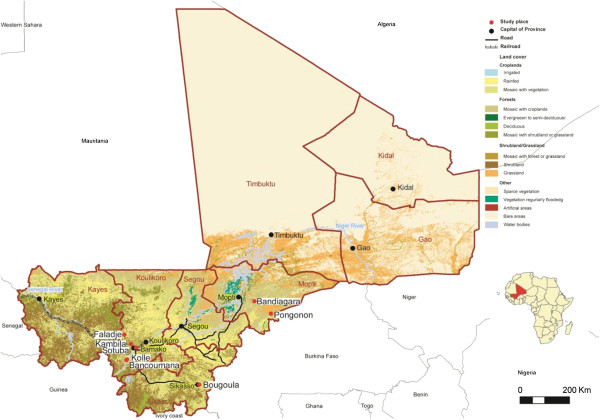
Pooled, individual malaria patient data were extracted from 13 clinical trials performed from 2002 to 2011 in various settings of Mali. Treatment regimens were artemether-lumefantrine, artesunate plus amodiaquine, artesunate plus sulphadoxine-pyrimethamine, artesunate plus sulphamethoxypyrazine-pyrimethamine, artesunate plus mefloquine, artesunate-pyronaridine, artesunate monotherapy, chloroquine, sulphadoxine-pyrimethamine, amodiaquine and sulphadoxine-pyrimethamine plus amodiaquine. Univariate and multivariate analyses were performed using the generalized linear and latent mixed model procedures to assess risk factors associated with haemoglobin concentration evolution and anaemia during the treatment follow-up.
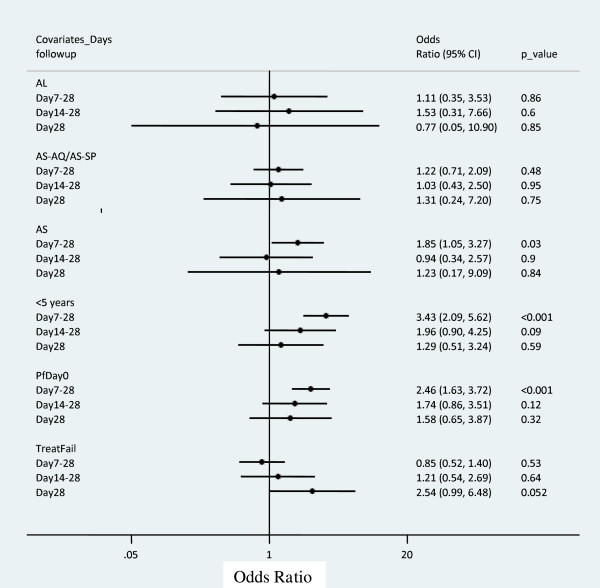
A total of 5,990 participants were recruited and followed from day 0 to day 28. The participants' median age was five years, ranging from three months to 70 years. There was a decrease in haemoglobin level on day 7 in all treatment arms, but the magnitude varied across treatments. There was a significant risk of haemoglobin level decrease on day 7 in the artemisinin-based therapy compared to the non-artemisinin treatments. The risk of haemoglobin concentration drop was associated with age group < five years old (0.61 g/dL 95% CI (0.71 to 0.51), p < 0.001), baseline high parasite density (0.43 g/dL 95% CI (0.51 to 0.35), p < 0.001) and treatment failure (0.40 g/dL 95% CI (0.59 to 0.20), p = 0.018), while high haemoglobin level at baseline was a protective factor (0.53 to 0.59) p < 0.001). No association was found between artemisinin-based therapy and severe delayed anaemia.
Oral artemisinin derivative treatments for uncomplicated P. falciparum malaria are associated with a transient and clinically moderate haemoglobin decrease by day 7 but not associated with a delayed severe anaemia.
在撒哈拉以南非洲地区,以青蒿素为基础的联合疗法(ACT)和注射用青蒿琥酯分别是无并发症和重症恶性疟原虫疟疾的一线治疗方法。然而,最近的研究表明,在非免疫旅行者中,这些治疗与延迟性贫血有关。本文旨在评估在疟疾流行地区,含青蒿素药物治疗恶性疟后与延迟性贫血相关的危险因素。
从2002年至2011年在马里不同地区进行的13项临床试验中提取汇总的个体疟疾患者数据。治疗方案包括蒿甲醚-本芴醇、青蒿琥酯加阿莫地喹、青蒿琥酯加磺胺多辛-乙胺嘧啶、青蒿琥酯加磺胺甲氧吡嗪-乙胺嘧啶、青蒿琥酯加甲氟喹、青蒿琥酯-咯萘啶、青蒿琥酯单药治疗、氯喹、磺胺多辛-乙胺嘧啶、阿莫地喹以及磺胺多辛-乙胺嘧啶加阿莫地喹。使用广义线性和潜在混合模型程序进行单变量和多变量分析,以评估治疗随访期间与血红蛋白浓度变化和贫血相关的危险因素。
共招募了5990名参与者,从第0天随访至第28天。参与者的年龄中位数为5岁,范围从3个月至70岁。所有治疗组在第7天血红蛋白水平均下降,但不同治疗组下降幅度不同。与非青蒿素治疗相比,基于青蒿素的疗法在第7天血红蛋白水平下降风险显著。血红蛋白浓度下降风险与年龄小于5岁组(0.61 g/dL,95%可信区间(0.71至0.51),p<0.001)、基线高寄生虫密度(0.43 g/dL,95%可信区间(0.51至0.35),p<0.001)和治疗失败(0.40 g/dL,95%可信区间(0.59至0.20),p = 0.018)相关,而基线血红蛋白水平高是一个保护因素(0.53至0.59),p<0.001。未发现基于青蒿素的疗法与严重延迟性贫血之间存在关联。
口服青蒿素衍生物治疗无并发症的恶性疟原虫疟疾在第7天时会导致血红蛋白短暂且临床上适度下降,但与延迟性严重贫血无关。