Wong Justin J-L, Lau Katherine A, Pinello Natalia, Rasko John E J
Gene and Stem Cell Therapy Program, Centenary Institute, Camperdown, New South Wales, Australia; Sydney Medical School, University of Sydney, Camperdown, New South Wales, Australia.
Cancer Sci. 2014 Nov;105(11):1457-63. doi: 10.1111/cas.12532. Epub 2014 Oct 18.
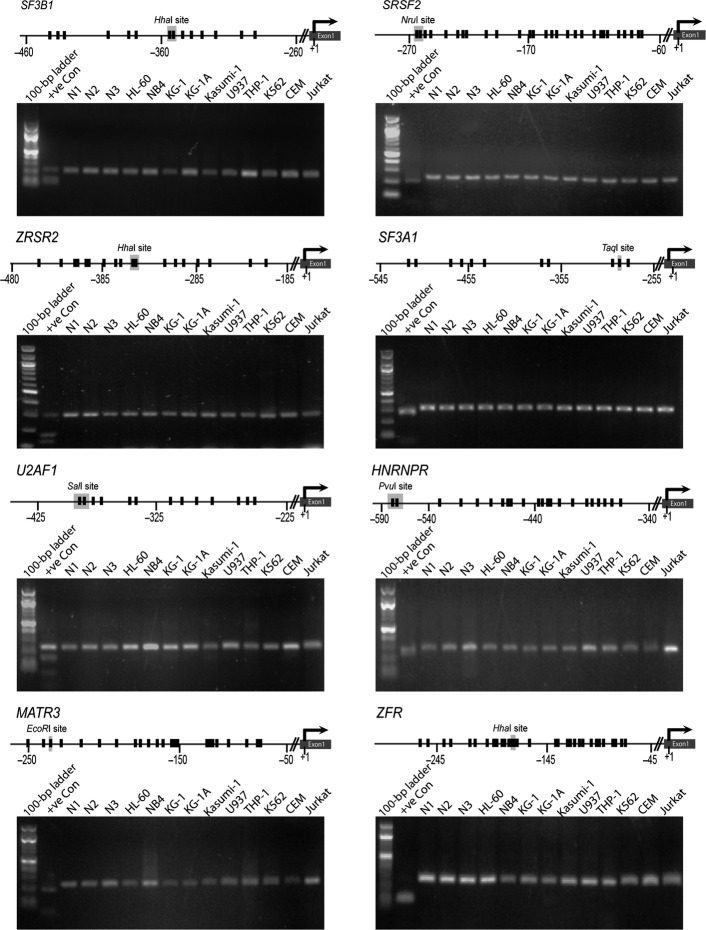
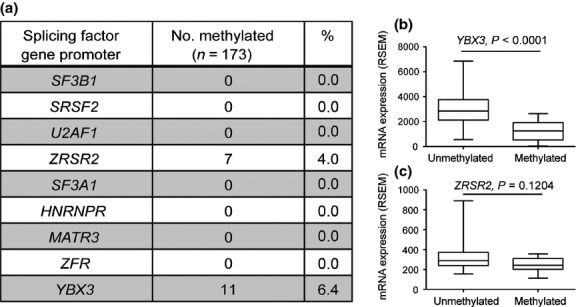
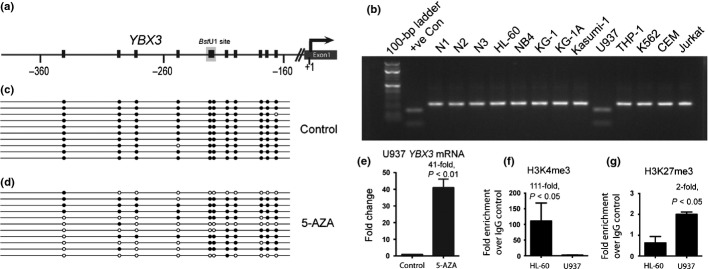
Somatic mutations in splicing factor genes have frequently been reported in myelodysplastic syndromes (MDS) and acute myeloid leukemia (AML). Although aberrant epigenetic changes are frequently implicated in blood cancers, their direct role in suppressing one or both alleles of critical splicing factors has not been previously examined. Here, we examined promoter DNA hypermethylation of nine splicing factors, SF3B1, SRSF2, U2AF1, ZRSR2, SF3A1, HNRNPR, MATR3, ZFR, and YBX3 in 10 leukemic cell lines and 94 MDS or AML patient samples from the Australasian Leukemia and Lymphoma Group Tissue Bank. The only evidence of epigenetic effects was hypermethylation of the YBX3 promoter in U937 cells in conjunction with an enrichment of histone marks associated with gene silencing. In silico analysis of DNA methylation data for 173 AML samples generated by the Cancer Genome Atlas Research Network revealed promoter hypermethylation of the gene encoding Y box binding protein 3, YBX3, in 11/173 (6.4%) AML cases, which was significantly associated with reduced mRNA expression (P < 0.0001). Hypermethylation of the ZRSR2 promoter was also detected in 7/173 (4%) cases but was not associated with decreased mRNA expression (P = 0.1204). Hypermethylation was absent at the promoter of seven other splicing factor genes in all cell lines and patient samples examined. We conclude that DNA hypermethylation does not frequently silence splicing factors in MDS and AML. However, in the case of YBX3, promoter hypermethylation-induced downregulation may contribute to the pathogenesis or maintenance of AML.
剪接因子基因的体细胞突变在骨髓增生异常综合征(MDS)和急性髓系白血病(AML)中屡有报道。尽管异常的表观遗传变化常与血液系统癌症相关,但其在抑制关键剪接因子的一个或两个等位基因方面的直接作用此前尚未得到研究。在此,我们检测了来自澳大利亚白血病和淋巴瘤组织库的10种白血病细胞系以及94份MDS或AML患者样本中9种剪接因子SF3B1、SRSF2、U2AF1、ZRSR2、SF3A1、HNRNPR、MATR3、ZFR和YBX3的启动子DNA高甲基化情况。表观遗传效应的唯一证据是U937细胞中YBX3启动子的高甲基化,同时伴有与基因沉默相关的组蛋白标记富集。对癌症基因组图谱研究网络生成的173份AML样本的DNA甲基化数据进行的计算机分析显示,在11/173(6.4%)的AML病例中,编码Y盒结合蛋白3(YBX3)的基因启动子存在高甲基化,这与mRNA表达降低显著相关(P < 0.0001)。在7/173(4%)的病例中也检测到ZRSR2启动子的高甲基化,但与mRNA表达降低无关(P = 0.1204)。在所检测的所有细胞系和患者样本中,其他7种剪接因子基因的启动子均未出现高甲基化。我们得出结论,DNA高甲基化在MDS和AML中并不常导致剪接因子沉默。然而,就YBX3而言,启动子高甲基化诱导的下调可能有助于AML的发病机制或维持。