Wlodarczyk Marcin, Rudnicka Wieslawa, Janiszewska-Drobinska Beata, Kielnierowski Grzegorz, Kowalewicz-Kulbat Magdalena, Fol Marek, Druszczynska Magdalena
Department of Immunology and Infectious Biology, Institute of Microbiology, Biotechnology and Immunology, Faculty of Biology and Environmental Protection, University of Lodz, Lodz, Poland.
Regional Specialised Hospital of Tuberculosis, Lung Diseases and Rehabilitation, Tuszyn, Poland.
PLoS One. 2014 Sep 15;9(9):e107208. doi: 10.1371/journal.pone.0107208. eCollection 2014.
Early diagnosis of infectious cases and treatment of tuberculosis (TB) are important strategies for reducing the incidence of this disease. Unfortunately, traditional TB diagnostic methods are time-consuming and often unreliable. This study compared the accuracy and reliability of the tuberculin skin test (TST) and interferon (IFN)-γ-based assay (IGRA) for the diagnosis of active pulmonary TB Polish cases that could or could not be confirmed by M. tuberculosis (M.tb) culture.
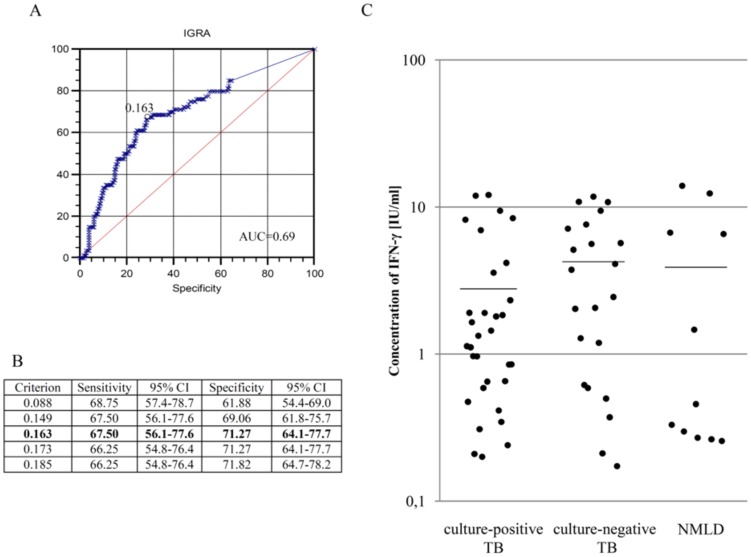
In total, 126 adult patients with clinically active TB or non-mycobacterial, community-acquired lung diseases (NMLD) hospitalised at the Regional Specialised Hospital of Tuberculosis, Lung Diseases and Rehabilitation in Tuszyn, Poland were enrolled in the present study. Sensitivity, specificity, positive predicted value (PPV), negative predicted value (NPV), and analytic accuracy (Acc) of TST and IGRA testing for the diagnosis of culture-positive and culture-negative TB patients were calculated. The quantities of IFN-γ produced in the response to M.tb specific antigens (TB Ag - Nil) in the cultures of blood from patients with active TB and NMLD patients were also analysed.
The IGRA sensitivity in culture-positive and culture-negative TB patients was similar, measuring 65.1% and 55.6%, respectively. The sensitivity of TST did not differ from the parameters designated for IGRA, measuring 55.8% in culture-positive and 64.9% in culture-negative TB. The sensitivity of TST and IGRA was age-dependent and decreased significantly with the age of the patients. No differences in the frequency or intensity of M.tb-stimulated IFN-γ production, as assessed by IGRA testing between culture-positive and culture-negative TB were noticed. Significantly lower concentrations of IFN-γ were observed in patients with advanced TB forms compared with those with mild or moderate TB pathologies.
Our results do not show that a combination of IGRA and TST might be a step forward in the diagnosis of culture-negative TB cases. However, M. tuberculosis-stimulated IFN-γ levels might help to assess the extent of pulmonary TB lesions.
早期诊断感染病例和治疗结核病是降低该疾病发病率的重要策略。不幸的是,传统的结核病诊断方法耗时且往往不可靠。本研究比较了结核菌素皮肤试验(TST)和基于干扰素(IFN)-γ的检测(IGRA)对波兰活动性肺结核病例的诊断准确性和可靠性,这些病例可通过结核分枝杆菌(M.tb)培养确诊或无法确诊。
本研究共纳入了126例成年患者,这些患者因临床活动性肺结核或非分枝杆菌性社区获得性肺部疾病(NMLD)在波兰图申的地区结核病、肺部疾病和康复专科医院住院。计算了TST和IGRA检测对培养阳性和培养阴性肺结核患者诊断的敏感性、特异性、阳性预测值(PPV)、阴性预测值(NPV)和分析准确性(Acc)。还分析了活动性肺结核患者和NMLD患者血液培养物中对M.tb特异性抗原(TB Ag - Nil)反应产生的IFN-γ量。
IGRA对培养阳性和培养阴性肺结核患者的敏感性相似,分别为65.1%和55.6%。TST的敏感性与IGRA指定的参数无差异,培养阳性肺结核患者中为55.8%,培养阴性肺结核患者中为64.9%。TST和IGRA的敏感性与年龄有关,且随患者年龄显著降低。通过IGRA检测,培养阳性和培养阴性肺结核之间在M.tb刺激的IFN-γ产生频率或强度上未发现差异。与轻度或中度肺结核病变患者相比,晚期肺结核患者中观察到的IFN-γ浓度显著更低。
我们的结果并未表明IGRA和TST联合使用可能是诊断培养阴性肺结核病例的一个进步。然而,结核分枝杆菌刺激的IFN-γ水平可能有助于评估肺结核病变的程度。