Saeed Munazza, Brewer Lester, Johnston Jason, McGhie Tony K, Gardiner Susan E, Heyes Julian A, Chagné David
BMC Plant Biol. 2014 Sep 16;14:241. doi: 10.1186/s12870-014-0241-3.
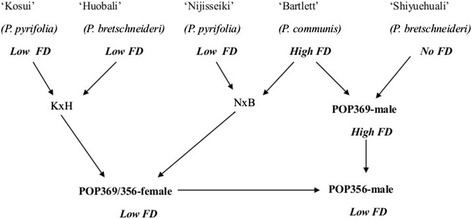
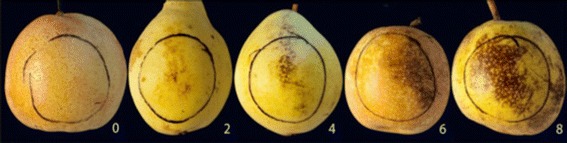
The unattractive appearance of the surface of pear fruit caused by the postharvest disorder friction discolouration (FD) is responsible for significant consumer dissatisfaction in markets, leading to lower returns to growers. Developing an understanding of the genetic control of FD is essential to enable the full application of genomics-informed breeding for the development of new pear cultivars. Biochemical constituents [phenolic compounds and ascorbic acid (AsA)], polyphenol oxidase (PPO) activity, as well as skin anatomy, have been proposed to play important roles in FD susceptibility in studies on a limited number of cultivars. However, to date there has been no investigation on the biochemical and genetic control of FD, employing segregating populations. In this study, we used 250 seedlings from two segregating populations (POP369 and POP356) derived from interspecific crosses between Asian (Pyrus pyrifolia Nakai and P. bretschneideri Rehd.) and European (P. communis) pears to identify genetic factors associated with susceptibility to FD.
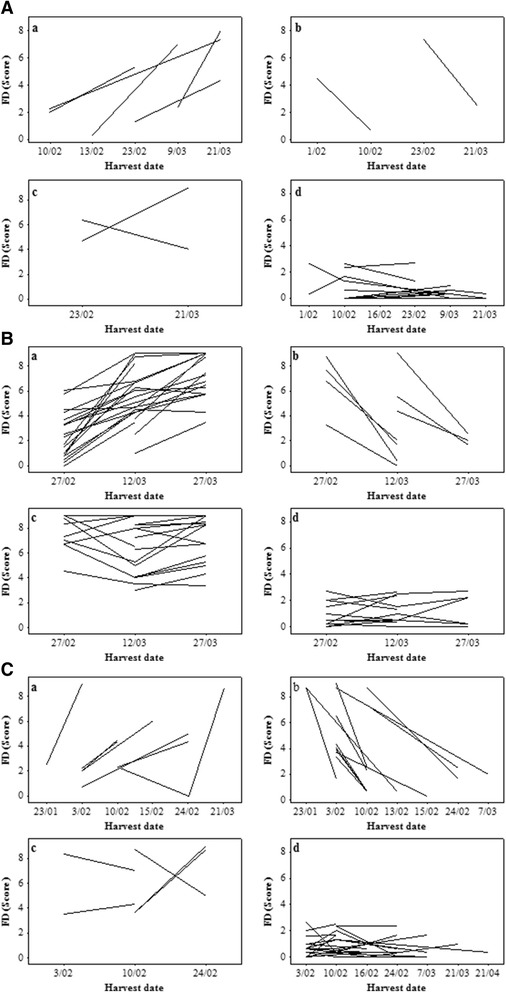
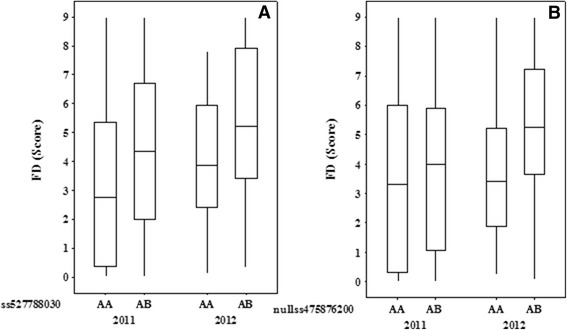
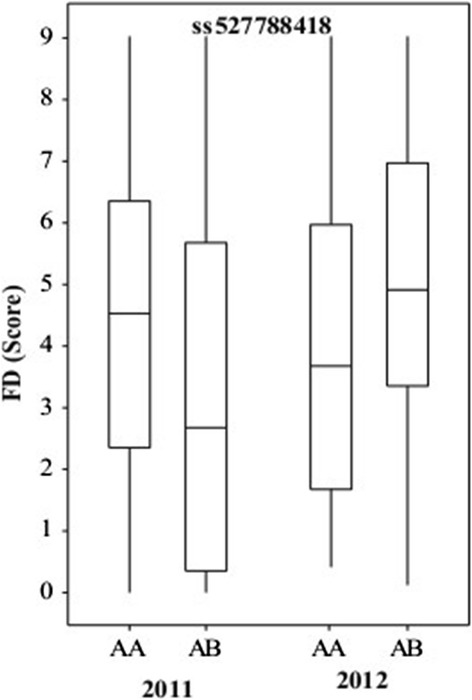
Single nucleotide polymorphism (SNP)-based linkage maps suitable for QTL analysis were developed for the parents of both populations. The maps for population POP369 comprised 174 and 265 SNP markers for the male and female parent, respectively, while POP356 maps comprised 353 and 398 SNP markers for the male and female parent, respectively. Phenotypic data for 22 variables were measured over two successive years (2011 and 2012) for POP369 and one year (2011) only for POP356. A total of 221 QTLs were identified that were linked to 22 phenotyped variables, including QTLs associated with FD for both populations that were stable over the successive years. In addition, clear evidence of the influence of developmental factors (fruit maturity) on FD and other variables was also recorded.
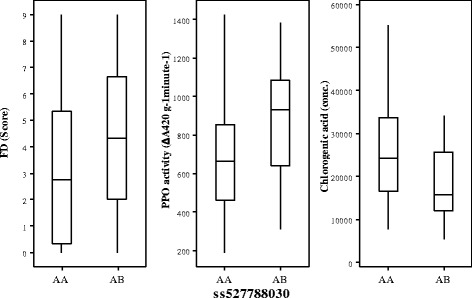
The QTLs associated with fruit firmness, PPO activity, AsA concentration and concentration of polyphenol compounds as well as FD are the first reported for pear. We conclude that the postharvest disorder FD is controlled by multiple small effect QTLs and that it will be very challenging to apply marker-assisted selection based on these QTLs. However, genomic selection could be employed to select elite genotypes with lower or no susceptibility to FD early in the breeding cycle.
采后失调摩擦变色(FD)导致梨果表面外观不佳,这在市场上引起了消费者的极大不满,导致种植者收益降低。了解FD的遗传控制对于全面应用基因组学辅助育种来培育新梨品种至关重要。在对少数品种的研究中,生化成分[酚类化合物和抗坏血酸(AsA)]、多酚氧化酶(PPO)活性以及果皮解剖结构被认为在FD易感性中起重要作用。然而,迄今为止,尚未利用分离群体对FD的生化和遗传控制进行研究。在本研究中,我们使用了来自亚洲梨(Pyrus pyrifolia Nakai和P. bretschneideri Rehd.)与欧洲梨(P. communis)种间杂交产生的两个分离群体(POP369和POP356)的250株幼苗,以鉴定与FD易感性相关的遗传因素。
为两个群体的亲本构建了适用于QTL分析的基于单核苷酸多态性(SNP)的连锁图谱。群体POP369的图谱中,父本和母本分别包含174和265个SNP标记,而POP356的图谱中,父本和母本分别包含353和398个SNP标记。对POP369连续两年(2011年和2012年)以及仅对POP356一年(2011年)测量了22个变量的表型数据。共鉴定出221个与22个表型变量相关的QTL,包括两个群体中与FD相关且多年稳定的QTL。此外,还记录了发育因素(果实成熟度)对FD和其他变量影响的明确证据。
与果实硬度、PPO活性、AsA浓度、多酚化合物浓度以及FD相关的QTL是首次在梨中报道。我们得出结论,采后失调FD由多个微效QTL控制,基于这些QTL进行标记辅助选择将极具挑战性。然而,基因组选择可用于在育种周期早期选择对FD敏感性较低或无敏感性的优良基因型。