Resnicow Ken, Zhou Yan, Hawley Sarah, Jimbo Masahito, Ruffin Mack T, Davis Rachel E, Shires Deirdre, Lafata Jennifer Elston
University of Michigan School of Public Health, Department of Health Behavior & Health Education, Ann Arbor, USA.
University of Michigan, Ann Arbor, USA.
Patient Educ Couns. 2014 Dec;97(3):370-5. doi: 10.1016/j.pec.2014.08.013. Epub 2014 Sep 3.
Test the impact of tailoring CRC screening messages for African Americans (AAs) using novel theoretical variables and to examine moderating effect of communication preferences.
Participants were randomized to receive two minimally tailored or two enhanced tailored print newsletters addressing CRC. The enhanced intervention was tailored on Self-Determination Theory and other novel psychological constructs. Minimal tailoring only used information available in the patient's EHR. The primary outcome was CRC screening based on EHR. Participants were AA members aged 50-74 of an integrated health care delivery system not up to date on CRC screening.
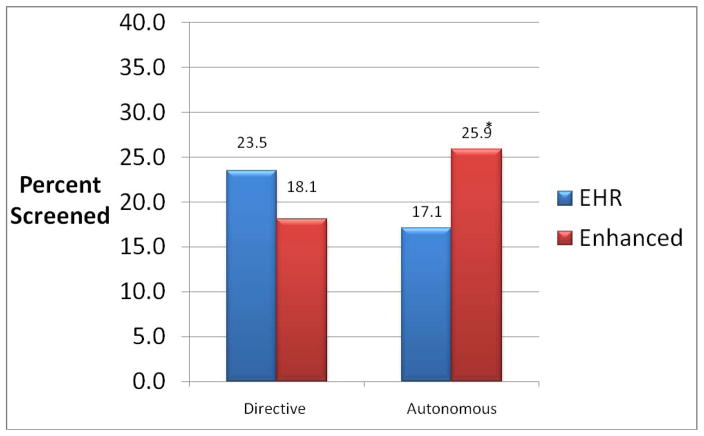
We enrolled 881 participants. CRC screening participation rates at 1-year follow up were 20.5% and 21.5% in the minimally and enhanced tailored groups, respectively. Communication preferences moderated the impact of the intervention. Specifically, among those with an autonomous communication preference, screening rates in the minimally and enhanced tailored groups were 17.1% and 25.9%, respectively, while no intervention effect was evident among those with a directive preference.
Future research is needed to explore the impact of communication preference tailoring for other health behaviors and among other populations.
Tailored communications should consider communication style preference to help guide the content and tone of messages.
使用新的理论变量测试为非裔美国人(AA)量身定制结直肠癌(CRC)筛查信息的影响,并检验沟通偏好的调节作用。
参与者被随机分为两组,分别接收两份针对CRC的最低限度量身定制或两份强化量身定制的印刷时事通讯。强化干预是根据自我决定理论和其他新的心理结构量身定制的。最低限度的量身定制仅使用患者电子健康记录(EHR)中可用的信息。主要结局是基于EHR的CRC筛查。参与者是综合医疗保健系统中年龄在50 - 74岁且未进行CRC筛查的AA成员。
我们招募了881名参与者。在1年随访时,最低限度量身定制组和强化量身定制组的CRC筛查参与率分别为20.5%和21.5%。沟通偏好调节了干预的影响。具体而言,在具有自主沟通偏好的人群中,最低限度量身定制组和强化量身定制组的筛查率分别为17.1%和25.9%,而在具有指令性偏好的人群中未观察到干预效果。
未来需要进行研究,以探索针对其他健康行为和其他人群量身定制沟通偏好的影响。
量身定制的沟通应考虑沟通风格偏好,以帮助指导信息的内容和语气。