Hartley Taila, Cavallone Luca, Sabbaghian Nelly, Silva-Smith Rachel, Hamel Nancy, Aleynikova Olga, Smith Erika, Hastings Valerie, Pinto Pedro, Tischkowitz Marc, Tomiak Eva, Foulkes William D
Department of Genetics, Children's Hospital of Eastern Ontario, 401 Smyth Rd, K1H 8 L1 Ottawa, ON, Canada.
Program in Cancer Genetics, Departments of Oncology and Human Genetics, Gerald Bronfman Centre for Clinical Research in Oncology, McGill University, Montreal, QC, Canada ; Lady Davis Institute, Segal Cancer Centre, Jewish General Hospital, McGill University, Montreal, QC, Canada.
Hered Cancer Clin Pract. 2014 Aug 28;12(1):19. doi: 10.1186/1897-4287-12-19. eCollection 2014.
PALB2 has emerged as a breast cancer susceptibility gene. Mutations in PALB2 have been identified in almost all breast cancer populations studied to date, but the rarity of these mutations and lack of information regarding their penetrance makes genetic counseling for these families challenging. We studied BRCA1/2 -negative breast and/or ovarian cancer families to a) assess the contribution of PALB2 mutations in this series and b) identify clinical, pathological and family history characteristics that might make PALB2 screening more efficient.
The coding region of the PALB2 gene was analyzed in 175 probands with family histories of breast and/or ovarian cancer ascertained from a single Canadian institution in Eastern Ontario.
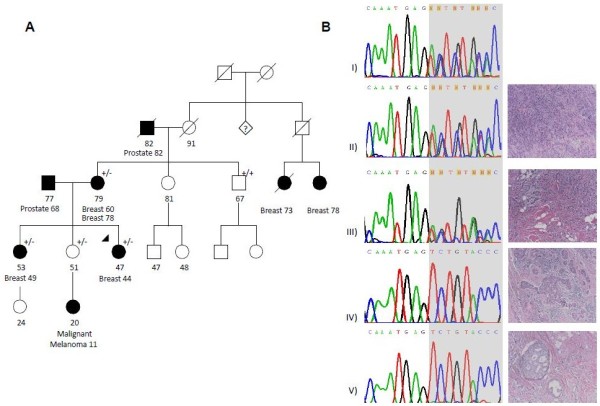
We identified 2 probands with PALB2 mutations that are known or strongly considered to be pathogenic and 3 probands with missense mutations that are possibly pathogenic. One of the identified truncating mutations [c.3113G > A (p.Gly1000_Trp1038del - major product)], has been previously described while the other four mutations [c.3507_3508delTC (p.H1170Ffs*19), c.1846G > C (p.D616H), c.3418 T > G (p.W1140G), c.3287A > G (p.N1096S)] have not been previously reported. Loss of heterozygosity was detected in two breast tumors from one c.3507_3508delTC mutation carrier but not in other available tumors from that family or in tumors from carriers of other mutations.
PALB2 mutation screening identifies a small, but significant number of mutations in BRCA1/2 -negative breast and/or ovarian cancer families. We show that mutations are more likely to be found in families with three or more breast cancers as well as other BRCA2-related cancers. In our cohort, both clearly pathogenic mutations were identified in premenopausal breast cancer cases (2/77, 2.6%). Testing should be preferentially offered to affected women from such families.
PALB2已成为一种乳腺癌易感基因。迄今为止,在几乎所有研究的乳腺癌人群中都发现了PALB2的突变,但这些突变罕见且缺乏关于其外显率的信息,这使得为这些家族提供遗传咨询具有挑战性。我们对BRCA1/2基因阴性的乳腺癌和/或卵巢癌家族进行了研究,以a)评估该系列中PALB2突变的贡献,以及b)确定可能使PALB2筛查更有效的临床、病理和家族史特征。
对来自安大略省东部一家加拿大机构确诊的175名有乳腺癌和/或卵巢癌家族史的先证者进行了PALB2基因编码区分析。
我们鉴定出2名携带已知或强烈怀疑为致病性的PALB2突变的先证者,以及3名携带可能致病性错义突变的先证者。其中一个已鉴定的截短突变[c.3113G>A(p.Gly1000_Trp1038del - 主要产物)]此前已有描述,而其他四个突变[c.3507_3508delTC(p.H1170Ffs*19)、c.1846G>C(p.D616H)、c.3418 T>G(p.W1140G)、c.3287A>G(p.N1096S)]此前尚未见报道。在一名携带c.3507_3508delTC突变的患者的两个乳腺肿瘤中检测到杂合性缺失,但在该家族的其他可用肿瘤或其他突变携带者的肿瘤中未检测到。
PALB2突变筛查在BRCA1/2基因阴性的乳腺癌和/或卵巢癌家族中鉴定出了少量但数量可观的突变。我们发现,在有三个或更多乳腺癌以及其他与BRCA有关的癌症的家族中更有可能发现突变。在我们的队列中,两个明确的致病性突变均在绝经前乳腺癌病例中鉴定出(2/77,2.6%)。应优先为来自此类家族的患病女性提供检测。