Roth Theodore L, Milenkovic Ljiljana, Scott Matthew P
Departments of Developmental Biology, Genetics, Bioengineering, & Biology, Stanford University School of Medicine, Stanford, California, United States of America.
PLoS One. 2014 Sep 16;9(9):e107329. doi: 10.1371/journal.pone.0107329. eCollection 2014.
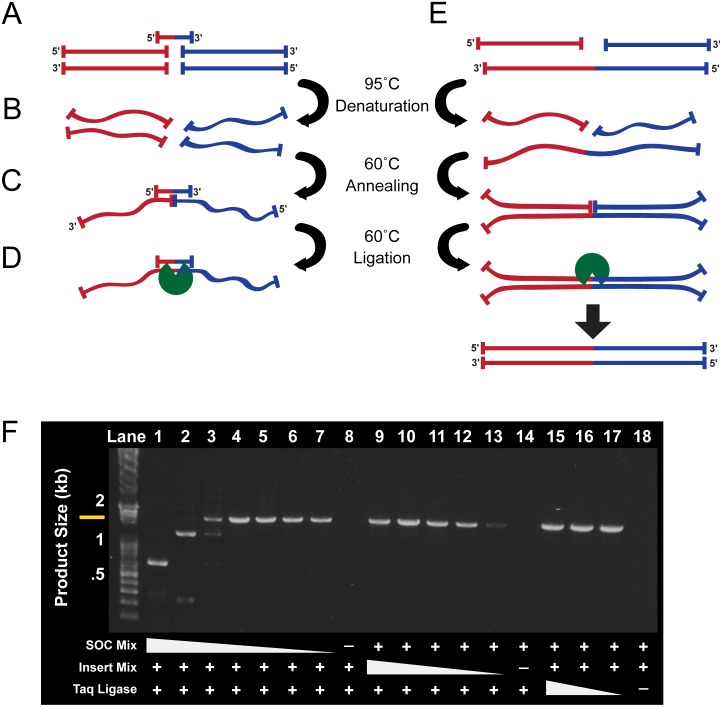
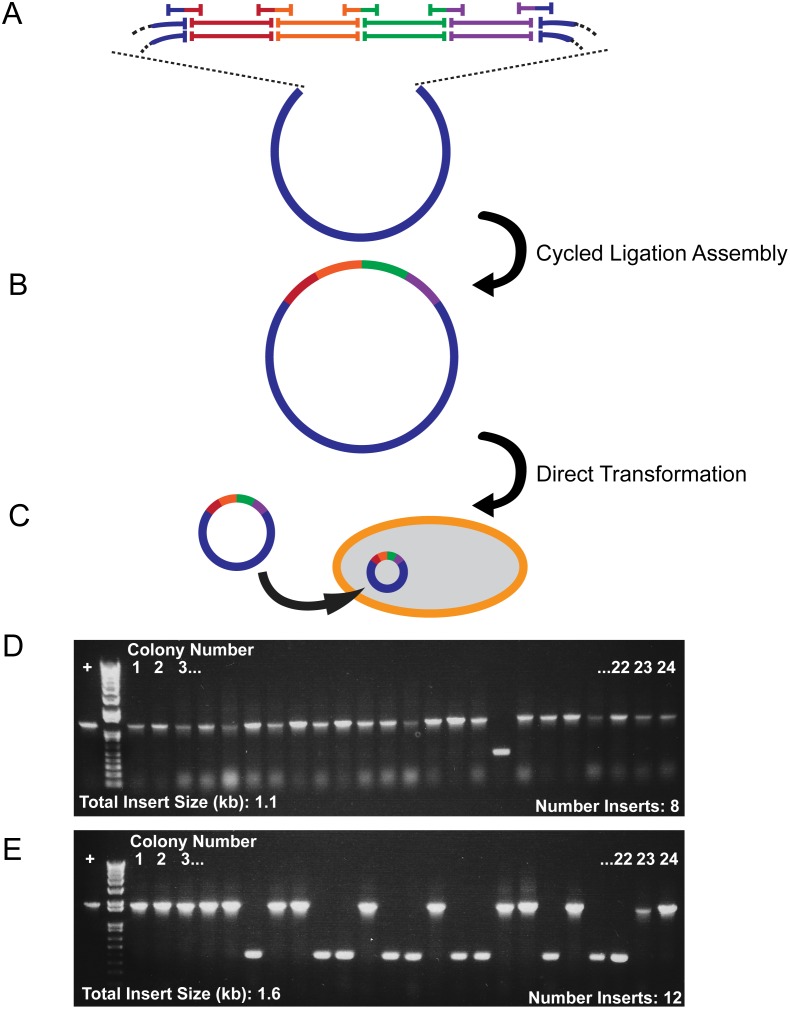
DNA assembly techniques have developed rapidly, enabling efficient construction of complex constructs that would be prohibitively difficult using traditional restriction-digest based methods. Most of the recent methods for assembling multiple DNA fragments in vitro suffer from high costs, complex set-ups, and diminishing efficiency when used for more than a few DNA segments. Here we present a cycled ligation-based DNA assembly protocol that is simple, cheap, efficient, and powerful. The method employs a thermostable ligase and short Scaffold Oligonucleotide Connectors (SOCs) that are homologous to the ends and beginnings of two adjacent DNA sequences. These SOCs direct an exponential increase in the amount of correctly assembled product during a reaction that cycles between denaturing and annealing/ligating temperatures. Products of early cycles serve as templates for later cycles, allowing the assembly of many sequences in a single reaction. To demonstrate the method's utility, we directed the assembly of twelve inserts, in one reaction, into a transformable plasmid. All the joints were precise, and assembly was scarless in the sense that no nucleotides were added or missing at junctions. Simple, efficient, and low-cost cycled ligation assemblies will facilitate wider use of complex genetic constructs in biomedical research.
DNA组装技术发展迅速,能够高效构建复杂的构建体,而使用传统的基于限制性消化的方法构建这些构建体难度极大。最近大多数体外组装多个DNA片段的方法都存在成本高、设置复杂以及用于多个DNA片段时效率降低的问题。在此,我们提出一种基于循环连接的DNA组装方案,该方案简单、廉价、高效且功能强大。该方法使用一种热稳定连接酶和短的支架寡核苷酸连接子(SOC),它们与两个相邻DNA序列的末端和起始部分同源。在变性温度和退火/连接温度之间循环的反应过程中,这些SOC会使正确组装产物的量呈指数增加。早期循环的产物作为后期循环的模板,从而能够在一个反应中组装多个序列。为证明该方法的实用性,我们在一个反应中将十二个插入片段组装到一个可转化的质粒中。所有接头都很精确,从连接处没有添加或缺失核苷酸的意义上来说,组装是无痕的。简单、高效且低成本的循环连接组装将有助于在生物医学研究中更广泛地使用复杂的基因构建体。