Margolin W, Rao G, Howe M M
Department of Bacteriology, University of Wisconsin-Madison 53706.
J Bacteriol. 1989 Apr;171(4):2003-18. doi: 10.1128/jb.171.4.2003-2018.1989.
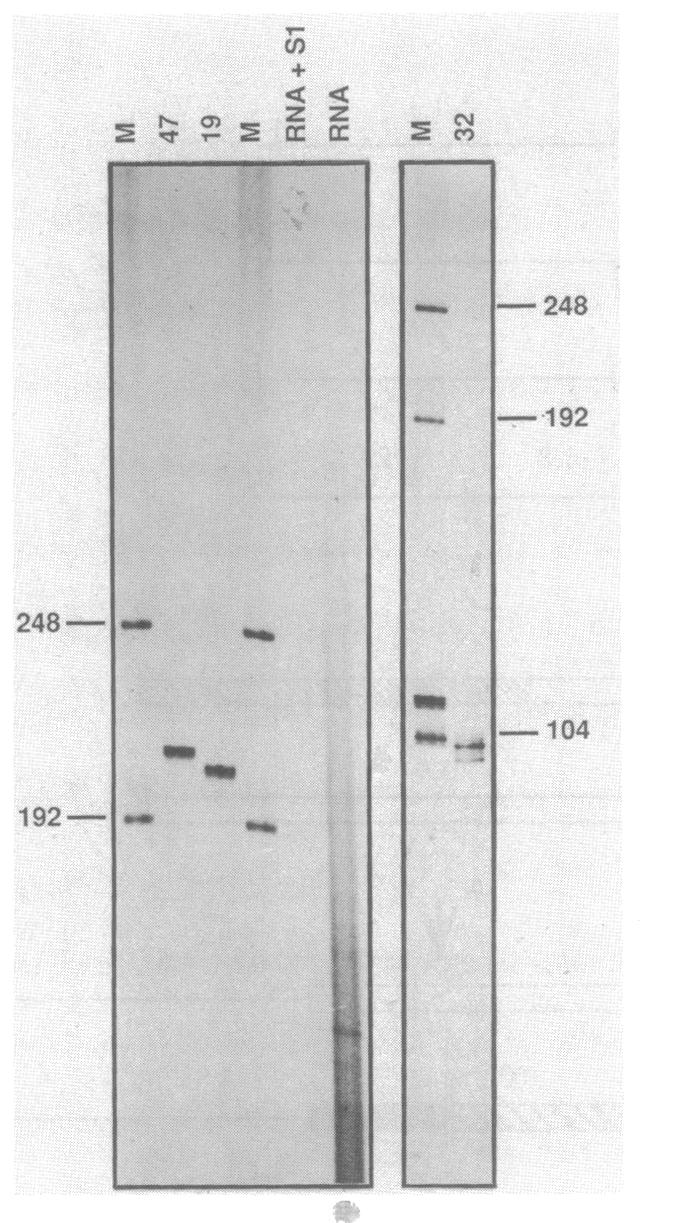
Late transcription of bacteriophage Mu, which results in the expression of phage morphogenetic functions, is dependent on Mu C protein. Earlier experiments indicated that Mu late RNAs originate from four promoters, including the previously characterized mom promoter. S1 nuclease protection experiments were used to map RNA 5' ends in the three new regions. Transcripts were initiated at these points only in the presence of C and were synthesized in a rightward direction on the Mu genome. Amber mutant marker rescue analysis of plasmid clones and limited DNA sequencing demonstrated that these new promoters are located between C and lys, upstream of I, and upstream of P within the N gene. A comparison of the promoter sequences upstream from the four RNA 5' ends yielded two conserved sequences: the first (tA . . cT, where capital and lowercase letters indicate 100 and 75% base conservation, respectively), at approximately -10, shares some similarity with the consensus Escherichia coli sigma 70 -10 region, while the second (ccATAAc CcCPuG/Cac, where Pu indicates a purine), in the -35 region, bears no resemblance to the E. coli -35 consensus. We propose that these conserved Mu late promoter consensus sequences are important for C-dependent promoter activity. Plasmids containing transcription fusions of these late promoters to lacZ exhibited C-dependent beta-galactosidase synthesis in vivo, and C was the only Mu product needed for this transactivation. As expected, the late promoter-lacZ fusions were activated only at late times after induction of a Mu prophage. The C-dependent activation of lacZ fusions containing only a few bases of the 5' end of Mu late RNA and the presence of altered promoter sequences imply that C acts at the level of transcription initiation.
噬菌体Mu的晚期转录导致噬菌体形态发生功能的表达,它依赖于Mu C蛋白。早期实验表明,Mu晚期RNA源自四个启动子,包括先前已鉴定的mom启动子。利用S1核酸酶保护实验来定位三个新区域中的RNA 5'末端。转录仅在有C存在时于这些位点起始,并在Mu基因组上向右合成。对质粒克隆进行琥珀突变体标记拯救分析和有限的DNA测序表明,这些新启动子位于C和lys之间、I上游以及N基因内P的上游。对四个RNA 5'末端上游的启动子序列进行比较,得到了两个保守序列:第一个(tA..cT,大写和小写字母分别表示100%和75%的碱基保守性),大约在-10处,与大肠杆菌σ70的-10共有序列有一些相似性,而第二个(ccATAAc CcCPuG/Cac,其中Pu表示嘌呤),在-35区域,与大肠杆菌的-35共有序列没有相似之处。我们认为这些保守的Mu晚期启动子共有序列对依赖C的启动子活性很重要。含有这些晚期启动子与lacZ转录融合的质粒在体内表现出依赖C的β-半乳糖苷酶合成,并且C是这种反式激活所需的唯一Mu产物。正如预期的那样,晚期启动子-lacZ融合仅在Mu原噬菌体诱导后的晚期被激活。含有仅Mu晚期RNA 5'末端几个碱基的lacZ融合的C依赖激活以及启动子序列的改变表明,C在转录起始水平起作用。