Tamás Gertrúd, Gulácsi László, Bereczki Dániel, Baji Petra, Takáts Annamária, Brodszky Valentin, Péntek Márta
Department of Neurology, Semmelweis University, Budapest, Hungary.
Department of Health Economics, Corvinus University of Budapest, Budapest, Hungary.
PLoS One. 2014 Sep 17;9(9):e107704. doi: 10.1371/journal.pone.0107704. eCollection 2014.
Patient reported outcomes and costs of illness are useful to capture some of the multiple effects of a disease and its treatments. Our aim was to assess quality of life (QoL) and costs of Parkinson's disease (PD) in Hungary, and to analyze their associations.
A cross-sectional questionnaire survey was conducted in one neurology university clinic. Clinical characteristics, PD related resource utilizations and productivity loss in the past 12 months were recorded; the Hoehn&Yahr (HY) scale, PDQ-39 and EQ-5D questionnaires were applied. Cost calculation was performed from the societal perspective.
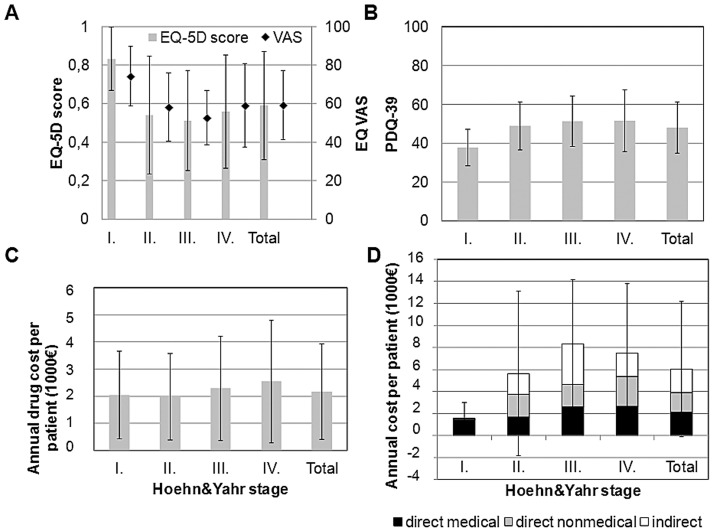
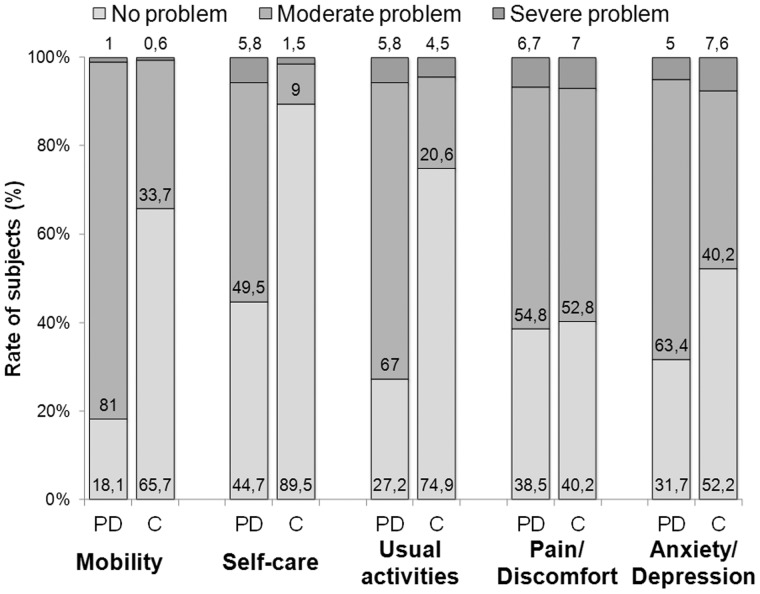
110 patients (34.5% female) were involved with mean age of 63.3 (SD=11.3) and disease duration of 8.2 (SD=5.8) years. PDQ-39 summary score was 48.1 (SD=13.4). The average EQ-5D score was 0.59 (SD=0.28), and was significantly lower than the population norm in age-groups 45-74. The correlation was significant between EQ-5D and PDQ-39 (-0.47, p=0.000), the HY scale and EQ-5D (-0.3416, p=0.0008) and PDQ-39 (0.3419, p=0.0006) scores. The total mean cost was €6030.2 (SD=6163.0)/patient/year (direct medical 35.7%, direct non-medical 29.4%, indirect cost 34.9%). A one year increase in disease duration and 0.1 decrease of the EQ-5D utility score increase the yearly costs by 8 to 10%, and 7.8%, respectively. The effect of the PDQ-39 score on total cost was not significant.
Disease severity and public health importance of PD are clearly demonstrated by the magnitude of QoL loss. PD-related costs are substantial, but are much lower in Hungary than in Western European countries. Disease duration and EQ-5D score are significant proxy of costs.
患者报告的疾病结局和成本有助于了解疾病及其治疗的多种影响。我们的目的是评估匈牙利帕金森病(PD)的生活质量(QoL)和成本,并分析它们之间的关联。
在一家大学神经科诊所进行了一项横断面问卷调查。记录了临床特征、过去12个月中与PD相关的资源利用情况和生产力损失;应用了Hoehn&Yahr(HY)量表、PDQ-39和EQ-5D问卷。从社会角度进行成本计算。
纳入110例患者(女性占34.5%),平均年龄63.3岁(标准差=11.3),病程8.2年(标准差=5.8)。PDQ-39总分是48.1(标准差=13.4)。EQ-5D平均得分为0.59(标准差=0.28),显著低于45-74岁年龄组的人群均值。EQ-5D与PDQ-39之间的相关性显著(-0.47,p=0.000),HY量表与EQ-5D之间的相关性显著(-0.3416,p=0.0008),与PDQ-39之间的相关性也显著(0.3419,p=0.0006)。总平均成本为6030.2欧元(标准差=6163.0)/患者/年(直接医疗成本占35.7%,直接非医疗成本占29.4%,间接成本占34.9%)。病程每增加1年,EQ-5D效用得分每降低0.1,每年成本分别增加8%至10%和7.8%。PDQ-39得分对总成本的影响不显著。
生活质量损失的程度清楚地表明了帕金森病的疾病严重程度和公共卫生重要性。与帕金森病相关的成本很高,但匈牙利的成本远低于西欧国家。病程和EQ-5D得分是成本的重要替代指标。