Chammartin Frédérique, Guimarães Luiz H, Scholte Ronaldo Gc, Bavia Mara E, Utzinger Jürg, Vounatsou Penelope
Department of Epidemiology and Public Health, Swiss Tropical and Public Health Institute, P,O, Box, CH-4002 Basel, Switzerland.
Parasit Vectors. 2014 Sep 18;7:440. doi: 10.1186/1756-3305-7-440.
In Brazil, preventive chemotherapy targeting soil-transmitted helminthiasis is being scaled-up. Hence, spatially explicit estimates of infection risks providing information about the current situation are needed to guide interventions. Available high-resolution national model-based estimates either rely on analyses of data restricted to a given period of time, or on historical data collected over a longer period. While efforts have been made to take into account the spatial structure of the data in the modelling approach, little emphasis has been placed on the temporal dimension.
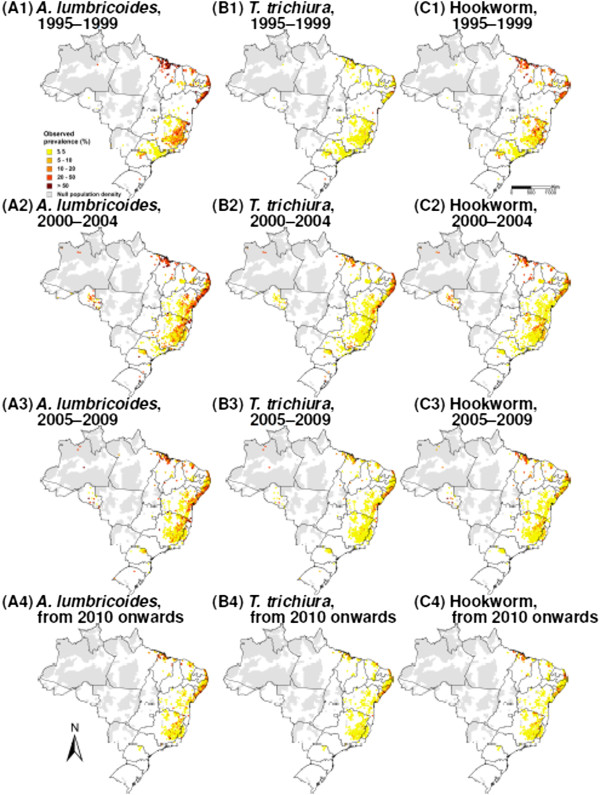
We extracted georeferenced survey data on the prevalence of infection with soil-transmitted helminths (i.e. Ascaris lumbricoides, hookworm and Trichuris trichiura) in Brazil from the Global Neglected Tropical Diseases (GNTD) database. Selection of the most important predictors of infection risk was carried out using a Bayesian geostatistical approach and temporal models that address non-linearity and correlation of the explanatory variables. The spatial process was estimated through a predictive process approximation. Spatio-temporal models were built on the selected predictors with integrated nested Laplace approximation using stochastic partial differential equations.
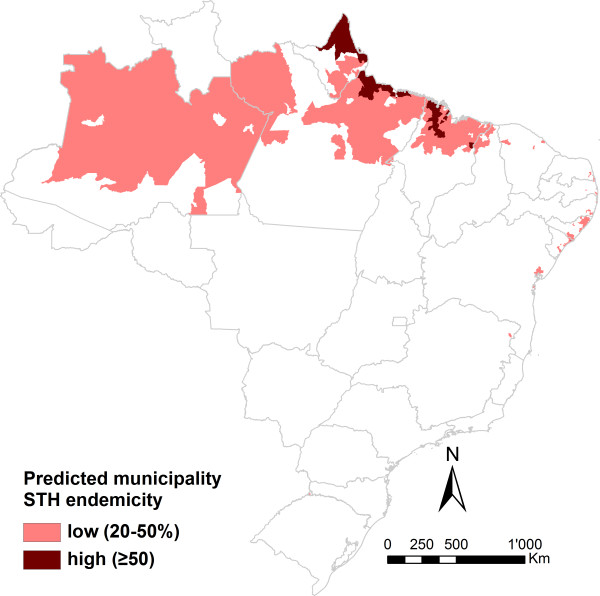
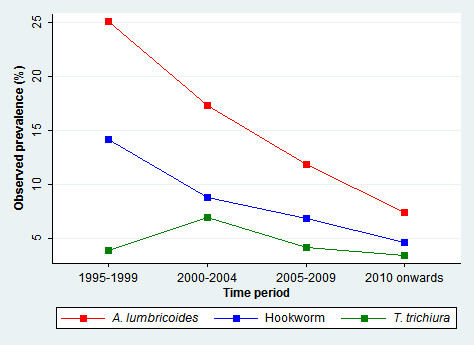
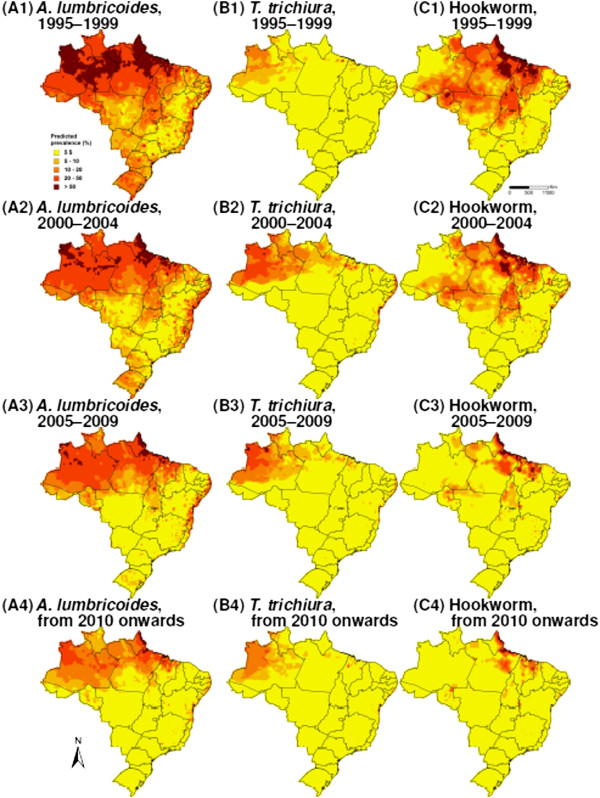
Our models revealed that, over the past 20 years, the risk of soil-transmitted helminth infection has decreased in Brazil, mainly because of the reduction of A. lumbricoides and hookworm infections. From 2010 onwards, we estimate that the infection prevalences with A. lumbricoides, hookworm and T. trichiura are 3.6%, 1.7% and 1.4%, respectively. We also provide a map highlighting municipalities in need of preventive chemotherapy, based on a predicted soil-transmitted helminth infection risk in excess of 20%. The need for treatments in the school-aged population at the municipality level was estimated at 1.8 million doses of anthelminthic tablets per year.
The analysis of the spatio-temporal aspect of the risk of infection with soil-transmitted helminths contributes to a better understanding of the evolution of risk over time. Risk estimates provide the soil-transmitted helminthiasis control programme in Brazil with useful benchmark information for prioritising and improving spatial and temporal targeting of interventions.
在巴西,针对土壤传播蠕虫病的预防性化疗正在扩大规模。因此,需要对感染风险进行空间明确的估计,以提供有关当前状况的信息,从而指导干预措施。现有的基于高分辨率国家模型的估计要么依赖于对特定时间段内数据的分析,要么依赖于较长时间内收集的历史数据。虽然在建模方法中已努力考虑数据的空间结构,但很少强调时间维度。
我们从全球被忽视热带病(GNTD)数据库中提取了巴西土壤传播蠕虫(即蛔虫、钩虫和鞭虫)感染率的地理参考调查数据。使用贝叶斯地理统计方法和处理解释变量的非线性和相关性的时间模型来选择感染风险的最重要预测因子。通过预测过程近似估计空间过程。使用随机偏微分方程,基于选定的预测因子,通过集成嵌套拉普拉斯近似建立时空模型。
我们的模型显示,在过去20年中,巴西土壤传播蠕虫感染风险有所下降,主要是因为蛔虫和钩虫感染减少。从2010年起,我们估计蛔虫、钩虫和鞭虫的感染率分别为3.6%、1.7%和1.4%。我们还提供了一张地图,突出显示了土壤传播蠕虫感染预测风险超过20%的需要预防性化疗的城市。估计市级学龄人口每年需要180万剂驱虫片进行治疗。
对土壤传播蠕虫感染风险的时空方面进行分析有助于更好地了解风险随时间的演变。风险估计为巴西的土壤传播蠕虫病控制计划提供了有用的基准信息,以便对干预措施的空间和时间定位进行优先排序和改进。