• 文献检索
  • 文档翻译
  • 深度研究
  • 学术资讯
  • Suppr Zotero 插件Zotero 插件
  • 邀请有礼
  • 套餐&价格
  • 历史记录
应用&插件
Suppr Zotero 插件Zotero 插件浏览器插件Mac 客户端Windows 客户端微信小程序
定价
高级版会员购买积分包购买API积分包
服务
文献检索文档翻译深度研究API 文档MCP 服务
关于我们
关于 Suppr公司介绍联系我们用户协议隐私条款
关注我们

Suppr 超能文献

核心技术专利:CN118964589B侵权必究
粤ICP备2023148730 号-1Suppr @ 2026

文献检索

告别复杂PubMed语法,用中文像聊天一样搜索,搜遍4000万医学文献。AI智能推荐,让科研检索更轻松。

立即免费搜索

文件翻译

保留排版,准确专业,支持PDF/Word/PPT等文件格式,支持 12+语言互译。

免费翻译文档

深度研究

AI帮你快速写综述,25分钟生成高质量综述,智能提取关键信息,辅助科研写作。

立即免费体验

巴西利什曼病发病率的贝叶斯地质统计学建模。

Bayesian geostatistical modeling of leishmaniasis incidence in Brazil.

机构信息

Department of Epidemiology and Public Health, Swiss Tropical and Public Health Institute, Basel, Switzerland ; University of Basel, Basel, Switzerland.

出版信息

PLoS Negl Trop Dis. 2013 May 9;7(5):e2213. doi: 10.1371/journal.pntd.0002213. Print 2013.

DOI:10.1371/journal.pntd.0002213
PMID:23675545
原文链接:https://pmc.ncbi.nlm.nih.gov/articles/PMC3649962/
Abstract

BACKGROUND

Leishmaniasis is endemic in 98 countries with an estimated 350 million people at risk and approximately 2 million cases annually. Brazil is one of the most severely affected countries.

METHODOLOGY

We applied Bayesian geostatistical negative binomial models to analyze reported incidence data of cutaneous and visceral leishmaniasis in Brazil covering a 10-year period (2001-2010). Particular emphasis was placed on spatial and temporal patterns. The models were fitted using integrated nested Laplace approximations to perform fast approximate Bayesian inference. Bayesian variable selection was employed to determine the most important climatic, environmental, and socioeconomic predictors of cutaneous and visceral leishmaniasis.

PRINCIPAL FINDINGS

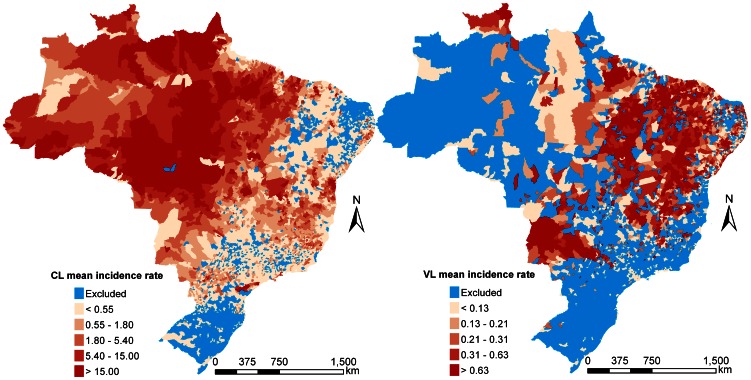
For both types of leishmaniasis, precipitation and socioeconomic proxies were identified as important risk factors. The predicted number of cases in 2010 were 30,189 (standard deviation [SD]: 7,676) for cutaneous leishmaniasis and 4,889 (SD: 288) for visceral leishmaniasis. Our risk maps predicted the highest numbers of infected people in the states of Minas Gerais and Pará for visceral and cutaneous leishmaniasis, respectively.

CONCLUSIONS/SIGNIFICANCE: Our spatially explicit, high-resolution incidence maps identified priority areas where leishmaniasis control efforts should be targeted with the ultimate goal to reduce disease incidence.

摘要

背景

利什曼病流行于 98 个国家,估计有 3.5 亿人面临风险,每年约有 200 万例病例。巴西是受影响最严重的国家之一。

方法

我们应用贝叶斯地理统计负二项式模型分析了巴西 10 年来(2001-2010 年)皮肤和内脏利什曼病的报告发病率数据。特别强调了时空模式。该模型使用集成嵌套拉普拉斯近似法进行快速近似贝叶斯推断。采用贝叶斯变量选择来确定皮肤和内脏利什曼病最重要的气候、环境和社会经济预测因子。

主要发现

对于两种类型的利什曼病,降水和社会经济指标被确定为重要的风险因素。预测 2010 年皮肤利什曼病的病例数为 30189 例(标准差[SD]:7676),内脏利什曼病为 4889 例(SD:288)。我们的风险图预测,内脏和皮肤利什曼病的感染人数最多的州分别是米纳斯吉拉斯州和帕拉州。

结论/意义:我们的空间显式、高分辨率发病率图确定了需要将利什曼病控制工作集中的重点地区,最终目标是降低疾病发病率。
https://cdn.ncbi.nlm.nih.gov/pmc/blobs/e710/3649962/f5c33255d07d/pntd.0002213.g005.jpg
https://cdn.ncbi.nlm.nih.gov/pmc/blobs/e710/3649962/fcf3dbe13793/pntd.0002213.g001.jpg
https://cdn.ncbi.nlm.nih.gov/pmc/blobs/e710/3649962/f36a0ea9a5fe/pntd.0002213.g002.jpg
https://cdn.ncbi.nlm.nih.gov/pmc/blobs/e710/3649962/33f92bbccbce/pntd.0002213.g003.jpg
https://cdn.ncbi.nlm.nih.gov/pmc/blobs/e710/3649962/c9c3fd11d953/pntd.0002213.g004.jpg
https://cdn.ncbi.nlm.nih.gov/pmc/blobs/e710/3649962/f5c33255d07d/pntd.0002213.g005.jpg
https://cdn.ncbi.nlm.nih.gov/pmc/blobs/e710/3649962/fcf3dbe13793/pntd.0002213.g001.jpg
https://cdn.ncbi.nlm.nih.gov/pmc/blobs/e710/3649962/f36a0ea9a5fe/pntd.0002213.g002.jpg
https://cdn.ncbi.nlm.nih.gov/pmc/blobs/e710/3649962/33f92bbccbce/pntd.0002213.g003.jpg
https://cdn.ncbi.nlm.nih.gov/pmc/blobs/e710/3649962/c9c3fd11d953/pntd.0002213.g004.jpg
https://cdn.ncbi.nlm.nih.gov/pmc/blobs/e710/3649962/f5c33255d07d/pntd.0002213.g005.jpg

相似文献

1
Bayesian geostatistical modeling of leishmaniasis incidence in Brazil.巴西利什曼病发病率的贝叶斯地质统计学建模。
PLoS Negl Trop Dis. 2013 May 9;7(5):e2213. doi: 10.1371/journal.pntd.0002213. Print 2013.
2
Identification of priority areas for surveillance of cutaneous leishmaniasis using spatial analysis approaches in Southeastern Brazil.利用空间分析方法在巴西南部确定皮肤利什曼病监测的重点领域。
BMC Infect Dis. 2019 Apr 11;19(1):318. doi: 10.1186/s12879-019-3940-4.
3
Modelling spatiotemporal patterns of visceral leishmaniasis incidence in two endemic states in India using environment, bioclimatic and demographic data, 2013-2022.利用环境、生物气候和人口数据对印度两个地方性流行州内脏利什曼病发病率的时空模式进行建模,2013-2022 年。
PLoS Negl Trop Dis. 2024 Feb 5;18(2):e0011946. doi: 10.1371/journal.pntd.0011946. eCollection 2024 Feb.
4
Dynamic spatiotemporal modeling of the infected rate of visceral leishmaniasis in human in an endemic area of Amhara regional state, Ethiopia.埃塞俄比亚阿姆哈拉州地方性流行区内脏利什曼病人体感染率的动态时空建模。
PLoS One. 2019 Mar 1;14(3):e0212934. doi: 10.1371/journal.pone.0212934. eCollection 2019.
5
Spatial analysis of leishmaniasis in Brazil: a systematized review.巴西利什曼病的空间分析:一项系统综述。
Rev Inst Med Trop Sao Paulo. 2019 Dec 20;61:e68. doi: 10.1590/S1678-9946201961068. eCollection 2019.
6
Spatial analysis for identification of priority areas for surveillance and control in a visceral leishmaniasis endemic area in Brazil.巴西内脏利什曼病流行地区监测和控制重点区域的空间分析。
Acta Trop. 2014 Mar;131:56-62. doi: 10.1016/j.actatropica.2013.12.002. Epub 2013 Dec 14.
7
Leishmaniasis in Sri Lanka: spatial distribution and seasonal variations from 2009 to 2016.斯里兰卡的利什曼病:2009 年至 2016 年的空间分布和季节性变化。
Parasit Vectors. 2018 Jan 25;11(1):60. doi: 10.1186/s13071-018-2647-5.
8
American cutaneous leishmaniasis in Southeast Brazil: space-time clustering.巴西东南部的美洲皮肤利什曼病:时空聚集性
Int J Epidemiol. 1999 Oct;28(5):982-9. doi: 10.1093/ije/28.5.982.
9
Study of sand flies (Diptera: Psychodidae) in visceral and cutaneous leishmaniasis areas in the central-western state of Minas Gerais, Brazil.巴西米纳斯吉拉斯州中西部内脏利什曼病和皮肤利什曼病流行区的白蛉研究(双翅目:白蛉科)。
Acta Trop. 2013 Mar;125(3):262-8. doi: 10.1016/j.actatropica.2012.11.005. Epub 2012 Nov 21.
10
Spatial and temporal trends of visceral leishmaniasis by mesoregion in a southeastern state of Brazil, 2002-2013.巴西东南部一个州内脏利什曼病按次区域的时空趋势,2002-2013 年。
PLoS Negl Trop Dis. 2017 Oct 6;11(10):e0005950. doi: 10.1371/journal.pntd.0005950. eCollection 2017 Oct.

引用本文的文献

1
Impact of Environmental Factors on the Distribution Patterns of Nephropathia Epidemica Cases in Western Europe.环境因素对西欧流行性肾病病例分布模式的影响
Environ Health Perspect. 2025 May;133(5):57023. doi: 10.1289/EHP15457. Epub 2025 May 27.
2
Epidemiology and future risk estimates of cutaneous leishmaniasis in district Dera Ismail Khan, Pakistan: analysis of data from 2019-2022.巴基斯坦德拉伊斯梅尔汗地区皮肤利什曼病的流行病学及未来风险评估:2019 - 2022年数据分析
Afr Health Sci. 2024 Dec;24(4):51-64. doi: 10.4314/ahs.v24i4.8.
3
Spatial Analysis and Socio-Environmental Determinants of Canine Visceral Leishmaniasis in an Urban Area in Northeastern Brazil.

本文引用的文献

1
Spatial Modeling With Spatially Varying Coefficient Processes.具有空间变化系数过程的空间建模
J Am Stat Assoc. 2003;98(462):387-396. doi: 10.1198/016214503000170. Epub 2011 Dec 31.
2
Neglected tropical diseases: diagnosis, clinical management, treatment and control.被忽视的热带病:诊断、临床管理、治疗和控制。
Swiss Med Wkly. 2012 Nov 22;142:w13727. doi: 10.4414/smw.2012.13727. eCollection 2012.
3
Leishmaniasis worldwide and global estimates of its incidence.全球利什曼病及其发病率的全球估计。
巴西东北部某城市地区犬内脏利什曼病的空间分析及社会环境决定因素
Trop Med Infect Dis. 2024 Dec 26;10(1):6. doi: 10.3390/tropicalmed10010006.
4
Comparison of the spatial and temporal distribution of cutaneous and mucosal leishmaniasis in the state of Rio de Janeiro between 2001 and 2011.2001年至2011年期间里约热内卢州皮肤利什曼病和黏膜利什曼病的时空分布比较。
PLoS One. 2024 Dec 31;19(12):e0308298. doi: 10.1371/journal.pone.0308298. eCollection 2024.
5
Tegumentary leishmaniasis in Brazil: priority municipalities and spatiotemporal relative risks from 2001 to 2020.巴西皮肤利什曼病:2001年至2020年的重点城市及时空相对风险
Pathog Glob Health. 2024 Jul;118(5):418-428. doi: 10.1080/20477724.2024.2367442. Epub 2024 Jun 21.
6
Modelling spatiotemporal patterns of visceral leishmaniasis incidence in two endemic states in India using environment, bioclimatic and demographic data, 2013-2022.利用环境、生物气候和人口数据对印度两个地方性流行州内脏利什曼病发病率的时空模式进行建模,2013-2022 年。
PLoS Negl Trop Dis. 2024 Feb 5;18(2):e0011946. doi: 10.1371/journal.pntd.0011946. eCollection 2024 Feb.
7
Association between the potential distribution of Lutzomyia longipalpis and Nyssomyia whitmani and leishmaniasis incidence in Piauí State, Brazil.巴西皮奥伊州长角血蝉和 whitmani 按蚊的潜在分布与利什曼病发病率之间的关系。
PLoS Negl Trop Dis. 2023 Jun 5;17(6):e0011388. doi: 10.1371/journal.pntd.0011388. eCollection 2023 Jun.
8
Distribution and Risk of Cutaneous Leishmaniasis in Khyber Pakhtunkhwa, Pakistan.巴基斯坦开伯尔-普赫图赫瓦省皮肤利什曼病的分布与风险
Trop Med Infect Dis. 2023 Feb 20;8(2):128. doi: 10.3390/tropicalmed8020128.
9
Patterns and drivers of Human Visceral Leishmaniasis in Pernambuco (Brazil) from 2007 to 2018.2007 年至 2018 年巴西伯南布哥州内脏利什曼病的流行模式和驱动因素。
PLoS Negl Trop Dis. 2023 Feb 8;17(2):e0011108. doi: 10.1371/journal.pntd.0011108. eCollection 2023 Feb.
10
Spatio-Temporal Pattern and Meteo-Climatic Determinants of Visceral Leishmaniasis in Italy.意大利内脏利什曼病的时空模式及气象气候决定因素
Trop Med Infect Dis. 2022 Oct 29;7(11):337. doi: 10.3390/tropicalmed7110337.
PLoS One. 2012;7(5):e35671. doi: 10.1371/journal.pone.0035671. Epub 2012 May 31.
4
Leishmaniasis and climate change-case study: Argentina.利什曼病与气候变化:案例研究——阿根廷。
J Trop Med. 2012;2012:601242. doi: 10.1155/2012/601242. Epub 2012 May 20.
5
Spatially explicit burden estimates of malaria in Tanzania: bayesian geostatistical modeling of the malaria indicator survey data.坦桑尼亚疟疾的空间明确负担估计:疟疾指标调查数据的贝叶斯地统计学建模。
PLoS One. 2012;7(5):e23966. doi: 10.1371/journal.pone.0023966. Epub 2012 May 23.
6
Mapping malaria risk among children in Côte d'Ivoire using Bayesian geo-statistical models.利用贝叶斯地统计学模型绘制科特迪瓦儿童疟疾风险图。
Malar J. 2012 May 9;11:160. doi: 10.1186/1475-2875-11-160.
7
Spatial analysis of eco-environmental risk factors of cutaneous leishmaniasis in Southern Iran.伊朗南部皮肤利什曼病生态环境风险因素的空间分析。
J Cutan Aesthet Surg. 2012 Jan;5(1):30-5. doi: 10.4103/0974-2077.94338.
8
Estimating the burden of malaria in Senegal: Bayesian zero-inflated binomial geostatistical modeling of the MIS 2008 data.估算塞内加尔的疟疾负担:基于 MIS 2008 数据的贝叶斯零膨胀二项式地统计学建模。
PLoS One. 2012;7(3):e32625. doi: 10.1371/journal.pone.0032625. Epub 2012 Mar 5.
9
Epidemiological and clinical changes in American tegumentary leishmaniasis in an area of Leishmania (Viannia) braziliensis transmission over a 20-year period.20 年间,美国利什曼原虫病在一个存在利什曼原虫(Viannia)巴西利什曼虫传播的地区的流行病学和临床变化。
Am J Trop Med Hyg. 2012 Mar;86(3):426-33. doi: 10.4269/ajtmh.2012.11-0378.
10
Geostatistical model-based estimates of Schistosomiasis prevalence among individuals aged ≤ 20 years in West Africa.基于地质统计学模型的西非 20 岁以下人群血吸虫病患病率估计。
PLoS Negl Trop Dis. 2011 Jun;5(6):e1194. doi: 10.1371/journal.pntd.0001194. Epub 2011 Jun 14.