Oluwole Akinola S, Ekpo Uwem F, Karagiannis-Voules Dimitrios-Alexios, Abe Eniola M, Olamiju Francisca O, Isiyaku Sunday, Okoronkwo Chukwu, Saka Yisa, Nebe Obiageli J, Braide Eka I, Mafiana Chiedu F, Utzinger Jürg, Vounatsou Penelope
Department of Biological Sciences, Federal University of Agriculture, Abeokuta, Nigeria.
Department of Epidemiology and Public Health, Swiss Tropical and Public Health Institute, Basel, Switzerland; University of Basel, Basel, Switzerland.
PLoS Negl Trop Dis. 2015 Apr 24;9(4):e0003740. doi: 10.1371/journal.pntd.0003740. eCollection 2015 Apr.
The acceleration of the control of soil-transmitted helminth (STH) infections in Nigeria, emphasizing preventive chemotherapy, has become imperative in light of the global fight against neglected tropical diseases. Predictive risk maps are an important tool to guide and support control activities.
STH infection prevalence data were obtained from surveys carried out in 2011 using standard protocols. Data were geo-referenced and collated in a nationwide, geographic information system database. Bayesian geostatistical models with remotely sensed environmental covariates and variable selection procedures were utilized to predict the spatial distribution of STH infections in Nigeria.
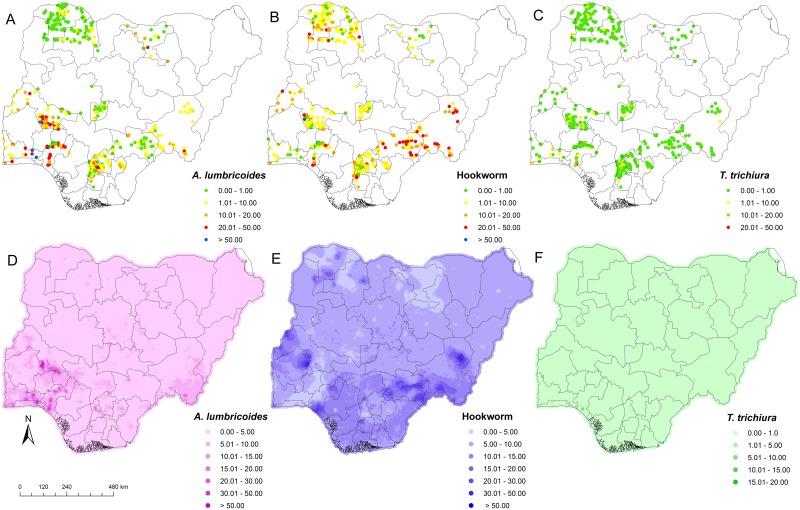
We found that hookworm, Ascaris lumbricoides, and Trichuris trichiura infections are endemic in 482 (86.8%), 305 (55.0%), and 55 (9.9%) locations, respectively. Hookworm and A. lumbricoides infection co-exist in 16 states, while the three species are co-endemic in 12 states. Overall, STHs are endemic in 20 of the 36 states of Nigeria, including the Federal Capital Territory of Abuja. The observed prevalence at endemic locations ranged from 1.7% to 51.7% for hookworm, from 1.6% to 77.8% for A. lumbricoides, and from 1.0% to 25.5% for T. trichiura. Model-based predictions ranged from 0.7% to 51.0% for hookworm, from 0.1% to 82.6% for A. lumbricoides, and from 0.0% to 18.5% for T. trichiura. Our models suggest that day land surface temperature and dense vegetation are important predictors of the spatial distribution of STH infection in Nigeria. In 2011, a total of 5.7 million (13.8%) school-aged children were predicted to be infected with STHs in Nigeria. Mass treatment at the local government area level for annual or bi-annual treatment of the school-aged population in Nigeria in 2011, based on World Health Organization prevalence thresholds, were estimated at 10.2 million tablets.
CONCLUSIONS/SIGNIFICANCE: The predictive risk maps and estimated deworming needs presented here will be helpful for escalating the control and spatial targeting of interventions against STH infections in Nigeria.
鉴于全球抗击被忽视热带病的斗争,在尼日利亚加速控制土壤传播蠕虫(STH)感染、强调预防性化疗已变得势在必行。预测风险地图是指导和支持控制活动的重要工具。
STH感染患病率数据来自于2011年使用标准方案开展的调查。数据进行了地理定位,并整理到一个全国性的地理信息系统数据库中。利用带有遥感环境协变量和变量选择程序的贝叶斯地理统计模型来预测尼日利亚STH感染的空间分布。
我们发现,钩虫、蛔虫和鞭虫感染分别在482个(86.8%)、305个(55.0%)和55个(9.9%)地点呈地方性流行。钩虫和蛔虫感染在16个州共存,而这三种寄生虫在12个州呈共同地方性流行。总体而言,STH在尼日利亚36个州中的20个州呈地方性流行,包括联邦首都地区阿布贾。在地方性流行地区,观察到的钩虫患病率在1.7%至51.7%之间,蛔虫在1.6%至77.8%之间,鞭虫在1.0%至25.5%之间。基于模型的预测显示,钩虫患病率在0.7%至51.0%之间,蛔虫在0.1%至82.6%之间,鞭虫在0.0%至18.5%之间。我们的模型表明,日间地表温度和茂密植被是尼日利亚STH感染空间分布的重要预测因素。2011年,预计尼日利亚共有570万(13.8%)学龄儿童感染STH。根据世界卫生组织的患病率阈值,2011年在尼日利亚地方政府层面针对学龄人口进行年度或半年一次治疗的大规模治疗所需药物估计为1020万片。
结论/意义:此处呈现的预测风险地图和估计的驱虫需求将有助于在尼日利亚加强针对STH感染的控制及干预措施的空间定位。