Miller Haylie L, Ragozzino Michael E, Cook Edwin H, Sweeney John A, Mosconi Matthew W
Department of Physical Therapy, University of North Texas Health Science Center, 3500 Camp Bowie Blvd., Fort Worth, TX, USA.
J Autism Dev Disord. 2015 Mar;45(3):805-15. doi: 10.1007/s10803-014-2244-1.
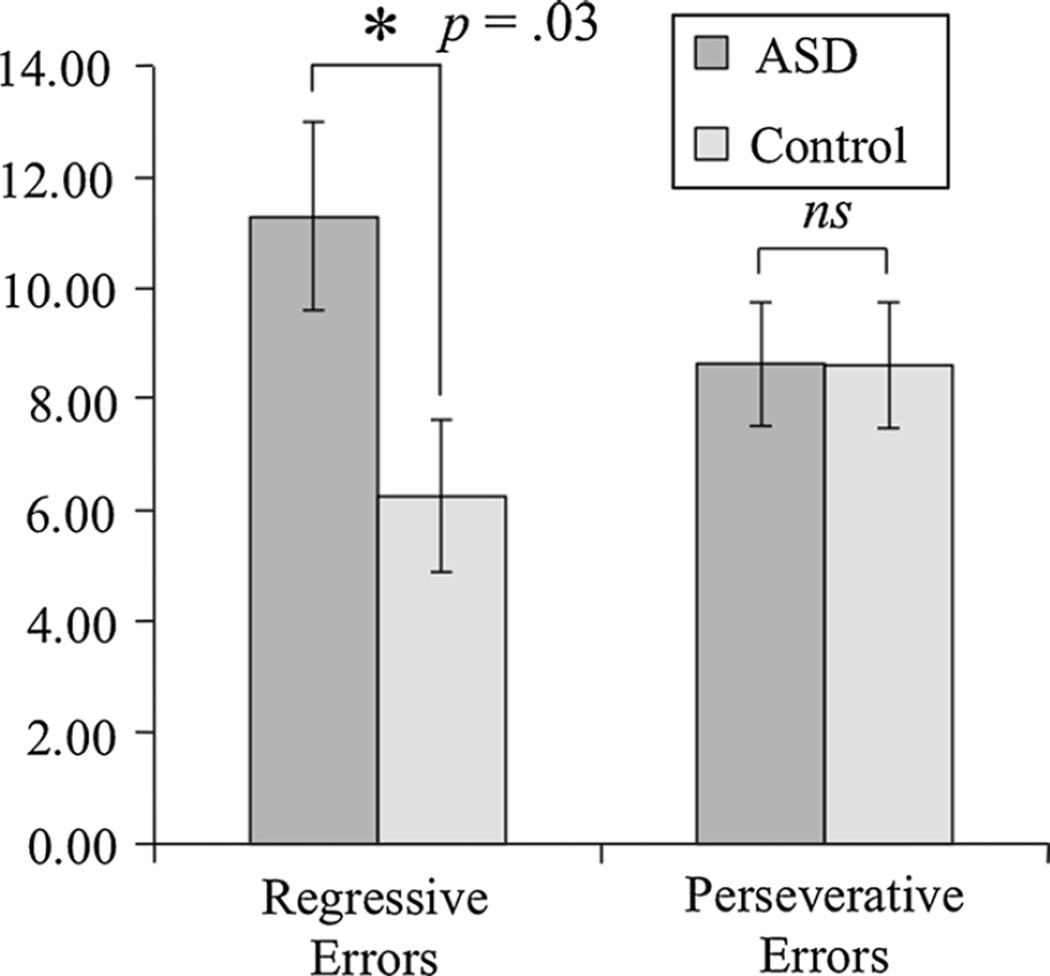
The neurocognitive impairments associated with restricted and repetitive behaviors (RRBs) in autism spectrum disorder (ASD) are not yet clear. Prior studies indicate that individuals with ASD show reduced cognitive flexibility, which could reflect difficulty shifting from a previously learned response pattern or a failure to maintain a new response set. We examined different error types on a test of set-shifting completed by 60 individuals with ASD and 55 age- and nonverbal IQ-matched controls. Individuals with ASD were able to initially shift sets, but they exhibited difficulty maintaining new response sets. Difficulty with set maintenance was related to increased severity of RRBs. General difficulty maintaining new response sets and a heightened tendency to revert to old preferences may contribute to RRBs.
自闭症谱系障碍(ASD)中与受限及重复行为(RRB)相关的神经认知障碍尚不清楚。先前的研究表明,患有ASD的个体表现出认知灵活性降低,这可能反映出他们难以从先前习得的反应模式中转换出来,或者无法维持新的反应集。我们在一项由60名患有ASD的个体以及55名年龄和非言语智商匹配的对照组完成的定势转换测试中,研究了不同的错误类型。患有ASD的个体最初能够转换定势,但他们在维持新的反应集方面表现出困难。定势维持困难与RRB严重程度增加有关。维持新反应集的总体困难以及恢复旧有偏好的强烈倾向可能导致RRB。