Lin Dachuan, Chen Kaichao, Li Ruichao, Liu Lizhang, Guo Jiubiao, Yao Wen, Chen Sheng
Food Safety and Technology Research Center, Hong Kong Polytechnic University - Shen Zhen Research Institute Shenzhen, China ; The State Key Lab of Chiroscience, Department of Applied Biology and Chemical Technology, The Hong Kong Polytechnic University Kowloon, Hong Kong.
College of Animal Science and Technology, Nanjin Agriculture University Nanjin, China.
Front Microbiol. 2014 Sep 4;5:468. doi: 10.3389/fmicb.2014.00468. eCollection 2014.
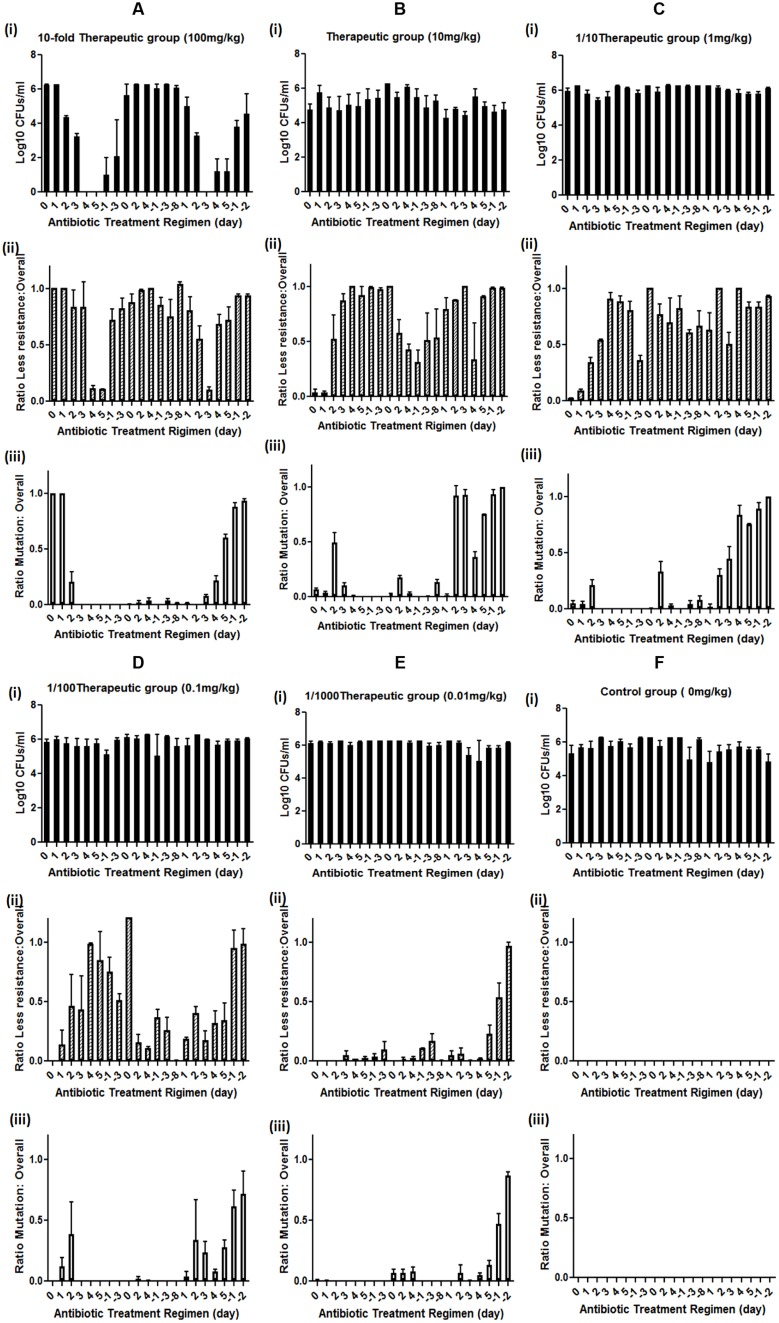
It has been suggested that bacterial resistance is selected within a mutation selection window of antibiotics. More recent studies showed that even extremely low concentration of antibiotic could select resistant bacteria in vitro. Yet little is known about the exact antibiotic concentration range that can effectively select for resistant organisms in animal gastrointestinal (GI) tract. In this study, the effect of different dosages of enrofloxacin on resistance and mutation development in rat GI tract E. coli was investigated by determining the number of resistant E. coli recoverable from rat fecal samples. Our data showed that high dose antibiotic treatment could effectively eliminate E. coli with single gyrA mutation in the early course of treatment, yet the eradication effects diminished upon prolonged treatment. Therapeutic and sub-therapeutic dose (1/10 and 1/100 of therapeutic doses) of enrofloxacin could effectively select for mutation in GI tract E. coli at the later course of enrofloxacin treatment and during the cessation periods. Surprisingly, very low dose of enrofloxacin (1/1000 therapeutic dose) could also select for mutation in GI tract E. coli at the later course of enrofloxacin treatment, only with slightly lower efficiency. No enrofloxacin-resistant E. coli could be selected at all test levels of enrofloxacin during long term treatment and the strength of antibiotic treatment does not alter the overall level of E. coli in rat GI tract. This study demonstrated that long term antibiotic treatment seems to be the major trigger for the development of target mutations in GI tract E. coli, which provided insight into the rational use of antibiotics in animal husbandry.
有人提出,细菌耐药性是在抗生素的突变选择窗口内被选择出来的。最近的研究表明,即使是极低浓度的抗生素也能在体外选择出耐药细菌。然而,对于能在动物胃肠道中有效选择出耐药菌的确切抗生素浓度范围,人们知之甚少。在本研究中,通过测定从大鼠粪便样本中可回收的耐药大肠杆菌数量,研究了不同剂量恩诺沙星对大鼠胃肠道大肠杆菌耐药性和突变发生的影响。我们的数据表明,高剂量抗生素治疗在治疗早期可有效清除具有单个gyrA突变的大肠杆菌,但长期治疗后清除效果会减弱。恩诺沙星的治疗剂量和亚治疗剂量(治疗剂量的1/10和1/100)在恩诺沙星治疗后期和停药期间可有效选择胃肠道大肠杆菌中的突变。令人惊讶的是,极低剂量的恩诺沙星(治疗剂量的1/1000)在恩诺沙星治疗后期也能选择胃肠道大肠杆菌中的突变,只是效率略低。在长期治疗的所有恩诺沙星测试水平下均未选择出耐恩诺沙星的大肠杆菌,且抗生素治疗强度不会改变大鼠胃肠道中大肠杆菌的总体水平。本研究表明,长期抗生素治疗似乎是胃肠道大肠杆菌中靶基因突变发生的主要触发因素,这为畜牧业中抗生素的合理使用提供了见解。