Park Sang Ho, Kim Kyung Do, Moon Young Tae, Myung Soon Chul, Kim Tae Hyoung, Chang In Ho, Kwon Jong Kyou
Department of Urology, Chung-Ang University College of Medicine, Seoul, Korea.
Department of Urology, Severance Hospital, Urological Science Institute, Yonsei University College of Medicine, Seoul, Korea.
Korean J Urol. 2014 Sep;55(9):581-6. doi: 10.4111/kju.2014.55.9.581. Epub 2014 Sep 5.
To evaluate the efficacy of low-dose computed tomography (LDCT) for detecting urinary stones with the use of an iterative reconstruction technique for reducing radiation dose and image noise.
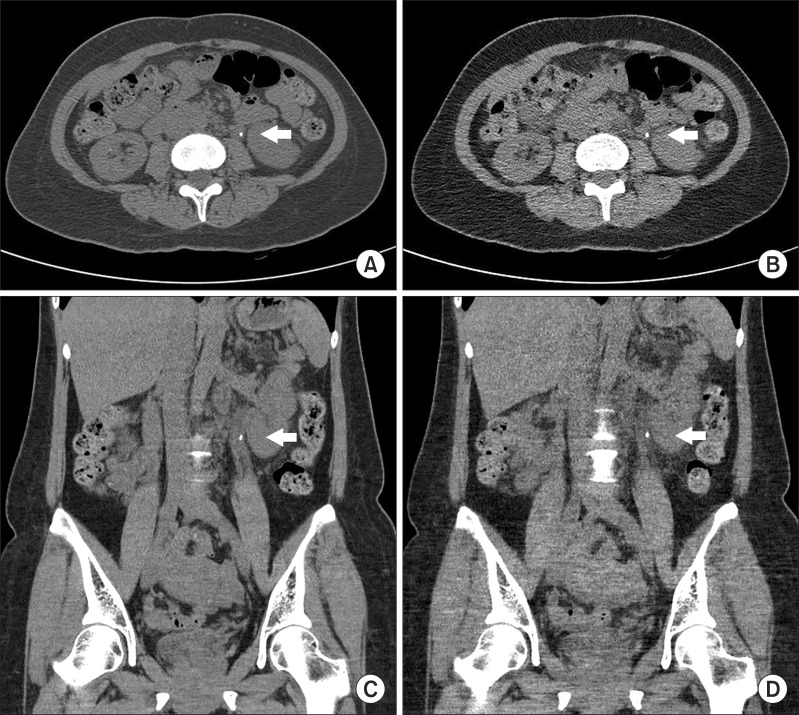
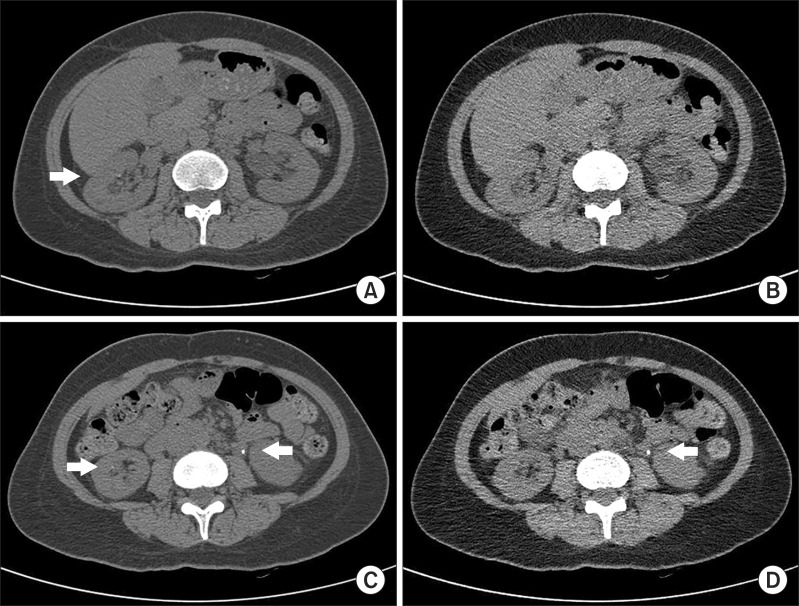
A total of 101 stones from 69 patients who underwent both conventional nonenhanced computed tomography (CCT) and LDCT were analyzed. Interpretations were made of the two scans according to stone characteristics (size, volume, location, Hounsfield unit [HU], and skin-to-stone distance [SSD]) and radiation dose by dose-length product (DLP), effective dose (ED), and image noise. Diagnostic performance for detecting urinary stones was assessed by statistical evaluation.
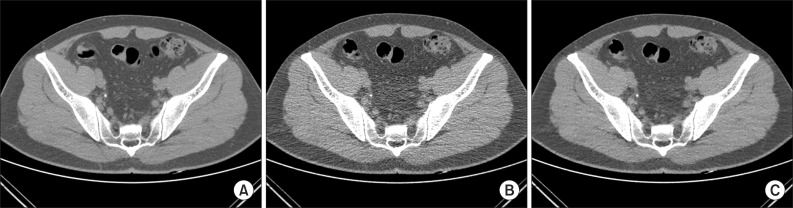
No statistical differences were found in stone characteristics between the two scans. The average DLP and ED were 384.60 ± 132.15 mGy and 5.77 ± 1.98 mSv in CCT and 90.08 ± 31.80 mGy and 1.34 ± 0.48 mSv in LDCT, respectively. The dose reduction rate of LDCT was nearly 77% for both DLP and ED (p<0.01). The mean objective noise (standard deviation) from three different areas was 23.0 ± 2.5 in CCT and 29.2 ± 3.1 in LDCT with a significant difference (p<0.05); the slight increase was 21.2%. For stones located throughout the kidney and ureter, the sensitivity and specificity of LDCT remained 96.0% and 100%, with positive and negative predictive values of 100% and 96.2%, respectively.
LDCT showed significant radiation reduction while maintaining high image quality. It is an attractive option in the diagnosis of urinary stones.
评估低剂量计算机断层扫描(LDCT)在使用迭代重建技术减少辐射剂量和图像噪声的情况下检测尿路结石的疗效。
分析了69例接受传统非增强计算机断层扫描(CCT)和LDCT的患者的101颗结石。根据结石特征(大小、体积、位置、亨氏单位[HU]和皮肤到结石距离[SSD])以及辐射剂量(通过剂量长度乘积[DLP]、有效剂量[ED])和图像噪声对两次扫描进行解读。通过统计评估来评估检测尿路结石的诊断性能。
两次扫描的结石特征无统计学差异。CCT的平均DLP和ED分别为384.60±132.15 mGy和5.77±1.98 mSv,LDCT的平均DLP和ED分别为90.08±31.80 mGy和1.34±0.48 mSv。LDCT的DLP和ED的剂量降低率均接近77%(p<0.01)。三个不同区域的平均客观噪声(标准差)在CCT中为23.0±2.5,在LDCT中为29.2±3.1,有显著差异(p<0.05);轻微增加为21.2%。对于位于整个肾脏和输尿管的结石,LDCT的敏感性和特异性分别保持在96.0%和100%,阳性和阴性预测值分别为100%和96.2%。
LDCT在保持高图像质量的同时显著降低了辐射剂量。它是尿路结石诊断中一个有吸引力的选择。