Landré Vivien, Rotblat Barak, Melino Sonia, Bernassola Francesca, Melino Gerry
Medical Research Council, Toxicology Unit, Leicester, UK.
Biochemistry Laboratory, IDI-IRCCS, c/o Department of Experimental Medicine and Surgery, University of Rome "Tor Vergata", Rome, Italy.
Oncotarget. 2014 Sep 30;5(18):7988-8013. doi: 10.18632/oncotarget.2431.
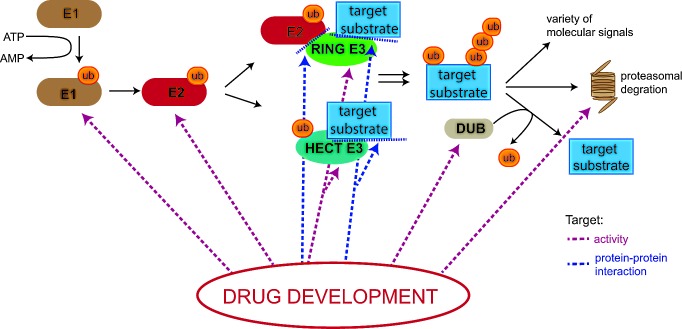
The ubiquitin proteasome system (UPS) plays a role in the regulation of most cellular pathways, and its deregulation has been implicated in a wide range of human pathologies that include cancer, neurodegenerative and immunological disorders and viral infections. Targeting the UPS by small molecular regulators thus provides an opportunity for the development of therapeutics for the treatment of several diseases. The proteasome inhibitor Bortezomib was approved for treatment of hematologic malignancies by the FDA in 2003, becoming the first drug targeting the ubiquitin proteasome system in the clinic. Development of drugs targeting specific components of the ubiquitin proteasome system, however, has lagged behind, mainly due to the complexity of the ubiquitination reaction and its outcomes. However, significant advances have been made in recent years in understanding the molecular nature of the ubiquitination system and the vast variety of cellular signals that it produces. Additionally, improvement of screening methods, both in vitro and in silico, have led to the discovery of a number of compounds targeting components of the ubiquitin proteasome system, and some of these have now entered clinical trials. Here, we discuss the current state of drug discovery targeting E3 ligases and the opportunities and challenges that it provides.
泛素蛋白酶体系统(UPS)在大多数细胞通路的调控中发挥作用,其失调与多种人类疾病有关,包括癌症、神经退行性疾病、免疫紊乱和病毒感染。因此,通过小分子调节剂靶向UPS为开发治疗多种疾病的疗法提供了机会。蛋白酶体抑制剂硼替佐米于2003年被美国食品药品监督管理局(FDA)批准用于治疗血液系统恶性肿瘤,成为临床上首个靶向泛素蛋白酶体系统的药物。然而,靶向泛素蛋白酶体系统特定成分的药物开发滞后,主要是由于泛素化反应及其结果的复杂性。不过,近年来在理解泛素化系统的分子本质及其产生的各种细胞信号方面取得了重大进展。此外,体外和计算机辅助筛选方法的改进导致发现了许多靶向泛素蛋白酶体系统成分的化合物,其中一些现已进入临床试验。在此,我们讨论靶向E3连接酶的药物发现的现状及其带来的机遇和挑战。