a Department of Biotechnology , Guangdong Polytechnic of Science and Trade , Guangzhou , Guangdong , China.
b Guangdong Province Key Laboratory for Green Processing of Natural Products and Product Safety, School of Food Science and Engineering , South China University of Technology , Guangzhou , Guangdong , China.
Expert Opin Ther Pat. 2018 Dec;28(12):919-937. doi: 10.1080/13543776.2018.1549229. Epub 2018 Nov 23.
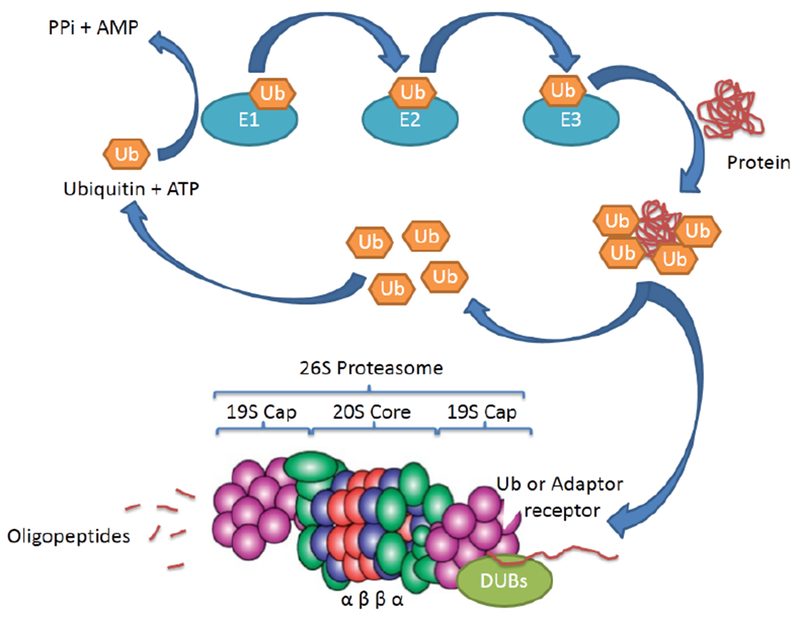
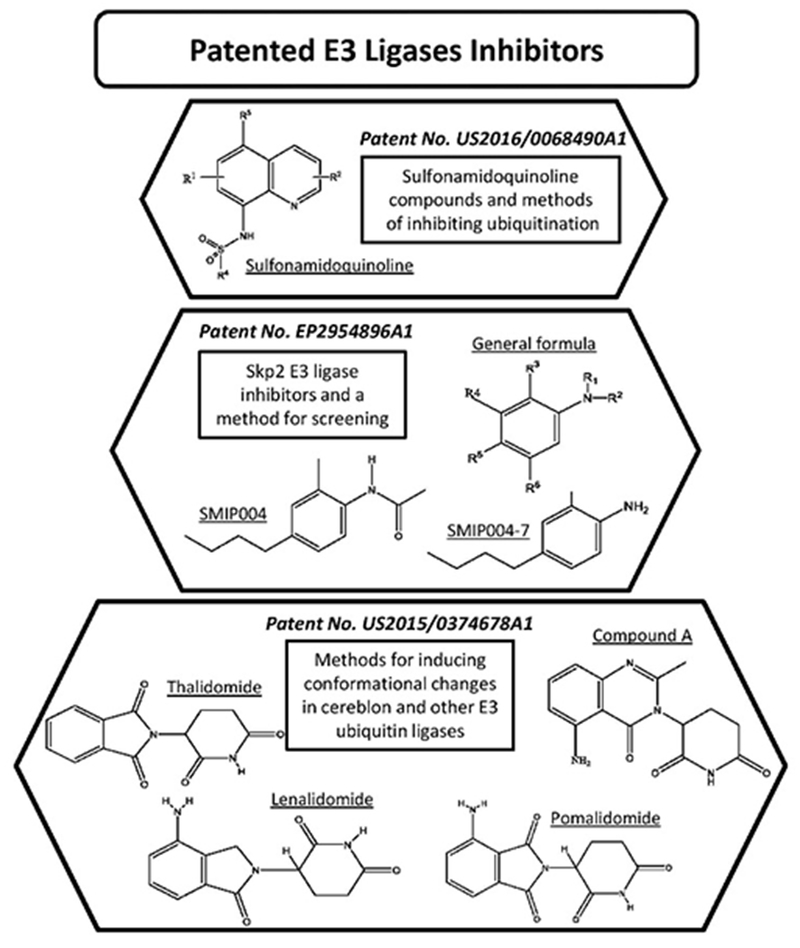
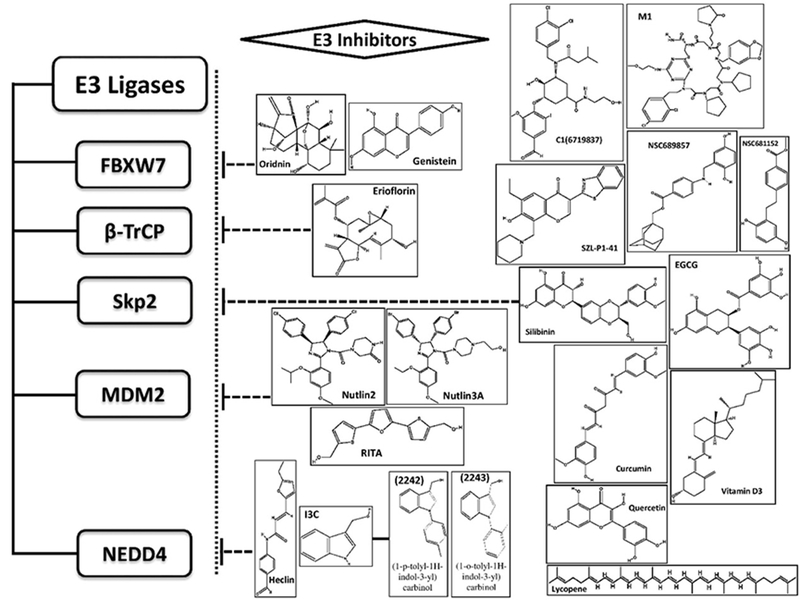
Ubiquitin-proteasome system (UPS) has been validated as a novel anticancer drug target in the past 20 years. The UPS contains two distinct steps: ubiquitination of a substrate protein by ubiquitin activating enzyme (E1), ubiquitin conjugating enzyme (E2), and ubiquitin ligase (E3), and substrate degradation by the 26S proteasome complex. The E3 enzyme is the central player in the ubiquitination step and has a wide range of specific substrates in cancer cells, offering great opportunities for discovery and development of selective drugs. Areas covered: This review summarizes the recent advances in small molecule inhibitors of E1s, E2s, and E3s, with a focus on the latest patents (from 2015 to 2018) of E3 inhibitors and modulators. Expert opinion: One strategy to overcome limitations of current 20S proteasome inhibitors is to discover inhibitors of the upstream key components of the UPS, such as E3 enzymes. E3s play important roles in cancer development and determine the specificity of substrate ubiquitination, offering novel target opportunities. E3 modulators could be developed by rational design, natural compound or library screening, old drug repurposes, and application of other novel technologies. Further understanding of mechanisms of E3-substrate interaction will be essential for discovering and developing next-generation E3 inhibitors as effective anticancer drugs.
泛素-蛋白酶体系统(UPS)在过去的 20 年中已被验证为一种新型的抗癌药物靶点。UPS 包含两个不同的步骤:泛素激活酶(E1)、泛素结合酶(E2)和泛素连接酶(E3)对底物蛋白的泛素化,以及 26S 蛋白酶体复合物对底物的降解。E3 酶是泛素化步骤中的核心因子,在癌细胞中有广泛的特定底物,为发现和开发选择性药物提供了巨大的机会。
本综述总结了近年来 E1、E2 和 E3 的小分子抑制剂的最新进展,重点介绍了 E3 抑制剂和调节剂的最新专利(2015 年至 2018 年)。
克服当前 20S 蛋白酶体抑制剂局限性的一种策略是发现 UPS 上游关键成分的抑制剂,如 E3 酶。E3 在癌症的发展中起着重要作用,并决定了底物泛素化的特异性,为新的靶标提供了机会。E3 调节剂可以通过合理设计、天然化合物或文库筛选、旧药再利用以及应用其他新技术来开发。进一步了解 E3-底物相互作用的机制对于发现和开发新一代作为有效抗癌药物的 E3 抑制剂至关重要。