• 文献检索
  • 文档翻译
  • 深度研究
  • 学术资讯
  • Suppr Zotero 插件Zotero 插件
  • 邀请有礼
  • 套餐&价格
  • 历史记录
应用&插件
Suppr Zotero 插件Zotero 插件浏览器插件Mac 客户端Windows 客户端微信小程序
定价
高级版会员购买积分包购买API积分包
服务
文献检索文档翻译深度研究API 文档MCP 服务
关于我们
关于 Suppr公司介绍联系我们用户协议隐私条款
关注我们

Suppr 超能文献

核心技术专利:CN118964589B侵权必究
粤ICP备2023148730 号-1Suppr @ 2026

文献检索

告别复杂PubMed语法,用中文像聊天一样搜索,搜遍4000万医学文献。AI智能推荐,让科研检索更轻松。

立即免费搜索

文件翻译

保留排版,准确专业,支持PDF/Word/PPT等文件格式,支持 12+语言互译。

免费翻译文档

深度研究

AI帮你快速写综述,25分钟生成高质量综述,智能提取关键信息,辅助科研写作。

立即免费体验

肿瘤来源的转化生长因子-β和前列腺素E2会减弱接受表皮生长因子受体抑制剂治疗的头颈部鳞状细胞癌的抗肿瘤免疫反应。

Tumor-derived TGF-β and prostaglandin E2 attenuate anti-tumor immune responses in head and neck squamous cell carcinoma treated with EGFR inhibitor.

作者信息

Kumai Takumi, Oikawa Kensuke, Aoki Naoko, Kimura Shoji, Harabuchi Yasuaki, Celis Esteban, Kobayashi Hiroya

出版信息

J Transl Med. 2014 Sep 21;12:265. doi: 10.1186/s12967-014-0265-3.

DOI:10.1186/s12967-014-0265-3
PMID:25240937
原文链接:https://pmc.ncbi.nlm.nih.gov/articles/PMC4177691/
Abstract

BACKGROUND

EGFR-targeted therapy is an attractive option for head and neck squamous cell carcinoma patients. We have recently reported the use of EGFR inhibitors as an adjunct treatment to enhance HLA-DR expression in tumor cells to improve cancer immunotherapy. Nevertheless, we observed that EGFR inhibitors resulted in decreased anti-tumor responses, regardless of upregulation of HLA-DR expression on the tumor cell. In this study, we specifically investigated the mechanisms by which EGFR inhibition modulated anti-tumor responses.

METHODS

An EGFR inhibitor erlotinib was used to assess the modulation of anti-tumor responses by tumor antigen-specific helper T cells. We then examined whether administration of the EGFR inhibitor altered tumor cytokine profiles and expression of immune-related molecules on tumor cells.

RESULTS

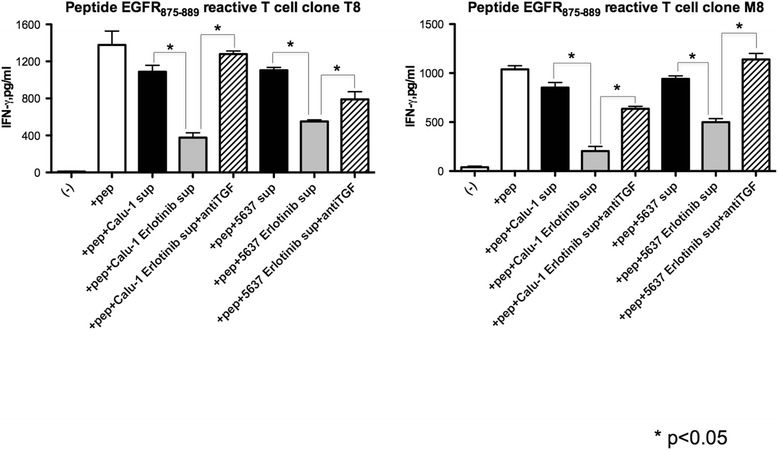
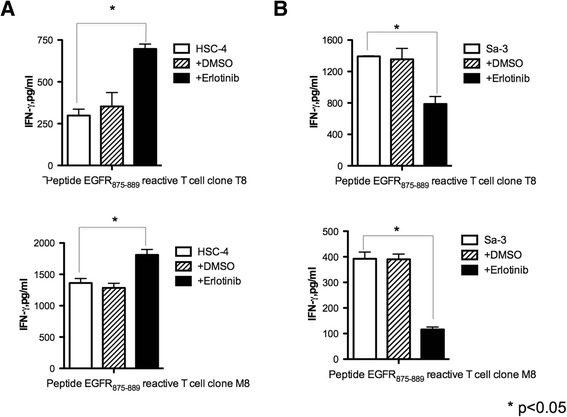
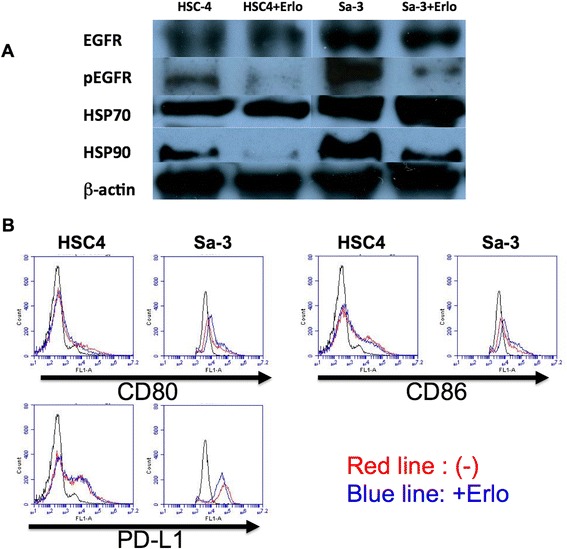
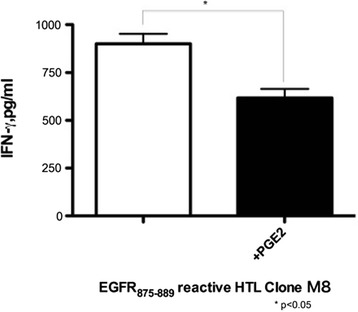
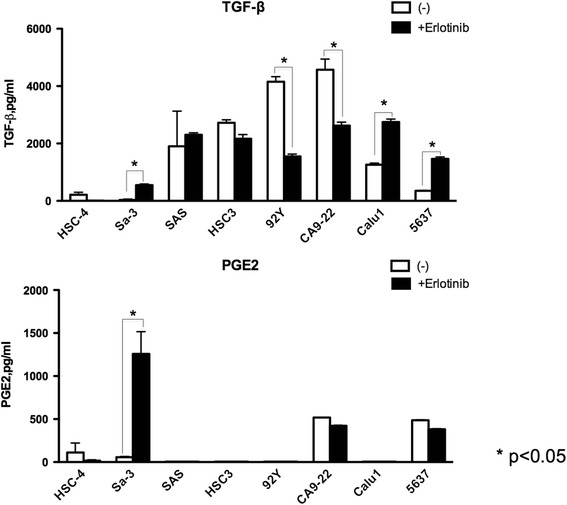
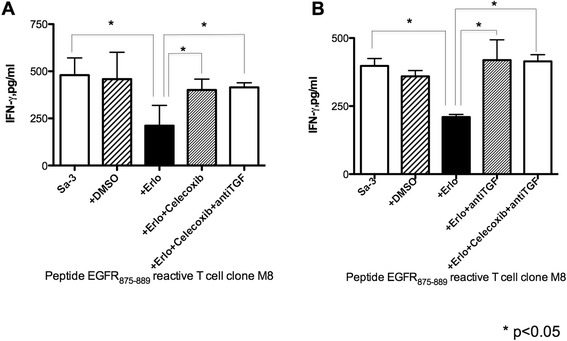
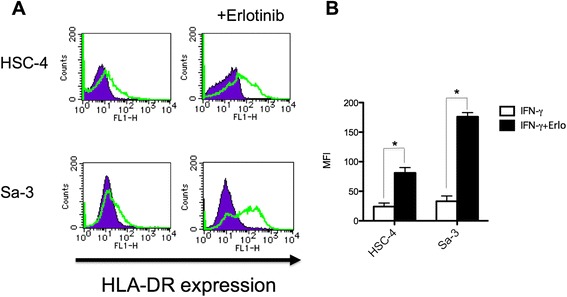
Despite the augmented HLA-DR expression on a gingival cancer cell line by EGFR inhibition, anti-tumor responses of EGFR reactive helper T cell clones against tumor cells were decreased. EGFR inhibition did not change the expression of CD80, CD86, or PD-L1 on the tumor cells. Conversely, production of transforming growth factor beta (TGF-β) and prostaglandin E2 was increased by EGFR inhibition, indicating that these immunosuppressive molecules were involved in diminishing tumor recognition by T cells. Significantly, attenuation of HTL responses against tumors after EGFR inhibition was reversed by the addition of anti-TGF-β antibody or COX2 inhibitors.

CONCLUSIONS

Targeting TGF-β and prostaglandin E2 may allow for improved outcomes for cancer patients treated with combination immunotherapy and EGFR inhibitors.

摘要

背景

表皮生长因子受体(EGFR)靶向治疗是头颈部鳞状细胞癌患者的一个有吸引力的选择。我们最近报道了使用EGFR抑制剂作为辅助治疗,以增强肿瘤细胞中HLA-DR的表达,从而改善癌症免疫治疗。然而,我们观察到,无论肿瘤细胞上HLA-DR表达上调与否,EGFR抑制剂都会导致抗肿瘤反应降低。在本研究中,我们专门研究了EGFR抑制调节抗肿瘤反应的机制。

方法

使用EGFR抑制剂厄洛替尼评估肿瘤抗原特异性辅助性T细胞对抗肿瘤反应的调节作用。然后,我们检查了EGFR抑制剂的给药是否改变了肿瘤细胞因子谱以及肿瘤细胞上免疫相关分子的表达。

结果

尽管EGFR抑制使牙龈癌细胞系上的HLA-DR表达增加,但EGFR反应性辅助性T细胞克隆对肿瘤细胞的抗肿瘤反应却降低了。EGFR抑制并未改变肿瘤细胞上CD80、CD86或PD-L1的表达。相反,EGFR抑制使转化生长因子β(TGF-β)和前列腺素E2的产生增加,表明这些免疫抑制分子参与了T细胞对肿瘤识别的减弱。值得注意的是,添加抗TGF-β抗体或COX2抑制剂可逆转EGFR抑制后HTL对肿瘤反应的减弱。

结论

靶向TGF-β和前列腺素E2可能会改善接受联合免疫治疗和EGFR抑制剂治疗的癌症患者的预后。
https://cdn.ncbi.nlm.nih.gov/pmc/blobs/1fb2/4177691/5293e89f32e1/12967_2014_265_Fig7_HTML.jpg
https://cdn.ncbi.nlm.nih.gov/pmc/blobs/1fb2/4177691/967a64e3b7ff/12967_2014_265_Fig1_HTML.jpg
https://cdn.ncbi.nlm.nih.gov/pmc/blobs/1fb2/4177691/82b6734d88bf/12967_2014_265_Fig2_HTML.jpg
https://cdn.ncbi.nlm.nih.gov/pmc/blobs/1fb2/4177691/137c6bb0f323/12967_2014_265_Fig3_HTML.jpg
https://cdn.ncbi.nlm.nih.gov/pmc/blobs/1fb2/4177691/78c10118624e/12967_2014_265_Fig4_HTML.jpg
https://cdn.ncbi.nlm.nih.gov/pmc/blobs/1fb2/4177691/2da47c45fd35/12967_2014_265_Fig5_HTML.jpg
https://cdn.ncbi.nlm.nih.gov/pmc/blobs/1fb2/4177691/48392fe84ec1/12967_2014_265_Fig6_HTML.jpg
https://cdn.ncbi.nlm.nih.gov/pmc/blobs/1fb2/4177691/5293e89f32e1/12967_2014_265_Fig7_HTML.jpg
https://cdn.ncbi.nlm.nih.gov/pmc/blobs/1fb2/4177691/967a64e3b7ff/12967_2014_265_Fig1_HTML.jpg
https://cdn.ncbi.nlm.nih.gov/pmc/blobs/1fb2/4177691/82b6734d88bf/12967_2014_265_Fig2_HTML.jpg
https://cdn.ncbi.nlm.nih.gov/pmc/blobs/1fb2/4177691/137c6bb0f323/12967_2014_265_Fig3_HTML.jpg
https://cdn.ncbi.nlm.nih.gov/pmc/blobs/1fb2/4177691/78c10118624e/12967_2014_265_Fig4_HTML.jpg
https://cdn.ncbi.nlm.nih.gov/pmc/blobs/1fb2/4177691/2da47c45fd35/12967_2014_265_Fig5_HTML.jpg
https://cdn.ncbi.nlm.nih.gov/pmc/blobs/1fb2/4177691/48392fe84ec1/12967_2014_265_Fig6_HTML.jpg
https://cdn.ncbi.nlm.nih.gov/pmc/blobs/1fb2/4177691/5293e89f32e1/12967_2014_265_Fig7_HTML.jpg

相似文献

1
Tumor-derived TGF-β and prostaglandin E2 attenuate anti-tumor immune responses in head and neck squamous cell carcinoma treated with EGFR inhibitor.肿瘤来源的转化生长因子-β和前列腺素E2会减弱接受表皮生长因子受体抑制剂治疗的头颈部鳞状细胞癌的抗肿瘤免疫反应。
J Transl Med. 2014 Sep 21;12:265. doi: 10.1186/s12967-014-0265-3.
2
EGFR inhibitors augment antitumour helper T-cell responses of HER family-specific immunotherapy.表皮生长因子受体抑制剂增强了针对 HER 家族的免疫治疗的抗肿瘤辅助性 T 细胞反应。
Br J Cancer. 2013 Oct 15;109(8):2155-66. doi: 10.1038/bjc.2013.577. Epub 2013 Sep 17.
3
Targeting HER-3 to elicit antitumor helper T cells against head and neck squamous cell carcinoma.靶向HER-3以引发针对头颈部鳞状细胞癌的抗肿瘤辅助性T细胞。
Sci Rep. 2015 Nov 5;5:16280. doi: 10.1038/srep16280.
4
Immunosuppressive activity of CD14+ HLA-DR- cells in squamous cell carcinoma of the head and neck.CD14+HLA-DR- 细胞对头颈部鳞状细胞癌的免疫抑制活性。
Cancer Sci. 2012 Jun;103(6):976-83. doi: 10.1111/j.1349-7006.2012.02248.x. Epub 2012 Apr 11.
5
Inhibition of TGF-β enhances the in vivo antitumor efficacy of EGF receptor-targeted therapy.抑制 TGF-β 增强了表皮生长因子受体靶向治疗的体内抗肿瘤疗效。
Mol Cancer Ther. 2012 Nov;11(11):2429-39. doi: 10.1158/1535-7163.MCT-12-0101-T. Epub 2012 Aug 27.
6
Elevated RET expression enhances EGFR activation and mediates EGFR inhibitor resistance in head and neck squamous cell carcinoma.RET表达升高增强了头颈部鳞状细胞癌中的表皮生长因子受体(EGFR)激活并介导EGFR抑制剂耐药。
Cancer Lett. 2016 Jul 10;377(1):1-10. doi: 10.1016/j.canlet.2016.04.023. Epub 2016 Apr 18.
7
PD-L1-specific helper T-cells exhibit effective antitumor responses: new strategy of cancer immunotherapy targeting PD-L1 in head and neck squamous cell carcinoma.PD-L1 特异性辅助 T 细胞表现出有效的抗肿瘤反应:针对头颈部鳞状细胞癌中 PD-L1 的癌症免疫治疗新策略。
J Transl Med. 2019 Jun 20;17(1):207. doi: 10.1186/s12967-019-1957-5.
8
Synergistic inhibition of head and neck tumor growth by green tea (-)-epigallocatechin-3-gallate and EGFR tyrosine kinase inhibitor.绿茶(-)-表没食子儿茶素-3-没食子酸酯与表皮生长因子受体酪氨酸激酶抑制剂协同抑制头颈部肿瘤生长
Int J Cancer. 2008 Sep 1;123(5):1005-14. doi: 10.1002/ijc.23585.
9
Preclinical modeling of EGFR inhibitor resistance in head and neck cancer.头颈部癌中表皮生长因子受体抑制剂耐药的临床前模型。
Cancer Biol Ther. 2012 Aug;13(10):935-45. doi: 10.4161/cbt.20846. Epub 2012 Aug 1.
10
The hypoxic tumor microenvironment and drug resistance against EGFR inhibitors: preclinical study in cetuximab-sensitive head and neck squamous cell carcinoma cell lines.缺氧肿瘤微环境与对表皮生长因子受体(EGFR)抑制剂的耐药性:西妥昔单抗敏感的头颈部鳞状细胞癌细胞系的临床前研究
BMC Res Notes. 2015 Jun 2;8:203. doi: 10.1186/s13104-015-1197-6.

引用本文的文献

1
The Role of Immune Modulatory Cytokines in the Tumor Microenvironments of Head and Neck Squamous Cell Carcinomas.免疫调节细胞因子在头颈部鳞状细胞癌肿瘤微环境中的作用
Cancers (Basel). 2022 Jun 11;14(12):2884. doi: 10.3390/cancers14122884.
2
Photodynamic Therapy-Mediated Immune Responses in Three-Dimensional Tumor Models.三维肿瘤模型中的光动力疗法介导的免疫反应。
Int J Mol Sci. 2021 Nov 23;22(23):12618. doi: 10.3390/ijms222312618.
3
Epithelial-to-Mesenchymal Transition-Derived Heterogeneity in Head and Neck Squamous Cell Carcinomas.

本文引用的文献

1
Non-cell-autonomous driving of tumour growth supports sub-clonal heterogeneity.非细胞自主驱动肿瘤生长支持亚克隆异质性。
Nature. 2014 Oct 2;514(7520):54-8. doi: 10.1038/nature13556. Epub 2014 Jul 30.
2
The TGFβ-miR200-MIG6 pathway orchestrates the EMT-associated kinase switch that induces resistance to EGFR inhibitors.TGFβ-miR200-MIG6 通路协调 EMT 相关激酶转换,从而诱导对 EGFR 抑制剂的耐药性。
Cancer Res. 2014 Jul 15;74(14):3995-4005. doi: 10.1158/0008-5472.CAN-14-0110. Epub 2014 May 15.
3
Elimination of IL-10-inducing T-helper epitopes from an IGFBP-2 vaccine ensures potent antitumor activity.
头颈部鳞状细胞癌中上皮-间质转化衍生的异质性
Cancers (Basel). 2021 Oct 26;13(21):5355. doi: 10.3390/cancers13215355.
4
Current Perspectives on the Immunosuppressive Niche and Role of Fibrosis in Hepatocellular Carcinoma and the Development of Antitumor Immunity.当前对肝癌免疫抑制微环境和纤维化作用以及抗肿瘤免疫发展的观点。
J Histochem Cytochem. 2022 Jan;70(1):53-81. doi: 10.1369/00221554211056853. Epub 2021 Nov 9.
5
The PD-L1 metabolic interactome intersects with choline metabolism and inflammation.程序性死亡配体1(PD-L1)代谢相互作用组与胆碱代谢和炎症相互交叉。
Cancer Metab. 2021 Feb 19;9(1):10. doi: 10.1186/s40170-021-00245-w.
6
The role of transforming growth factor-beta in immune suppression and chronic inflammation of squamous cell carcinomas.转化生长因子-β在鳞状细胞癌免疫抑制和慢性炎症中的作用。
Mol Carcinog. 2020 Jul;59(7):745-753. doi: 10.1002/mc.23196. Epub 2020 Apr 17.
7
Preclinical and Clinical Evidence of Immune Responses Triggered in Oncologic Photodynamic Therapy: Clinical Recommendations.肿瘤光动力治疗引发免疫反应的临床前及临床证据:临床建议
J Clin Med. 2020 Jan 24;9(2):333. doi: 10.3390/jcm9020333.
8
Prostanoid receptor genes confer poor prognosis in head and neck squamous cell carcinoma via epigenetic inactivation.前列腺素受体基因通过表观遗传失活导致头颈部鳞状细胞癌预后不良。
J Transl Med. 2020 Jan 21;18(1):31. doi: 10.1186/s12967-020-02214-1.
9
Tumor-released autophagosomes induces CD4 T cell-mediated immunosuppression via a TLR2-IL-6 cascade.肿瘤释放的自噬体通过 TLR2-IL-6 级联诱导 CD4 T 细胞介导的免疫抑制。
J Immunother Cancer. 2019 Jul 12;7(1):178. doi: 10.1186/s40425-019-0646-5.
10
Tumor cell-intrinsic EPHA2 suppresses anti-tumor immunity by regulating PTGS2 (COX-2).肿瘤细胞内在的 EphA2 通过调节 PTGS2(COX-2)抑制抗肿瘤免疫。
J Clin Invest. 2019 Jun 4;129(9):3594-3609. doi: 10.1172/JCI127755.
从 IGFBP-2 疫苗中消除 IL-10 诱导的辅助性 T 细胞表位可确保强大的抗肿瘤活性。
Cancer Res. 2014 May 15;74(10):2710-8. doi: 10.1158/0008-5472.CAN-13-3286. Epub 2014 Apr 28.
4
Erlotinib, erlotinib-sulindac versus placebo: a randomized, double-blind, placebo-controlled window trial in operable head and neck cancer.厄洛替尼、厄洛替尼-舒林酸与安慰剂对比:一项针对可手术头颈部癌的随机、双盲、安慰剂对照窗口期试验。
Clin Cancer Res. 2014 Jun 15;20(12):3289-98. doi: 10.1158/1078-0432.CCR-13-3360. Epub 2014 Apr 11.
5
EGFR inhibition induces proinflammatory cytokines via NOX4 in HNSCC.EGFR 抑制通过 NOX4 在头颈部鳞状细胞癌中诱导促炎细胞因子。
Mol Cancer Res. 2013 Dec;11(12):1574-84. doi: 10.1158/1541-7786.MCR-13-0187. Epub 2013 Sep 18.
6
EGFR inhibitors augment antitumour helper T-cell responses of HER family-specific immunotherapy.表皮生长因子受体抑制剂增强了针对 HER 家族的免疫治疗的抗肿瘤辅助性 T 细胞反应。
Br J Cancer. 2013 Oct 15;109(8):2155-66. doi: 10.1038/bjc.2013.577. Epub 2013 Sep 17.
7
Turning tumors into vaccines: co-opting the innate immune system.将肿瘤转化为疫苗:利用固有免疫系统。
Immunity. 2013 Jul 25;39(1):27-37. doi: 10.1016/j.immuni.2013.07.011.
8
Melanoma-educated CD14+ cells acquire a myeloid-derived suppressor cell phenotype through COX-2-dependent mechanisms.黑色素瘤诱导的 CD14+ 细胞通过 COX-2 依赖性机制获得髓系来源的抑制细胞表型。
Cancer Res. 2013 Jul 1;73(13):3877-87. doi: 10.1158/0008-5472.CAN-12-4115. Epub 2013 Apr 30.
9
Identification of two distinct carcinoma-associated fibroblast subtypes with differential tumor-promoting abilities in oral squamous cell carcinoma.鉴定两种具有不同肿瘤促进能力的口腔鳞状细胞癌相关成纤维细胞亚型。
Cancer Res. 2013 Jul 1;73(13):3888-901. doi: 10.1158/0008-5472.CAN-12-4150. Epub 2013 Apr 18.
10
Combined treatment with erlotinib and a transforming growth factor-β type I receptor inhibitor effectively suppresses the enhanced motility of erlotinib-resistant non-small-cell lung cancer cells.厄洛替尼联合转化生长因子-β Ⅰ型受体抑制剂有效抑制厄洛替尼耐药非小细胞肺癌细胞迁移能力增强。
J Thorac Oncol. 2013 Mar;8(3):259-69. doi: 10.1097/JTO.0b013e318279e942.