Abdullah Jafri Malin, Mustafa Zulkifli, Ideris Aini
Center for Neuroscience Services and Research, Universiti Sains Malaysia, Health Campus, 16150 Kubang Kerian, Kelantan, Malaysia ; Department of Neurosciences, School of Medical Sciences, Universiti Sains Malaysia, Health Campus, 16150 Kubang Kerian, Kelantan, Malaysia ; Department of Neurosciences, Hospital Universiti Sains Malaysia, Jalan Sultanah Zainab 2, Kubang Kerian, 16150 Kota Bharu, Kelantan, Malaysia.
Department of Neurosciences, School of Medical Sciences, Universiti Sains Malaysia, Health Campus, 16150 Kubang Kerian, Kelantan, Malaysia.
Biomed Res Int. 2014;2014:386470. doi: 10.1155/2014/386470. Epub 2014 Aug 27.
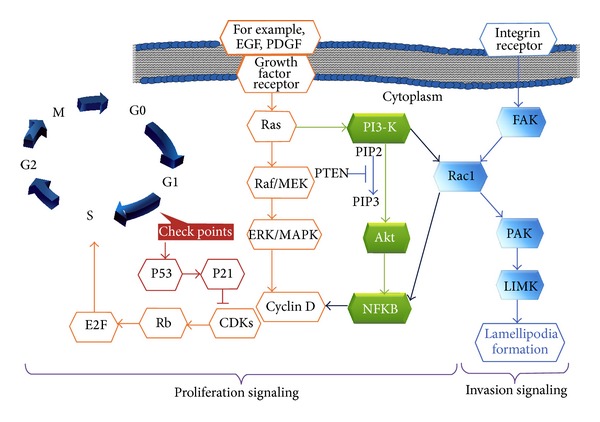
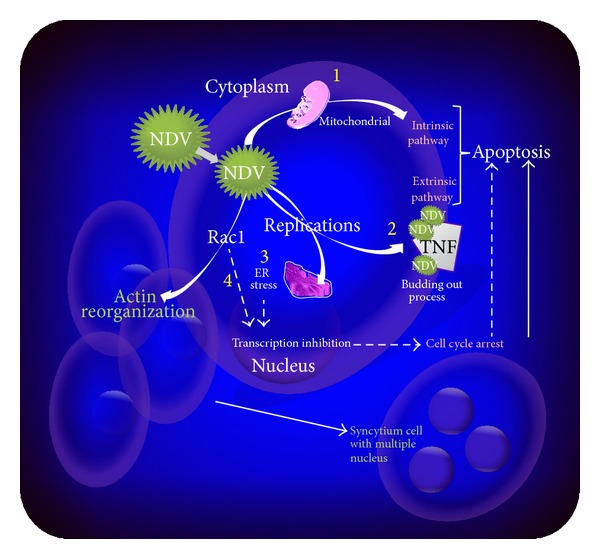
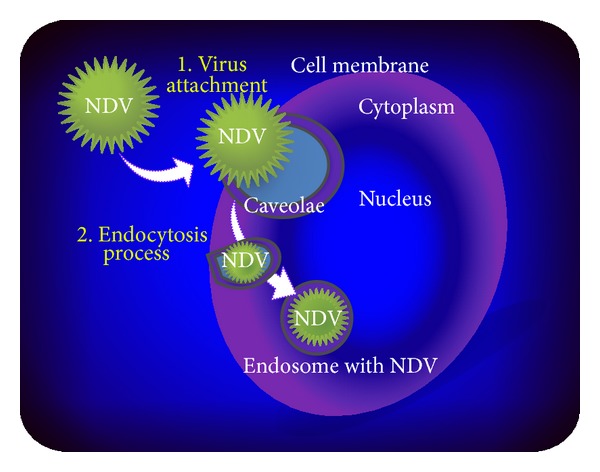
Glioblastoma multiforme (GBM), or grade IV glioma, is one of the most lethal forms of human brain cancer. Current bioscience has begun to depict more clearly the signalling pathways that are responsible for high-grade glioma initiation, migration, and invasion, opening the door for molecular-based targeted therapy. As such, the application of viruses such as Newcastle disease virus (NDV) as a novel biological bullet to specifically target aberrant signalling in GBM has brought new hope. The abnormal proliferation and aggressive invasion behaviour of GBM is reported to be associated with aberrant Rac1 protein signalling. NDV interacts with Rac1 upon viral entry, syncytium induction, and actin reorganization of the infected cell as part of the replication process. Ultimately, intracellular stress leads the infected glioma cell to undergo cell death. In this review, we describe the characteristics of malignant glioma and the aberrant genetics that drive its aggressive phenotype, and we focus on the use of oncolytic NDV in GBM-targeted therapy and the interaction of NDV in GBM signalling that leads to inhibition of GBM proliferation and invasion, and subsequently, cell death.
多形性胶质母细胞瘤(GBM),即IV级胶质瘤,是人类脑癌中最致命的形式之一。当前的生物科学已开始更清晰地描绘出导致高级别胶质瘤起始、迁移和侵袭的信号通路,为基于分子的靶向治疗打开了大门。因此,诸如新城疫病毒(NDV)等病毒作为一种新型生物武器来特异性靶向GBM中异常信号传导的应用带来了新希望。据报道,GBM的异常增殖和侵袭性行为与异常的Rac1蛋白信号传导有关。在病毒进入、诱导多核体形成以及受感染细胞的肌动蛋白重组过程中,NDV作为复制过程的一部分与Rac1相互作用。最终,细胞内应激导致受感染的胶质瘤细胞发生细胞死亡。在本综述中,我们描述了恶性胶质瘤的特征以及驱动其侵袭性表型的异常遗传学,并且我们重点关注溶瘤性NDV在GBM靶向治疗中的应用以及NDV在GBM信号传导中的相互作用,这种相互作用导致GBM增殖和侵袭受到抑制,随后细胞死亡。