Saletu Bernd, Garg Amit, Shoeb Ahsan
Section of Sleep Research and Pharmacopsychiatry, Department of Psychiatry, Medical University of Vienna, Waehringer Guertel, 1090 Vienna, Austria.
Biomed Res Int. 2014;2014:610103. doi: 10.1155/2014/610103. Epub 2014 Aug 28.
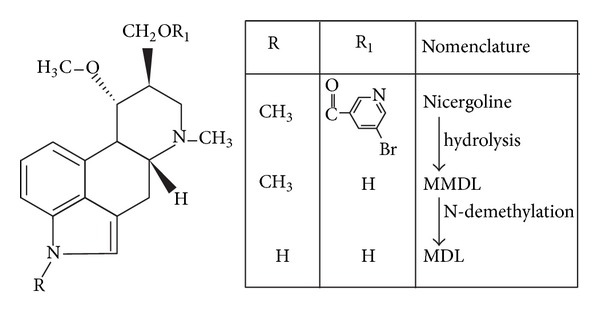
Nicergoline is a semisynthetic ergot derivative and has a selective alpha-1A adrenergic receptor blocking property and also other additional mechanisms of actions, both in the brain and in the periphery. It is in clinical use for over three decades in over fifty countries for conditions such as cerebral infarction, acute and chronic peripheral circulation disorders, vascular dementia, and Alzheimer's disease and has been found to be beneficial in a variety of other conditions. However, concerns about its safety have been raised, especially after the European medicines agency's (EMEA's) restriction in the use of all ergot derivatives including nicergoline. But, most of the available literature and data suggest that the adverse events with nicergoline are mild and transient. Further, none of the available treatment options for cognitive disorders afford definitive resolution of symptoms. In this backdrop, we discuss the pharmacology of nicergoline with special emphasis on the safety of this compound, especially when used in patients suffering from cognitive function disorders.
尼麦角林是一种半合成麦角衍生物,具有选择性α-1A肾上腺素能受体阻断特性,在大脑和外周还具有其他附加作用机制。在五十多个国家,它已临床使用三十多年,用于治疗脑梗死、急慢性外周循环障碍、血管性痴呆和阿尔茨海默病等病症,并且已发现其在多种其他病症中有益。然而,人们对其安全性提出了担忧,尤其是在欧洲药品管理局(EMEA)对包括尼麦角林在内的所有麦角衍生物的使用进行限制之后。但是,大多数现有文献和数据表明,尼麦角林的不良事件轻微且短暂。此外,对于认知障碍,现有的治疗选择均无法彻底解决症状。在此背景下,我们讨论尼麦角林的药理学,特别强调该化合物的安全性,尤其是在用于患有认知功能障碍的患者时。