González-Otero Digna M, Ruiz Jesus, Ruiz de Gauna Sofía, Irusta Unai, Ayala Unai, Alonso Erik
Communications Engineering Department, University of the Basque Country (UPV/EHU), Alameda Urquijo S/N, 48013 Bilbao, Spain.
Biomed Res Int. 2014;2014:865967. doi: 10.1155/2014/865967. Epub 2014 Aug 28.
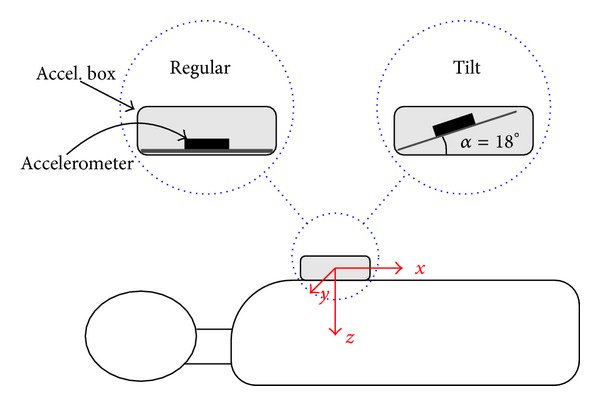
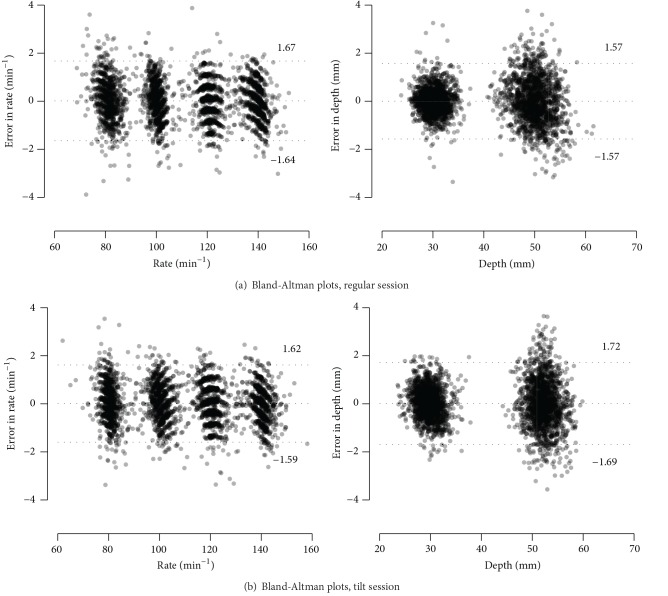
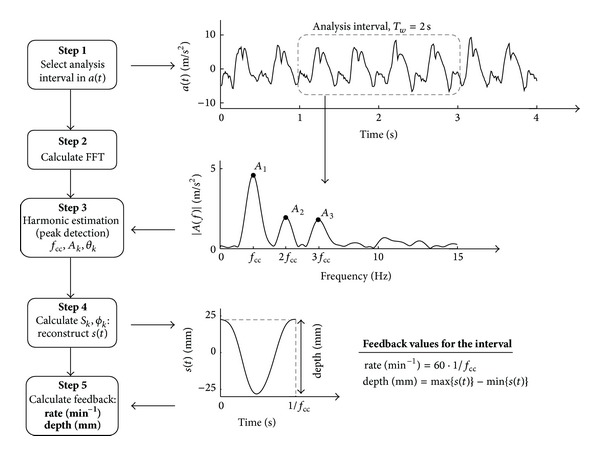
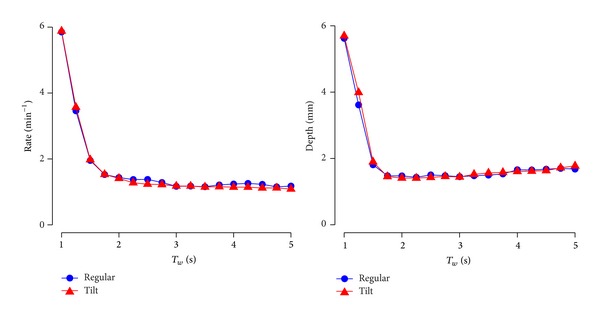
Quality of cardiopulmonary resuscitation (CPR) improves through the use of CPR feedback devices. Most feedback devices integrate the acceleration twice to estimate compression depth. However, they use additional sensors or processing techniques to compensate for large displacement drifts caused by integration. This study introduces an accelerometer-based method that avoids integration by using spectral techniques on short duration acceleration intervals. We used a manikin placed on a hard surface, a sternal triaxial accelerometer, and a photoelectric distance sensor (gold standard). Twenty volunteers provided 60 s of continuous compressions to test various rates (80-140 min(-1)), depths (3-5 cm), and accelerometer misalignment conditions. A total of 320 records with 35312 compressions were analysed. The global root-mean-square errors in rate and depth were below 1.5 min(-1) and 2 mm for analysis intervals between 2 and 5 s. For 3 s analysis intervals the 95% levels of agreement between the method and the gold standard were within -1.64-1.67 min(-1) and -1.69-1.72 mm, respectively. Accurate feedback on chest compression rate and depth is feasible applying spectral techniques to the acceleration. The method avoids additional techniques to compensate for the integration displacement drift, improving accuracy, and simplifying current accelerometer-based devices.
通过使用心肺复苏(CPR)反馈设备可提高心肺复苏的质量。大多数反馈设备对加速度进行两次积分以估计按压深度。然而,它们使用额外的传感器或处理技术来补偿由积分引起的大幅位移漂移。本研究介绍了一种基于加速度计的方法,该方法通过对短时间加速度区间使用频谱技术来避免积分。我们使用了放置在硬表面上的人体模型、胸骨三轴加速度计和光电距离传感器(金标准)。20名志愿者进行了60秒的持续按压,以测试各种速率(80 - 140次/分钟)、深度(3 - 5厘米)和加速度计未对准情况。共分析了320条记录,包含35312次按压。对于2至5秒的分析区间,速率和深度的全局均方根误差分别低于1.5次/分钟和2毫米。对于3秒的分析区间,该方法与金标准之间的95%一致性水平分别在-1.64至-1.67次/分钟和-1.69至-1.72毫米之间。将频谱技术应用于加速度可实现对胸外按压速率和深度的准确反馈。该方法避免了用于补偿积分位移漂移的额外技术,提高了准确性,并简化了当前基于加速度计的设备。